CHINA> Regional

|
CHINA> Regional
|
|
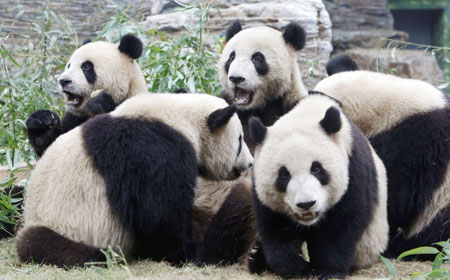
Scientists complete sequencing giant panda genome
(Xinhua)
Updated: 2008-10-11 21:56 SHENZHEN - Chinese scientists have completed sequencing the genome of giant pandas. The announcement was made here Saturday. They hope the new information will give them a better biological understanding of why pandas eat bamboo, have black circles around their eyes and produce few offspring.
"By sequencing the giant panda genome we've laid the genetic and biological foundation for us to gain a deeper understanding of the peculiar species," said Dr. Wang Jun, a scientist with the Beijing Genomics Institute's Shenzhen branch (BGI Shenzhen), a core participant in the project. So far, scientists learned, through drawing and assembling the genome sequence, that giant pandas are akin to dogs and human beings but are very different from mice. They also discovered more supporting evidence that giant pandas might be a subspecies of black bears. Giant pandas, known for being sexually inactive, are among the world's most endangered animals due to a shrinking habitat. It's one reason why scientists decided to sequence its genome. "It will help genetically explain why giant pandas have poor reproductive abilities, so that scientists can help them deliver more cubs," Wang said. Enhanced disease control was another benefit of the study, Wang said. The International Giant Panda Genome Project started in March 2008 with scientists from China, Britain, the United States, Denmark and Canada. According to BGI Shenzhen scientists, data from the project is expected to have an extensive impact on various scientific areas such as ecology,evolution and sequencing technology. A three-year-old female panda, named Jing Jing, from the Chengdu Research Base of Giant Panda breeding in southwest China's Sichuan Province, was chosen by scientists for the genome sequencing. Jing Jing was also the prototype of one of the five mascots of the Beijing Olympics. "We have done such a huge amount of research that if we compile a book with the genome sequence, the height would be equal to the landmark 384-meter Diwang Tower of Shenzhen," Wang said. There are about 1,590 pandas living in China's wild, mostly in Sichuan and the northwestern provinces of Shaanxi and Gansu. In 2007, there were 239 captive-bred giant pandas in the country. Yang Huanming, another scientist at BGI Shenzhen, said his colleagues will work on mapping out a more detailed genome sequence of the panda by the end of this year. Chinese scientists have made big improvements in gene studies and genome sequencing in the past few years through their own efforts and participation in a series of international projects, Yang said. Chinese scientists have contributed to the genome sequencing of a rice paddy, silkworm, hen and pig. In October last year, they finished sequencing the first Han Chinese genome, Yang said. |
主站蜘蛛池模板: 静海县| 湘阴县| 麻栗坡县| 额敏县| 佛山市| 洛宁县| 太康县| 浦江县| 大城县| 略阳县| 神农架林区| 七台河市| 洛南县| 密山市| 麻栗坡县| 平邑县| 锦屏县| 普兰店市| 巴青县| 甘肃省| 安庆市| 扶绥县| 大悟县| 灌阳县| 武陟县| 禹州市| 崇礼县| 嘉黎县| 孝感市| 林口县| 甘洛县| 公安县| 阿克陶县| 阳春市| 综艺| 高密市| 那曲县| 岚皋县| 额尔古纳市| 香格里拉县| 青浦区| 东平县| 广昌县| 永新县| 吉安市| 东海县| 富川| 井研县| 新余市| 江川县| 盐亭县| 宽甸| 鹰潭市| 永德县| 凤城市| 田阳县| 手机| 汝城县| 景泰县| 凯里市| 乌兰浩特市| 家居| 新建县| 西平县| 炉霍县| 涟水县| 文登市| 叙永县| 陵川县| 海淀区| 泾阳县| 龙门县| 镇江市| 普格县| 正阳县| 晴隆县| 灌云县| 新蔡县| 榆林市| 江华| 民丰县| 普兰县|