CHINA> National

|
CHINA> National
|
|
On the reform road to rural areas
By Wu Jiao (China Daily)
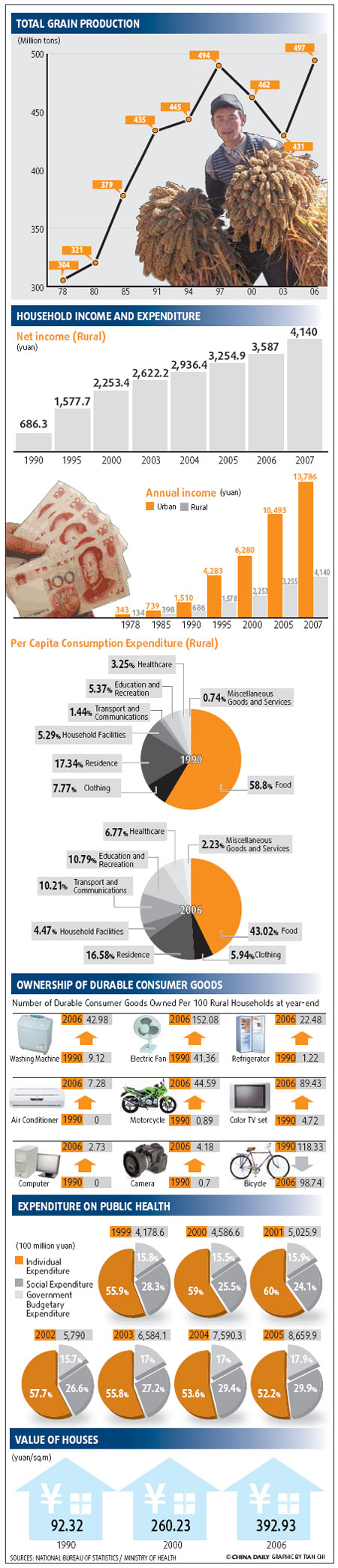
Updated: 2008-10-28 07:50 After almost a decade, the hard-working and desperate people who leave their villages for "greener pastures" have started enjoying better social security benefits in the cities. Some of them can even admit their children to city schools and depend on local governments to get their wages and guarantee their medical insurance. But compared to the blistering urban economic growth, rural development still has a long way to go. The urban-rural gap has been widening, and rural production has begun to stagnate. Rural communities have been complaining about insufficient input, and a large number of laborers in rural areas don't have jobs. That's why the administration has launched a full-fledged reform plan for rural areas with the funds acquired from three decades of fast-paced industrialization. New countryside To tackle the problem, the central government quintupled its spending from 2002 to 2007 to boost rural infrastructure. Under its "new countryside program", it abolished the centuries-old rural agriculture tax, made the nine-year compulsory education free for rural children and subsidized agriculture production. All these have lifted farmers' living standards and provided them better social security. Thanks to such efforts, the country saw four successive years of good harvest, a rarity since the middle 1980s. This is a boon today when global food prices are rising rapidly and an increasing number of non-farm units are eating up into the country's arable land. Millions of farmers have achieved breakthroughs in political life. Direct elections at the grassroots level to choose village leaders have become stronger since the early 1990s. Villagers today have a stronger desire to promote self-governance. The practice, legalized in 1998, has been adopted by more than 80 percent of China's villages, with villagers choosing more than 611,000 committee leaders. Many rural areas have also joined the reform for household contract system of the collective ownership of forest land. Forest cover across the country has increased rapidly, after the State Council guaranteed people longer-term ownership and decision-making rights last year. Added to these, the central leadership's new proposals to carry forward rural reforms is likely to make life more comfortable for farmers and lift their living standards.
|
主站蜘蛛池模板: 定安县| 浏阳市| 滨州市| 肥西县| 龙南县| 青川县| 株洲市| 中西区| 汽车| 界首市| 大荔县| 双柏县| 商丘市| 绥德县| 海盐县| 中卫市| 咸丰县| 陵水| 大悟县| 砀山县| 蒲城县| 常山县| 封开县| 剑川县| 泾源县| 东乌珠穆沁旗| 沁水县| 舟山市| 翁牛特旗| 赤城县| 景洪市| 临武县| 长沙县| 和林格尔县| 泾川县| 和林格尔县| 南木林县| 海晏县| 都江堰市| 满城县| 调兵山市| 历史| 涞水县| 贞丰县| 扶绥县| 白朗县| 浠水县| 饶阳县| 伊川县| 石阡县| 登封市| 盘山县| 福建省| 闻喜县| 兖州市| 广宗县| 平舆县| 咸丰县| 宜春市| 萝北县| 新巴尔虎左旗| 沅陵县| 潞西市| 新密市| 绍兴市| 仙居县| 肃宁县| 黄平县| 互助| 来安县| 荣昌县| 英吉沙县| 高清| 洛扎县| 温州市| 富平县| 望城县| 镇安县| 湖南省| 六安市| 嘉定区| 布拖县|
