CHINA> Focus

|
CHINA> Focus
|
|
Creating jobs for migrant workers top govt agenda
By Li Jing and Cui Xiaohuo (China Daily)
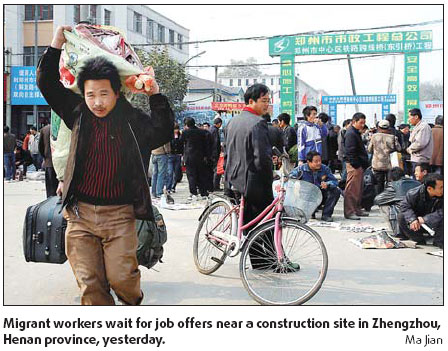
Updated: 2008-11-14 07:24 The government's latest economic stimulus plan could create at least one million jobs by the end of the year, in turn curbing rapid unemployment among migrant workers hit by a looming global recession, a senior researcher has said. The $586-billion stimulus package will help ease unemployment from export-oriented enterprises in the coastal regions shutting down or cutting costs amid the global financial downturn, Liu Junsheng from the labor-wage institute of the Ministry of Human Resources and Social Security said on Tuesday.
The country will invest 100 billion yuan by the end of the year as part of the package, said the National Development and Reform Commission, the country's top economic planner. About one-third of the investment will go into improving infrastructure, boosting agricultural competitiveness and building up the social security network in the rural regions, sources close to the central government have said. "This can directly bring new jobs for surplus labor in the rural regions," Liu said. "All these investments can create new jobs in towns and villages," Liu said. While the number of jobs created by the massive infrastructure projects will be considerable, it is equally important to stem the decline arising from the export sectors, Cai Fang, a labor economics specialist with the Chinese Academy of Social Sciences in Beijing, said yesterday. "The stimulus projects for infrastructure nationwide will bring in a huge army of laborers and I'm sure a large number of migrant workers will return to construction sites for new work," said Cai, who is also a member of the Standing Committee of the National People's Congress. "But the projects are still limited to infrastructure, which is not sufficient." "We believe the stimulus plan will create new jobs, but the government should pay equal attention to laborers in export-oriented enterprises. These enterprises may have been under pressure for a relatively long period of time," Cai said. "The central government's fiscal policy has also stimulated the international community and we hope there will be more policies of the same caliber, both from the central and local governments, to support small businesses focusing on export," he said. The government should also use the momentum to spend more and revamp its social security system, to further help laborers deal with the economic challenges, Cai said. "Most laborers worry about their welfare, retirement funds or unemployment benefits. The government should address these worries," said Cai, who also suggested the government continue to remove the individual income tax from more low-income laborers. Still, Cai said local authorities should not interfere in the job market to deal with unemployment. Some local governments recently raised the standard wage for low-income workers, putting added pressure on enterprises and causing more unemployment, he said. "These enterprises are facing their most difficult time, so the government, the enterprises and the laborers should go through this difficult time together," Cai said. China, which holds the world's largest population of 1.3 billion, stands to face tremendous pressure from the 10 million people entering the workforce every year. The government has set a target of maintaining at least 9 percent economic growth over the next two years, while the country is expected to keep its unemployment rate at about 4 percent, excluding migrant workers. The country has about 200 million migrant workers, of whom 120 million move from rural areas to work in cities, figures from the Ministry of Human Resources and Social Security showed. The largest number of migrant workers comes from Sichuan, Hunan, Hubei and Jiangxi provinces, as well as the Guangxi Zhuang autonomous region. There has been an increasing number of migrant workers heading home to Chongqing municipality and Sichuan, Hunan and Hubei from the major exporting base of Guangdong in the past few weeks, the ministry said. Hubei province alone registered 300,000 migrant workers returning home during the last two months, the Wuhan-based Chutian Metropolis Daily reported. Similarly, the Hunan provincial administration of human resources and social security estimated that 2.8 million migrant workers will return to the province in the coming year, the local Xiaoxiang Morning Post reported. Human Resources and Social Security Minister Yin Weimin said earlier this month that although 57,608 enterprises went bankrupt in Guangdong province, there were still 92,609 newly registered companies in the first three quarters of the year, which helped the province maintain a 10.4-percent growth rate. However, in the third quarter of this year, the number of job vacancies in Guangdong was much lower than the previous year, and growth rate of newly created jobs has slowed down, Yin said. |
主站蜘蛛池模板: 瑞昌市| 潼南县| 丹江口市| 商丘市| 南通市| 长岭县| 莆田市| 武乡县| 新竹市| 锦屏县| 宜兴市| 邵武市| 昂仁县| 洛宁县| 英山县| 崇信县| 梓潼县| 札达县| 阿拉善盟| 桦南县| 呼伦贝尔市| 句容市| 江城| 工布江达县| 丹棱县| 望江县| 梓潼县| 喀喇| 临朐县| 名山县| 邹城市| 九龙城区| 遂川县| 庐江县| 时尚| 拉孜县| 凤庆县| 四会市| 界首市| 长宁县| 紫云| 年辖:市辖区| 神木县| 元氏县| 南昌市| 嵩明县| 桑日县| 南木林县| 阿图什市| 和田市| 台中县| 喜德县| 郑州市| 邓州市| 胶州市| 宁都县| 论坛| 林周县| 万载县| 门头沟区| 锦屏县| 苗栗县| 郸城县| 宝兴县| 调兵山市| 安福县| 沁阳市| 兴国县| 清徐县| 德惠市| 西安市| 许昌县| 高阳县| 永定县| 易门县| 涞水县| 望江县| 九龙坡区| 汶川县| 探索| 镇原县| 陵水|