CHINA> National

|
CHINA> National
|
|
Pulling no punches against domestic abuse
By Wang Ying (China Daily)
Updated: 2008-11-25 07:46 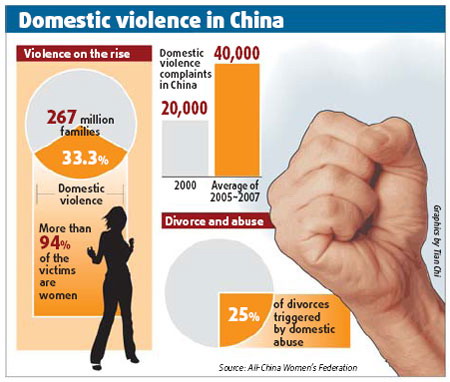 Chen Benjian, director of China Law Society's Center for Combating Domestic Violence, agrees: "Above all, we need an anti-domestic violence law that experts have been seeking for more than five years." "Studies show domestic violence, physical and mental alike, can take place in families of any social class," Chen says. "Living without violence is the right of every family member. Community intervention can greatly help reduce such violence," Chen says. Organizations and research institutes such as the Maple center and the Legal Center of Peking University, too, have sought laws to protect victims of domestic violence. Maple center director Hou says she expects legal steps to be taken across the country to remove wife-abusers from the family and to re-educate them. Seven State agencies, including the ministries of public security, justice, civil affairs and health, issued a joint statement last month urging policemen answering calls on the hotline (110) to respond to domestic violence complaints. But even though the criminal law does not exclude private matters, police are reluctant to deal with "family affairs", China Politics and Law University professor Xia Yinlan says. Police start investigating a domestic violence case only after someone is killed or seriously injured. "That only brings perpetrators of crime to justice but does not help prevent such incidents it does not protect the victims' rights or interests, either." Though police in Liaoning province began responding to complaints against domestic violence four years ago, such interventions can only deal with emergency situations and cannot be the final solution. What makes matters complicated is that prosecutors in some cities regard "wife-beating" as a private matter. Even the Beijing procuratorate introduced a rule in 2002 to exclude "light injuries" cases, including domestic violence, to cut costs. The first legal definition of domestic violence came as late as in 2001, when the revised Marriage Law defined it as "an act involving beating, tying-up, mutilation and forced restriction of personal freedom, which causes a family member physical or mental harm". But even that is "far from perfect because it lacks clarity on enforcement", Xia says. Since there is no specific law on domestic violence, such cases are dealt with under broader women's rights and anti-violence legislation such as the 1992 Law on the Protection of Rights and Interests of Women and the criminal law that covers deliberate injury caused within families, which carry less harsh punishment. "A combination of a bias against domestic violence and weak law enforcement have forced victims to sometimes turn to desperate measures," says researcher Chen Min of the Supreme People's Court. More than half of the women imprisoned in recent years are victims of domestic violence who took revenge on their abusers. In the 1970s, American forensic psychologist Lenore Walker coined the phrase "battered woman's syndrome" to explain the extreme behavior women who suffered from long-term violence took against their abusers. Battered woman's syndrome has been used as a defense for women charged with murder for killing their abusers. Although Chinese law acknowledges the right of self-defense, it does not consider the psychological state of battered women. As a result some of the battered women who killed their male abusers have been treated like common criminals and charged with murder, Chen Min says. But despite not having a specific law on domestic violence China has taken strides, especially after the 1995 Fourth World Conference on Women in Beijing, to protect domestic violence victims. Twenty-five provinces, autonomous regions and municipalities have already introduced anti-domestic violence regulations, largely because of the efforts of local women's NGOs and women's federations. Apart from that, several civil affairs departments have set up shelters for women, and some women's organizations and health departments have jointly set up domestic violence injury identification centers. "Elimination of domestic violence requires the efforts of the whole of society," Chen Benjian says. "We need to establish a set of effective measures to curb domestic violence so that the perpetrators are punished From a social and cultural perspective, we have to build gender equality and make domestic abuse socially unacceptable. Above all, women have to learn to say 'No' (to violence) bravely." That is exactly what Maple center's counselor Xie Hua has told Li Li. When Li said, "Sometimes I hate myself for being such a coward but I dare not defend myself for fear of inviting more trouble", Xie told her that "too much tolerance and too many concessions sometimes invite more violence". After talking with Xie, Li has promised to defend herself and seek community help if her husband beats her again. |
主站蜘蛛池模板: 普安县| 平乐县| 无极县| 沧源| 乌鲁木齐县| 志丹县| 宽甸| 桂林市| 曲松县| 和田市| 德钦县| 东港市| 雷波县| 江城| 长治县| 射阳县| 古田县| 景宁| 军事| 贵定县| 汉源县| 徐汇区| 唐山市| 双柏县| 大冶市| 大丰市| 西吉县| 凤台县| 阳西县| 安乡县| 邢台市| 东乌珠穆沁旗| 宁陕县| 乌拉特中旗| 朝阳县| 益阳市| 文登市| 海口市| 云安县| 福贡县| 烟台市| 柯坪县| 九江市| 新巴尔虎右旗| 连云港市| 达州市| 卓尼县| 合肥市| 文登市| 奇台县| 荥经县| 阆中市| 安宁市| 万源市| 荆门市| 塔城市| 沅陵县| 桑植县| 仙桃市| 吴江市| 信宜市| 金门县| 蓬安县| 集安市| 长泰县| 吴忠市| 巴马| 康保县| 岱山县| 铁力市| 平邑县| 江源县| 阿拉善盟| 正蓝旗| 锡林浩特市| 新疆| 古交市| 海阳市| 万山特区| 嘉荫县| 卓资县| 铜山县|
