CHINA> Focus

|
CHINA> Focus
|
|
'Stingy group': thrifty is nifty
By Lin Qi (China Daily)
Updated: 2008-12-02 10:31 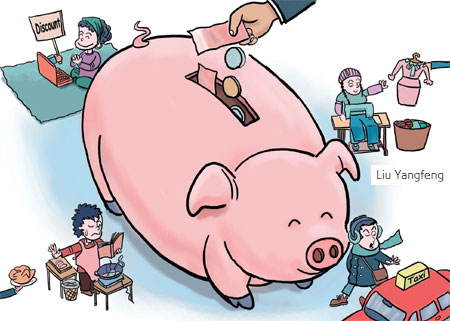 Cheng Zi fell under the banner of "kou kou zu", or the "stingy group", soon after she went to university. "I realized it was wrong for us students not to care about our finances just because we don't work," she says. "Actually, we do have a job. We take classes and our parents pay for it." Cheng, a senior university student in Shaanxi province, says that "kou kou zu" means maintaining a high standard of living for the cheapest cost. For instance, she only buys new clothes when she has sold some of her old ones. She also shops online, where clothes are much cheaper, discounts are always on offer and delivery is often free. She normally eats in the school canteen and rarely eats out in decent restaurants. She has also learned many cost-cutting ideas from "kou kou" people in the workforce. "Students are not suffering from the financial crisis as much as those in work," she says. "Many of my schoolmates worry about how much money their families have lost or will lose in the stock market." What really worries Cheng and other students is the impact of the global recession on their job prospects. They are being as frugal as they can to prepare for rainy days ahead. Other "kou kou"s are using more public transport, downloading free books and music instead of buying them, using credit cards less and eating homemade lunches. Cheng adds: "They've also taught me how to pay less for electricity and water bills, by washing small clothes like underwear and socks by hand, unplugging electrical outlets before leaving the room and using leftover water to flush the toilet. I've started to implement some of these tips. It is good to prepare early for my independent days ahead." Money savers like Cheng counter the notion that China's post-80s generation is full of spoiled, free-spending youngsters and while other students around the world face a tough Christmas, they are benefiting from their thriftiness. Some, like Cheng, changed their lifestyles some time ago but the worldwide crisis has swelled the number of 20-something "kou kou zu". Online communities are cluttered with their mantras: "We don't take taxis we don't go shopping there is no eating out we can manage the housework ourselves." Once upon a time Cheng's parents gave her 700-1,000 yuan ($100-143) a month and she would spend it all before she had realized it and couldn't figure out when and where. Now she limits her monthly outgoings to about 300 yuan and last year opened an online store selling clothes and ornaments.
The business makes a profit of 600-1,000 yuan a month and has been a life-changing experience. "My parents were taken aback one day when, instead of asking them for money like I used to, I told them that I could live on my own," she says. "Now I have several thousand yuan in the bank, 80 percent of which comes from my online shop. Sometimes I buy them presents. I'm so proud of myself." In Fujian province, Zhang Yan has persuaded some of her friends to become a "kou kou" but had more trouble with others. "They are lukewarm about it, since they feel little pressure from the crisis," she says. "They don't think it's necessary to be so stingy. "But I tell them this is not just a response to the crisis - it's something you can benefit from your whole life. Plus, it is environmentally friendly and represents a healthy and positive life attitude." Others find having a handle on their spending ensures they always have some available. Every night for the last year, Zhang has been punching her expenses into an online accounting system to determine if she has spent her money wisely or not. Now her savings are steadily rising. "In previous years I invested in stocks and funds because I thought saving money in the bank was quite silly," she says. "But when the bubble burst, I came to realize the importance of stable savings accounts." Zhang's conviction grew even stronger when she read that Americans on average save at best 1 percent of their monthly incomes. "Now they're suffering from both the economic crisis and the consequences of low savings." Zhang's online accounting system, www.qian8ao.com, has received about 2,000 new users each day for the last two months, a 50 percent increase on previous months . While high street shops fear the harshest conditions since the Great Depression of the 1930s, online retailers are more upbeat, on the back of an upsurge in website shopping over the past year. "Online products are much cheaper than those in shopping malls and are often of good quality," says Zhao Li, a young mother in Suzhou, Jiangsu province. She also hedges her bets. "Sometimes, if I want a pair of luxury brand shoes, I will try them on in a shopping center and then order them online, where they cost much less." Statistics from the Chinese Academy of Social Science show that by last June there were 162 million netizens in China, 70 percent of them under 30. The Internet Society of China, meanwhile, noted in its annual China Netguide 2008 that an average netizen spent 186.6 yuan online in 2007, expected to rise to 198.6 this year. "Consumers are shopping more on the Internet, where they can both save cash and live a high-quality life," says Zhang Lingxiao, from www.taobao.com, a major Chinese online retailer. "Chinese people still represent great buying potential," says Zhang, "and we believe that online retailing may help businesses survive the financial winter." |
主站蜘蛛池模板: 灵川县| 金塔县| 海伦市| 铜山县| 蓝山县| 长兴县| 南康市| 大厂| 东阳市| 平顺县| 即墨市| 辛集市| 平利县| 江西省| 蚌埠市| 志丹县| 勐海县| 兴安县| 和平县| 宁化县| 台东市| 宁阳县| 兴和县| 淮南市| 自治县| 上虞市| 六盘水市| 综艺| 西盟| 隆德县| 汾西县| 大石桥市| 商城县| 车致| 三亚市| 秭归县| 灵宝市| 富宁县| 沙洋县| 三原县| 枣强县| 博爱县| 隆昌县| 扬州市| 旬邑县| 昂仁县| 兴文县| 衡南县| 杭锦旗| 本溪市| 安龙县| 玉林市| 孟连| 吴桥县| 张家界市| 焦作市| 兴宁市| 满洲里市| 安阳市| 苍山县| 遂宁市| 高州市| 上饶县| 桐城市| 徐州市| 维西| 庆元县| 甘南县| 北京市| 佛学| 盖州市| 乐昌市| 霍林郭勒市| 安徽省| 上高县| 华蓥市| 城步| 武山县| 全州县| 东源县| 黎城县| 察雅县|