CHINA> Regional

|
CHINA> Regional
|
|
Fueling return to business as usual
By Diao Ying (China Daily)
Updated: 2008-12-16 07:58
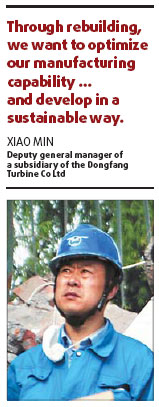
It seems the most unlikely of offices for the country's largest turbine maker, but Xiao Min, a deputy general manager of a subsidiary of the Dongfang Turbine Co Ltd, is not complaining.
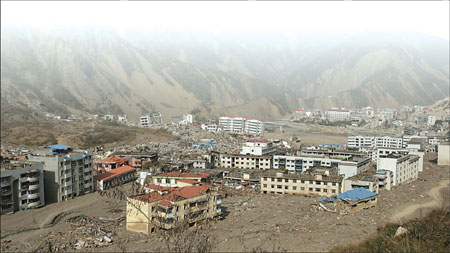
"The kindergarten works well, and we can save some money," Xiao, 45, told China Daily. Four months after his old office in Hanwang town in Mianzhu city was leveled in the May 12 quake in Sichuan province that killed more than 69,000 people, Xiao and his colleagues moved to this kindergarten in the neighboring city of Deyang. Other than picking up the pieces left by the disaster, the group now has to face the added challenge of restarting its business amid a global economic slowdown. The company's subsidiary was first built in 1966 and handled nearly half of total production before it was hit by the quake. The disaster claimed the lives of 612 workers, injured 1,400 others and caused more than 5,000 families attached to it to lose their homes, a publication circulated within the company reported. Dongfang itself manufactures about 30 percent of the country's homemade turbines, a core component of power generation equipment.
The company's manufacturing capacity was 2.8 million kilowatts, or a contract value of about 10 billion yuan ($1.46 billion), before the tremor halted operations, a circular of parent company Dongfang Electric stated. The direct economic loss of Dongfang from the quake is about 5 billion yuan, said Xiao, who joined the company located in the mountains after he graduated from college 25 years ago. In the immediate aftermath of the quake, Xiao helped managed relief work to pull Dongfang workers and students buried under the debris. Now the deputy director has piles of documents to sift through as the subsidiary rebuilds its factory. The wall outside his makeshift office displays construction deadlines to meet for the 5-billion-yuan project, slated for completion by May 12, 2010. Red flags, of which there are few, mark tasks met. Xiao is approaching the challenges brought about by the quake and economic recession as opportunities to forge a more sustainable enterprise for the future. "We were developing rapidly before the earthquake, but costs were still too high," Xiao said. With the country's demand for power increasing, so too was that for turbines. But the capacity of the factory, which was designed in the 1960s, could not keep up with the growth. Xiao said the company is now being steered toward meeting market demands better. "Through rebuilding, we want to optimize our manufacturing capability ... and develop in a sustainable way," he said. To that effect, Xiao said the Hanwang factory will expand projects to allow for wind and nuclear power. Future demand remained uncertain, he added. "We need to proceed carefully and it is possible we will have no work after the new factory is completed, if the market remains gloomy," Xiao said. Other challenges include building new homes for more than 5,000 workers. "We were used to the simple life in villages before the quake," Xiao said. "We would buy the local vegetables and cook them at home for our dinner," he said. Now the workers and their families have to adjust to life in the city, Xiao said. In a publication circulated within the company, a girl who moved to the Dongfang subsidiary in Deyang after losing her home in Hanwang after the quake wrote: "I had been dreaming of the life of big cities. I thought urban life was colorful, but now that I am here, I feel there is nothing in it for me.". "Our people overstretched themselves to meet the huge demand and fast growth," Xiao said. "The employees almost had no life outside of work." Despite the "remarkable" achievements in business, Xiao said the cost was "too high". There are plans to have facilities in rebuilding work to ensure life for these quake victims is comfortable, Xiao said. "Our colleagues did not really enjoy the fruits of our labor before. We want them to live happily in their new home," he said. There are other bright spots on the horizon, Xiao said. Prices for raw materials are going down for now, with many other construction projects being stopped as a result of cash flow problems faced by real estate companies, Xiao said. This means construction costs "could be cheaper and there would be enough labor to ensure the project is delivered on time", he said. With more than 1,000 Dongfang workers left disabled and hospitalized from the quake, Xiao said the new factory will also incorporate opportunities for these victims to continue working. "We will make machines easy to operate, we don't want our former colleagues to feel they are useless after the disaster," he said. |
主站蜘蛛池模板: 天长市| 道孚县| 祥云县| 红原县| 中宁县| 罗源县| 卓尼县| 土默特左旗| 互助| 迭部县| 德格县| 遂溪县| 鲁山县| 开阳县| 海城市| 凤台县| 若尔盖县| 大名县| 喀喇| 开江县| 西乡县| 沧州市| 南投县| 拉萨市| 苍山县| 海伦市| 黄大仙区| 仁怀市| 克山县| 梅州市| 洪洞县| 舟山市| 苏尼特右旗| 尖扎县| 凤城市| 常州市| 抚松县| 西华县| 凤凰县| 饶阳县| 温宿县| 曲阳县| 温宿县| 刚察县| 刚察县| 惠东县| 昆山市| 彭阳县| 崇州市| 和田市| 武宁县| 自治县| 闸北区| 新郑市| 沙河市| 岑巩县| 建始县| 沙雅县| 仲巴县| 顺平县| 边坝县| 内黄县| 隆林| 小金县| 无极县| 铜川市| 汝阳县| 新巴尔虎左旗| 桦甸市| 陆丰市| 聂拉木县| 广元市| 达孜县| 博乐市| 新宾| 克拉玛依市| 铁力市| 大兴区| 北海市| 依兰县| 宁夏| 湖南省|