CHINA> Focus

|
CHINA> Focus
|
|
Dedicated to the jungle
By Chen Liang (China Daily)
Updated: 2008-12-16 08:15
Pu Fuqiang earns just 300 yuan ($44) a month and sees his wife and children just once every few weeks, even though they are just a few kms away. He also lives in the middle of a remote forest where it rains nine months a year ... but for all his troubles, he has no complaints. Pu is a reserve patrolman and, remarkably, is well off compared to his fellow villagers in Luchun county, bordering Vietnam. "The average annual income of people in our village is only 700-800 yuan a year," he says.
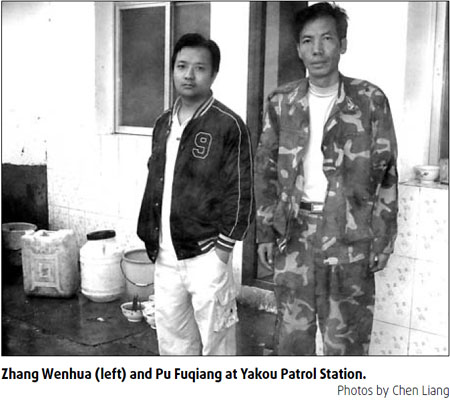
Pu, 35, has spent nearly half his life - 16 years - working at Yakou Patrol Station in Huanglianshan National Nature Reserve, home to China's most diverse primate species.
Two of Pu's colleagues, Zhang Wenhua and Ma Yu, also do it tough. They started working at the station in 2005 after graduating from a local forestry polytechnic school and passing the reserve's exam. They earn 700 yuan a month. Zhang, 25, is still single and complains that he can't see his girlfriend enough and can't even chat to her online because there is no Internet connection. For 27-year-old Ma the main problem is there is not "enough water to have a shower once in a while". Like Pu, she is also separated from her husband and son. While their lives are deeply affected by the constant rain, Ma says: "We have to get our drinking water from a nearby stream and transport it back by motorbike. I have to go to the hydroelectric station about 2 km down the slope just to have a shower." Her husband works at another hydro station a few kms away and she leaves her son with her parents in the county town. To keep busy, this dedicated trio have all joined a three-year training program in "nature resources management", launched by the reserve in cooperation with a forestry college in Kunming. "After attending periodical lectures given at the county town and passing all the examinations, we can get a college degree," says Pu Fuqiang, whose previous level of education was primary school. "It is truly a big challenge for me. To get it, I have to study hard." Whatever hardships the trio are enduring now, Pu says the working and living conditions are much better than several years ago. "When I started working here on Dec 15, 1995, I lived in a wooden hut which had no power supply. My wage was just 30 yuan a month," Pu says.
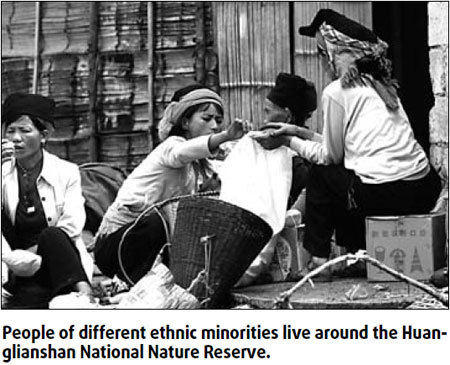
When the reserve was established in 1983, it had just four patrol stations with 18 employees. With the country's investment of 20 million yuan since 2003, the reserve administration has moved into a new office building in the town of Luchun, seven more patrol stations have been built and upgraded, along with the other four old stations. In addition the dirt road from the county town to the Yakou station has been upgraded into a blacktop road, and a research department has been established, with a specimen exhibition room and nursery garden. The reserve currently employs 52 patrolmen and a technical staff of 20, including Zhang and Ma. "Most of the technical staff are graduates of polytechnic schools and a few are college graduates," Bai Zuowen, deputy director of the reserve, says. "In a backward county where 90 percent of residents are ethnic minorities, with poor education, it's not easy to build up such a team." The manager admits, however, conservation at the reserve is still at "very basic level" because of "being short of funds, techniques, talented people and management experience". Although the reserve has been established for 25 years, Bai says, it hasn't launched a complete scientific survey yet. "We know we have eight primate species, based mainly on historical data," he says. "But we don't know their detailed distributions, size of their populations or their living circumstances." The technical staff have cultivated dozens of the reserve's rare and endemic plants and medical herbs with high economic value in the nursery garden, but have failed to promote them in the local communities. There are 54 villages with 23,000 people who live around the reserve, Bai says. Most of them make a living by growing rice in terraced fields. "The yield of rice is only 300 kg per mu (0.0667 hectare)," Bai says. The locals' traditional earnings are boosted by hunting, forest product collection, and tsaoko amomu fruit planting. But hunting has long been banned and guns have been collected by the local government. Cultivation of tsaoko amomu fruit, a spice, has become a major source of conflict between the reserve and local communities, Bai says. "The fruits must be planted in the moist forest but needs to be exposed to sunshine," he says. "So, to plant the fruit, the locals must enter the forests, most of which are within the reserve, cut down trees and clean secondary growth, which has damaged our forests." Additionally, to dry the fruits, villagers log for firewood at the reserve. "We can't ban the traditional practice," the manager says. "But we only allow them to keep their old growing areas within the reserve and prohibit them from expanding their cultivation." Pu and his fellow rangers make regular patrols in the reserve to prevent the villagers from poaching and planting. "Conflicts do happen sometimes," says He Jifu, head of Nagu village, near Yakou station. "When the reserve staff destroyed villagers' tsaoko fields they fight back with dirty words. "But it's mainly because our people are short of alternative means of earning a livelihood." Even so, He says, locals appreciate the value of the forests and have benefited from their conservation: "Because of the forests, water in our terraced fields no longer dries up," the Hani farmer says. Pu, like other patrolmen of the reserve, plays an important role in settling conflicts. "All of our patrolmen have been chosen from influential families at the local communities," Bai says.
|
主站蜘蛛池模板: 雷波县| 蕲春县| 万州区| 万宁市| 固阳县| 且末县| 建湖县| 海阳市| 池州市| 新干县| 淳安县| 壶关县| 科尔| 东安县| 赤城县| 青川县| 安阳县| 博野县| 汶上县| 吴川市| 长治县| 卢湾区| 定陶县| 民乐县| 土默特左旗| 普定县| 湘潭市| 霞浦县| 霍林郭勒市| 宜阳县| 大名县| 嵩明县| 田阳县| 江口县| 浪卡子县| 临清市| 翁源县| 平乡县| 沁水县| 桦南县| 南平市| 洛浦县| 盐亭县| 句容市| 泊头市| 万源市| 桐柏县| 宣威市| 北辰区| 罗定市| 乌什县| 铜山县| 寿光市| 北海市| 徐汇区| 鄱阳县| 芜湖市| 庆阳市| 广水市| 平谷区| 吴堡县| 柘城县| 平罗县| 万全县| 婺源县| 八宿县| 静乐县| 南丰县| 岚皋县| 云安县| 舟曲县| 吉木萨尔县| 凤翔县| 修文县| 双流县| 哈尔滨市| 曲阜市| 宿州市| 大荔县| 铜鼓县| 墨竹工卡县| 张家口市|