|
|
Plain-spoken man of the 'mass line'
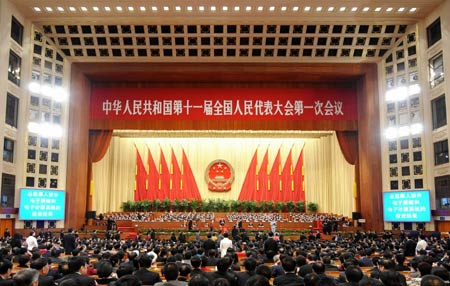
(China Daily) Updated: 2008-03-17 07:06 Pragmatic and amiable, Wu Bangguo has kept a low profile, though he and the National People's Congress (NPC) he leads have frequently come under the spotlight for their outstanding legislation and supervision efforts. "The NPC exercises power collectively in accordance with the law. The chairman (of the NPC Standing Committee) enjoys the same power as the other deputies." Wu often says these words, usually to play down his role. Nevertheless, he has impressed the nearly 3,000 NPC deputies and was reelected chairman of the NPC Standing Committee on Saturday at the NPC's annual full session.
In March 2003, Wu was elected as China's top legislator to succeed Li Peng. The NPC is sovereign in China as it is authorized by the Constitution to elect the country's top leadership, enact laws and supervise the cabinet, the supreme court and the supreme procuratorate. The NPC Standing Committee serves as its executive body when the NPC is out of its annual full session. The NPC maintains its authority because it does everything according to law, he said. One hundred new or revised laws were adopted over the past five years, Wu said in a report to the NPC annual session. The clauses that "the State respects and preserves human rights" and "the State, in accordance with the law, protects the rights of citizens to private property and to its inheritance" were for the first time enshrined in the amended constitution, a milestone in China's constitutional history. The Anti-Secession Law, promulgated in 2005, provides a legal basis for the mainland's stance to strive for peaceful reunification of the country and oppose and contain secessionist activities. All this, together with the enacting of the Law on Property Rights and the Law on Oversight, is a measure of the NPC's work with Wu at the helm. Observers see the Law on Property Rights, designed to protect private and State-owned property, as the biggest step taken during Wu's tenure as top lawmaker. Industry expert China's booming market economy has benefited from a number of laws, including the Law on Property Rights, Law on Corporate Income Tax, Antitrust Law and Banking Oversight and Management Law and Securities Law. Analysts credit Wu's efforts, saying his rich experience in economic work and industrial development formed his views on the framework for the socialist market economy. Wu, a native of Feidong, Anhui province, came up through the ranks in Shanghai, where he became a member of the Standing Committee of the Shanghai municipal committee of the Communist Party of China (CPC) in 1983 and Party chief in 1991. Wu was elected a member of the Political Bureau of the CPC Central Committee in 1992 and moved to work in Beijing two years later. He became vice-premier in 1995. During the following eight years, Wu took charge of economic work and trade, transportation and communications, energy, information industry and social security. Wu also focused on legislation to address social problems. In 2007 alone, the NPC enacted the Labor Contract Law, Employment Promotion Law and Law on the Mediation and Arbitration of Labor Disputes. The body also revised the Law on Compulsory Education and Law on the Protection of Minors. Wu, in his plain words, interpreted this work as "following the mass line". Wu's "mass line" could be traced back to the days he worked in Shanghai. As Party chief of the metropolis, Wu often went to bazaars and stores, picking up vegetables and rice and chatting with farmers, peddlers, customers and shopkeepers on the street. Wu always seeks "substantial achievements" in supervision work, which, along with legislation, is a key task for the NPC. Wu has also brought China's top legislature into a new phase of foreign exchanges. So far, the NPC has established regular exchange mechanisms with the European Parliament as well as the congresses and parliaments of 14 countries, including the United States, Russia, Japan and India. Wu was born in 1941, went to study in the Radio and Electronics Department of the prestigious Tsinghua University in 1960. Wu likes to read or play tennis in his spare time. Though busy with work, he still manages to spare some time watching TV plays with his wife, Zhang Ruizhen. Xinhua (China Daily 03/17/2008 page5) |
|