CHINA> Commentary

|
CHINA> Commentary
|
|
Close look reveals African ties no oil safari
By Ian Taylor (China Daily)
Updated: 2009-02-20 07:41 The latest tour by President Hu Jintao to five Asian and African countries is of great interest, given that none of the African nations visited are particularly resource-rich. Chinese officials have been keen to stress that Chinese interests in Africa go beyond oil and minerals - the common accusation of critics. It seems that foreign criticism of the burgeoning Sino-African relationship has had an effect. Yet, in assessing relations between China and Africa, three realities are generally overlooked by the critics. First, China is not a unitary actor. This truth might seem elemental, but judging from much of the recent commentaries on Chinese relations with Africa, it seems to have been overlooked. One manifestation is in the huge proliferation of small-scale traders of Chinese origin operating businesses in Africa, very often at an individual or family level and private in nature. For the Chinese state to manage or direct this phenomenon is all but impossible. Beijing is in a perpetual struggle to keep up with a surging economy, whether domestically or when this is projected overseas and so demands that China should do x, y or z in Africa, as if there is one lever to pull and all will come right, misses the subtleties and realities of contemporary Chinese foreign policy. Chinese trade with Africa has become, in many ways, normalized: diverse and involving multiple actors and individuals, rather than being more state-directed, as previously, and under the direct control of central organs of government. The concept of a China Inc., complete with master plan, either at home or abroad, is intrinsically flawed.
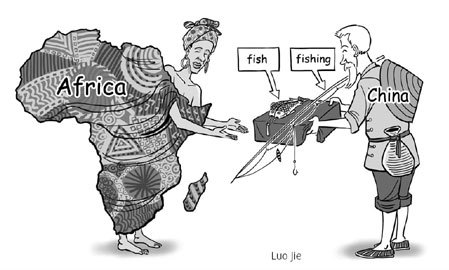 Second, there has been a fair degree of scapegoating of China and its alleged negative impacts upon Africa. This criticism is directed at a variety of Chinese activities in Africa, but upon close inspection is much less accurate and in fact is often balanced out by other positive aspects of the engagement. Sometimes, the problem cited is not actually the fault of the Chinese. For instance, in construction and infrastructure development, it is alleged that Chinese companies only use imported Chinese workers, even unskilled ones, and so do not generate much local employment or engage in skills transfers. Yet research suggests that local people accounted for the vast majority of the total workforce of most of the Chinese construction companies in Africa. While many Chinese are employed as unskilled casual laborers, there are also many counter examples of local Africans being employed in management and administrative positions. Given the low skills-base in much of Africa, it is in fact unreasonable to expect a high proportion of the skilled jobs to be held by Africans anyway. Western corporations in Africa still make great use of expensive expatriates at the management level, even after many years of activities. Africa benefits from the willingness of skilled Chinese laborers and managers to work in places like Mali or Senegal at relatively low salaries and in conditions that western expatriates would not dream of enduring. Another allegation about Chinese activities in Africa is that manufactured goods are flooding African countries and wiping out small and medium producers as well as ousting local traders. Yet consumers in Africa are more than happy with the availability of Chinese products and are benefiting, particularly those on limited incomes. In any event, much of Africa's manufacturing industry collapsed long ago, well before Chinese imports appeared on the scene. Of course, it is not only African producers who have had to adjust to globalization. Even China itself loses jobs to countries where labor is cheaper, such as Vietnam. Chinese exports may possibly block avenues for diversification away from traditional exports for African economies. This is a potential problem, but domestic African issues are more significant in making African manufacturers uncompetitive, and had been undermining the continent's productive base long before China came on the scene. It is also worth noting that talented African entrepreneurs are profiting from the China trade, since they themselves import a large proportion of the Chinese-made products entering Africa. Third, it is up to African leaders to manage their relations with China to benefit their own economies and citizens. It is not China's responsibility to look out for Africa's interests. However, while China has an Africa policy, Africa does not have a China policy (there is in fact no official African Union view on Sino-African ties, either with regard to their benefits or possible downsides). Nonetheless, China's need and desire for good economic relations with Africa actually affords the region considerable space in its connection with China but only if this maneuverability is used wisely by Africa's elites. In some countries, this should not be a problem because capable and sensible governments are more than able to manage the relationship to mutual benefit. Mauritius and Senegal would be two such examples. In others, however, there is a worry that predatory elites who are not bothered by the impulse to promote development will make a mess of the chance to benefit from China's interest in Africa. Ordinary Africans can possibly play a crucial role in facilitating a true win-win situation by holding their leaders to account and critically examining the deals done with Beijing in their name. The author is Professor of International Relations, University of St Andrews, Scotland, and at the University of Stellenbosch, South Africa. (China Daily 02/20/2009 page9) |
主站蜘蛛池模板: 安陆市| 和龙市| 南陵县| 定南县| 兴文县| 甘南县| 揭阳市| 石阡县| 新巴尔虎右旗| 抚顺市| 即墨市| 曲靖市| 苗栗市| 辽中县| 自治县| 徐闻县| 永泰县| 临沂市| 张家界市| 永寿县| 绥中县| 湾仔区| 普兰店市| 谷城县| 临城县| 永兴县| 阆中市| 海林市| 喀喇| 虹口区| 山西省| 成武县| 濉溪县| 五家渠市| 介休市| 芦溪县| 平阴县| 曲阜市| 顺义区| 河间市| 鹤峰县| 大关县| 邯郸市| 渑池县| 通化县| 喜德县| 尤溪县| 无锡市| 杭锦旗| 宁南县| 孝昌县| 广汉市| 德化县| 洪江市| 依安县| 松桃| 乌兰察布市| 临武县| 定西市| 弥渡县| 卓尼县| 江华| 正宁县| 陆丰市| 云南省| 永泰县| 平遥县| 新邵县| 比如县| 开原市| 扶风县| 石家庄市| 揭阳市| 纳雍县| 曲阳县| 泽州县| 凤城市| 民丰县| 绵竹市| 桃源县| 闸北区| 巴东县|
