CHINA> Focus

|
CHINA> Focus
|
|
Toxic water scare leaves a sour taste
By Qian Yanfeng (China Daily)
Updated: 2009-02-25 08:10
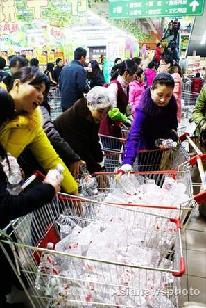
Four days after being shut down, Biaoxin Chemical Company's factory in Longgang Township, a southwestern suburb of Yancheng, is empty, its brick-red workshops sealed as police patrolled outside. Beside it, the waterway that flows into Mangshe River, the city's major source for drinking water, is dark and smells strongly of chemicals. But there is also a sense of joy in the air, with locals who have lived near the plant since it opened eight years ago hailing its closure as "a gift from heaven".
Crops in the village had also fallen victim to the deteriorating water quality, which had caused the soil to be poisoned and a reduced output, he said, explaining: "I used to earn 10,000 yuan a year from two mu (0.13 hectares) of farmland. That has decreased by 30 percent." Zhou also recalled with bitterness how the wheat he planted two years ago died after it was irrigated with water from the river.
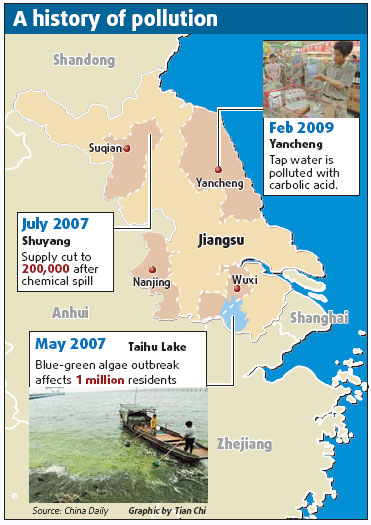
Petitions calling for action by the government also went unanswered, said fellow villager Zhou Weixiang, who added: "The factory is said to have contributed a lot to the local tax revenue. We could do nothing about it." But Yandu District spokesman Wang said the authorities were trying their best to upgrade the city's industrial structure while maintaining steady economic growth. Tax contributions from chemical firms, for example, had dropped below 1 percent of the total revenue - it was 10 percent three years ago - while the district had closed more than 150 plants in two years, he said. "Following the water crisis we have stepped up efforts to close all remaining enterprises. We know it is a chance for us to accelerate industrial restructuring," he added. But for people like Zhou Weixiang, the price villagers have been forced to pay has been too high for too long. "Many people complain of a soar throat after inhaling smoke from the factory. This is truly a matter of life and death." Water pollution incidents in cities across China in the past few years have raised questions over what measures should be taken to prevent a disaster in the future. Following a blue-green algae outbreak in Taihu Lake in May 2007 that disrupted supplies to more than a million people in Wuxi, Jiangsu province, drinking water was also cut off to 200,000 people in nearby Shuyang County for more than 40 hours after chemicals polluted a local river two months later. And in 2005, about 100 tons of pollutants containing benzene and nitrobenzene spilled into the Songhua River in Heilongjiang province. The toxic slick forced Harbin, a city with a population of more than 4 million, to suspend its supply for nearly four days. For Jiang Wei, director of the Taihu Lake division under Jiangsu's provincial environmental protection bureau, the prevention and treatment of water pollution in China is more of a management problem than a technical one. If no one is held responsible or if the punishment is not severe enough, violation of the law and damage to the environment will occur time and again, he warned. "So the key lies in the development of a mechanism in which different parties would share both the costs and benefits of protection initiatives," he said, adding that the environment compensation scheme in force in Jiangsu is a good example of how a market mechanism could serve to deter polluters. The initiative, introduced last year, stipulates that cities on the upper reaches of Taihu must compensate neighbors in the lower reaches if their pollutant discharge exceeds the maximum limit. "By making clear who is responsible for the excessive discharge and imposing payments, it encourages the reduction of pollution and makes all sides work together," explained Jiang. Zheng Zheng, a professor at Nanjing University's environmental protection department, also added that during the current wave of industrial transfer from affluent to less developed cities, governments at all levels should pay close attention to controlling companies' environmental standards. Zhang Lijun, deputy minister of environmental protection, told a national meeting on pollution control yesterday in Shanghai that water, air pollution in China is still serious and environmental protection departments across the country should press enterprises harder on pollution control. "The fundamental way to overcome this is to continue to press enterprises to reduce pollution emission through technology and management," he said.
|
||||||
主站蜘蛛池模板: 瓮安县| 武陟县| 志丹县| 松潘县| 台湾省| 西吉县| 双牌县| 南江县| 霍林郭勒市| 射洪县| 石门县| 巢湖市| 肇州县| 正宁县| 治县。| 隆回县| 方山县| 阳春市| 克山县| 宜章县| 弥渡县| 本溪| 深泽县| 中卫市| 通渭县| 靖西县| 海盐县| 衡南县| 响水县| 赤水市| 遂宁市| 崇明县| 察哈| 金寨县| 旅游| 浦东新区| 梅州市| 昌江| 曲麻莱县| 综艺| 呼图壁县| 南皮县| 丘北县| 志丹县| 章丘市| 漳州市| 定兴县| 房山区| 错那县| 德惠市| 共和县| 海安县| 临夏县| 灵宝市| 革吉县| 兴隆县| 阳江市| 甘洛县| 榆社县| 博罗县| 拜城县| 工布江达县| 江城| 靖宇县| 东平县| 开封市| 东至县| 山东省| 建平县| 东乡| 新源县| 南木林县| 玉田县| 汕头市| 宁武县| 比如县| 杭锦后旗| 中方县| 浦县| 康乐县| 台南市| 高雄市|