CHINA> National

|
CHINA> National
|
|
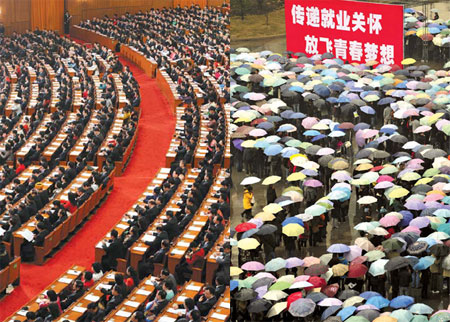
Employment top issue for NPC
By He Bolin and Xiao Yang (China Daily)
Updated: 2009-03-09 10:45 It looked at first like an acrobatic show. On a chilly morning last week, a large crowd gathered in front of the National Agricultural Exhibition Center in Beijing to watch 40 students from a Henan martial arts academy perform traditional Chinese boxing and sword-dancing routines.
Led by Party chief Xu Guangchun, in Beijing to attend the National People's Congress (NPC), Henan was showcasing its talents: construction workers and security guards trained by masters from Shaolin Temple, China's martial arts Mecca. The reason for the first-ever exhibition was lost on no one. Some 2.5 million workers from Henan are among the 20 million who have lost their jobs in China's coastal areas due to the global economic slowdown.
In his report to the NPC on Thursday, Premier Wen Jiabao promised to add 9 million new jobs this year and keep the urban registered jobless rate below 4.6 percent. The registered urban jobless rate stood at 4.2 percent at the end of 2008, rising from 4 percent in 2007. However, that figure did not include the 20 million migrant workers who lost their jobs last year. Many experts have warned that the employment issue will be a hard nut to crack - perhaps even harder than securing an 8 percent GDP growth during the global downturn. "There are various means of raising the GDP, such as building infrastructure. But how many permanent jobs can railway and road projects create? Probably not many," said He Keng, a member of NPC's Standing Committee. Small businesses far outnumber colossal infrastructure projects and can create many more jobs, he said. "I know the central government is very concerned with employment and has taken many measures. But if local governments focus only on GDP, without paying attention to employment, they will miss the mark," He added. Cai Fang, another member of the NPC Standing Committee, also warned of the danger of a "jobless recovery". He said the government's US$586-billion stimulus package and its plan to bolster 10 major industries will not necessarily solve the employment crisis. "Most of the industries that will get government support are not labor-intensive. The central government's incentives seem more attentive to big companies than small ones, which are the mainstay of employment," Cai said. Local governments are expected to map out their own stimulus plans, complementing the central government's package. Cai called on local governments to focus on the service sector, particularly small firms. Meanwhile, China's labor minister Yin Weimin promised that his ministry will "make all efforts" to address the country's tough employment picture this year. Yin told China Youth Daily the ministry has planned a handful of measures to stimulate employment, including tax cuts and subsidies for small employers, favorable loans for individuals starting up new businesses, and training programs for job seekers and would-be self-employers. Policy makers are already looking past the current crisis. "Normally, a crisis like this leads to a new period of growth, which demands more and better workers. If our country can manage to position its labor forces correctly now, we will be ready to take advantage of new opportunities when they arrive," said Cai, the NPC Standing Committee member. While the debate rages in Beijing, millions of unemployed migrant workers face bleak prospects at home. Many have started small groceries or poultry farms in their hometowns, hoping to weather the economic storm. At least, these workers have homes to return to and in many cases, plots of land to till. For the estimated 6.1 million students who will graduate college this spring, the prospects are even bleaker. Colleges have advised their graduates to lower their income expectations and consider job offers in second-tier cities or even rural areas. Job services are warning clients to think twice before switching jobs, lest they find themselves at the bottom of the employment heap. "I think it will take a while before the government's employment policies take effect. The economy is not good, and we have to wait for employers to recover," said Hu Jie, who holds an MBA from Peking University's Resource College. She graduated last summer and just landed a job as an accountant after a half year's search. About one-third of her classmates now have jobs, Hu said. "My classmates started looking for jobs six months before graduation. I've heard the graduates this year have to start a full year ahead," she said. "Hopefully in the future things won't be so tough so that students can spend more time learning." |
主站蜘蛛池模板: 五河县| 九寨沟县| 萨迦县| 河东区| 洛宁县| 白朗县| 麟游县| 通道| 托里县| 资阳市| 五大连池市| 南昌市| 隆子县| 安阳市| 永年县| 玉林市| 通州区| 高邮市| 荆州市| 宣恩县| 石阡县| 祥云县| 门头沟区| 潞城市| 盐山县| 苍溪县| 南雄市| 虹口区| 钟山县| 日喀则市| 华池县| 磐石市| 阿坝县| 本溪市| 蚌埠市| 云安县| 昂仁县| 那曲县| 舞阳县| 闸北区| 昌吉市| 镇江市| 武隆县| 五大连池市| 通渭县| 通化县| 台州市| 英德市| 宜良县| 新闻| 文山县| 邢台县| 梅州市| 渭南市| 九龙坡区| 思茅市| 陆河县| 东乌珠穆沁旗| 马关县| 五峰| 松滋市| 刚察县| 阿拉善右旗| 利辛县| 孙吴县| 开远市| 札达县| 禄丰县| 克什克腾旗| 平度市| 东山县| 石城县| 定襄县| 城口县| 灵石县| 汉中市| 全椒县| 伊吾县| 信宜市| 甘孜| 兴化市| 金川县|