CHINA> Opinion

|
CHINA> Opinion
|
|
Living Buddha: Religious freedom respected
(China Daily)
Updated: 2009-03-20 08:08 NEW YORK: Religious freedom is a basic right of Chinese citizens, including the Tibetans, a living Buddha said on Wednesday.
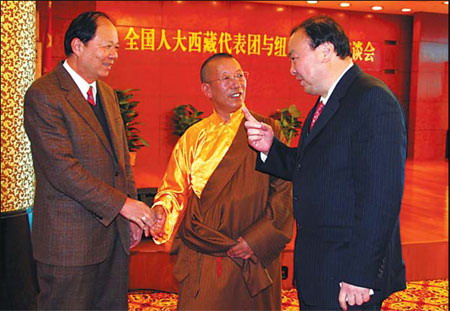
"It's completely the (Chinese) people's choice to believe in religion or not, or for that matter, which religion to follow," Shingtsa Tenzinchodrak, head of a five-member delegation of Tibetan deputies of the Standing Committee of the National People's Congress, said while addressing overseas Chinese. The delegation is in the United States to "improve the outer world's understanding" of Tibet, following a wave of attacks from the Dalai Lama, who, on March 10 said: "Religion, culture, language and the identity of Tibetans were nearing extinction." Speaking through an interpreter, Tenzinchodrak, dressed in a traditional Tibetan robe, said those who had been to Tibet know very well that Buddhism in the region was "nowhere near extinction".
"Religious practices are protected by law, as long as they are legal and do not harm the interests of other people," he said. The 59-year-old living Buddha of the Kagyu sect of Tibetan Buddhism, also said that the region saw serious conflicts between different religious sects before 1959, but "now all religious sects and religions co-exist peacefully". Tenzinchodrak said the Tibetan cultural heritage had been effectively protected, inherited and developed over the past 50 years. "The Tibetan oral epic tale Life of King Gesar for example I remember I saw only two or three books on it when I was young. Now I have seen more than 70 books on the subject," he said. The lengthy oral epic, which was scripted between the 10th and 16th centuries, tells the story of the ancient Tibetan King Gesar, who conquered other Tibetan tribes and brought stability to the region. For years, the tale has been passed from generation to generation in the form of singing or reciting among Tibetans, Mongolians, and Tu and Naxi people living on the Qinghai-Tibet Plateau. The central government has earmarked special funds for collecting and publishing the text of the oral epic tale. Chen Ching-chun, head of a Chinese society in New York, said he visited Tibet in 2007 and was convinced that "there is no such thing like oppression of religion in the region". "I think the so-called religious oppression was fabricated by the Western media and politicians for their own interests," he said. Taiwanese-American Hua Chuen-hsiung, leader of another overseas Chinese association, said he visited Tibet in 1984 and 2005 and saw great changes in the region. "It's obvious that people's lives have greatly improved." However, Hua said most people in the West knew nothing of the achievements Tibet has made over the past 50 years. "Their knowledge of Tibet is one-sided." Xinhua |
主站蜘蛛池模板: 金华市| 黄平县| 涞水县| 镇江市| 故城县| 哈密市| 广东省| 宁河县| 论坛| 屏东县| 普兰店市| 射阳县| 青田县| 云南省| 沙洋县| 鄱阳县| 临洮县| 锡林浩特市| 阿拉善左旗| 丰城市| 石狮市| 韶关市| 禹州市| 济南市| 油尖旺区| 昭平县| 建宁县| 石嘴山市| 涞源县| 温州市| 仙桃市| 凤山县| 道真| 陆良县| 桑日县| 慈溪市| 融水| 竹山县| 屏边| 庆云县| 遂昌县| 黄陵县| 靖宇县| 万荣县| 合阳县| 宜黄县| 腾冲县| 太保市| 双辽市| 佛山市| 凤翔县| 竹北市| 兴安盟| 阳原县| 科技| 本溪市| 绥芬河市| 河西区| 和政县| 胶州市| 喀喇沁旗| 旺苍县| 达拉特旗| 玛多县| 诸暨市| 泌阳县| 西宁市| 饶河县| 濉溪县| 江北区| 辛集市| 依兰县| 中牟县| 巴彦淖尔市| 大足县| 凌海市| 金塔县| 张家口市| 子洲县| 霍山县| 黄石市| 辽阳县|