CHINA> National

|
CHINA> National
|
|
Tibetans embrace changes, development
(Xinhua)
Updated: 2009-03-26 15:40 QAMDO COUNTY, Tibet -- Sheltered in a valley, the county seat of Qamdo, in eastern Tibet, seems like many other Tibetan towns with monasteries perched on hilltops and sun-weathered residents. Fifty years after the Democratic Reform in Tibet in 1959, its Tibetan inhabitants embrace development and co-exist with other nationalities, including Han Chinese.
Dressed in a padded purple Tibetan gown, Tsering Drolma, 18, a student at the No.1 High School of Qamdo Prefecture, dreams of studying in Beijing.
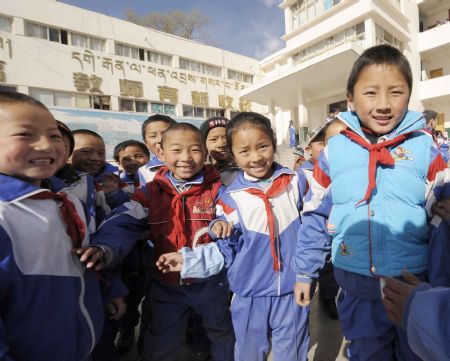
But Tsering is confident. She is a top student in her school and she can enter the college with lower exam scores than her Han Chinese peers thanks to the government's favorable education policy towards Tibetans. Equal Opportunity Students at her school can choose to study either Tibetan or Mandarin. Tsering says only three of the 17 classes in her grade are taught in Mandarin only and the rest in both languages. Tibetans can choose their classes, and the teaching materials are all the same. In job markets, local Tibetans also have choice. Tashi Drolma,who works at the local government publicity department, says the local government employs equal numbers of Tibetans and Hans. Government posts are considered the best and most stable jobs and are accessible to anyone who passes the examination. "Some government agencies, such as the police offices and political consultative conferences tend to hire more Tibetan employees as such posts require effective communication in Tibetan," she says. In the streets of Qamdo County, most signs are in Chinese and Tibetan. Locals can buy groceries and medicines in shops run by Han Chinese, who mostly hire local Tibetans to ensure effective communication. Modernization On The Plateau Qamdo Experimental Primary School, the first modern primary school in Tibet, was built by the Communist Party of China government in 1951. Here, Qiangba Puncog, chairman of Tibet Autonomous Region, once studied, and today 10-year-old Drolma Yangjen watches slides in the new multimedia room. "In Tibetan language classes, the slides were all in Tibetan language," she says, adding the computer has made her classes fun. The school also offers English classes. Not every Tibetan child is as lucky as Drolma Yangjen. It is impossible to provide multimedia facilities to every school in a region where the economy is mainly based on farming and animal husbandry. Tashi Drolma's favorite pastime is watching local TV, which airs adaptations of Chinese classics such as "Three Kingdoms" and "Journey to the West", all translated into Tibetan. Mobile phone services have long been available, but she was delighted when China Telecom, the country's largest telecommunications firm, introduced text messaging in Tibetan. "It was a great step forward to retain the language, but it may need some improvement as the input is a bit difficult to operate," she says. Tashi Drolma also chats online occasionally. "When I chat with Tibetans, I write Tibetan, and I use Mandarin with Han friends online." Inputting Tibetan on a computer is a lot more convenient than on a mobile phone, she adds. |
主站蜘蛛池模板: 驻马店市| 淮南市| 营山县| 碌曲县| 贵阳市| 广南县| 吉木萨尔县| 长泰县| 芒康县| 天柱县| 家居| 那曲县| 乐昌市| 贵南县| 会昌县| 靖西县| 高唐县| 封开县| 惠来县| 隆子县| 聊城市| 上饶市| 吴桥县| 札达县| 阿坝县| 苏尼特左旗| 开阳县| 磐安县| 麻栗坡县| 门头沟区| 铁岭市| 博白县| 武山县| 勐海县| 额敏县| 航空| 尖扎县| 忻城县| 驻马店市| 烟台市| 大庆市| 得荣县| 新巴尔虎左旗| 张家口市| 兴城市| 松潘县| 闻喜县| 青川县| 朝阳区| 蛟河市| 井陉县| 隆昌县| 贞丰县| 长沙市| 云阳县| 烟台市| 忻州市| 黔江区| 昆山市| 桃园市| 田林县| 辛集市| 乌鲁木齐市| 江山市| 思南县| 二手房| 鱼台县| 安义县| 西华县| 福贡县| 兴义市| 镇平县| 花莲市| 云龙县| 平阳县| 布拖县| 建昌县| 类乌齐县| 定西市| 阿巴嘎旗| 大渡口区| 渭南市|