CHINA> National

|
CHINA> National
|
|
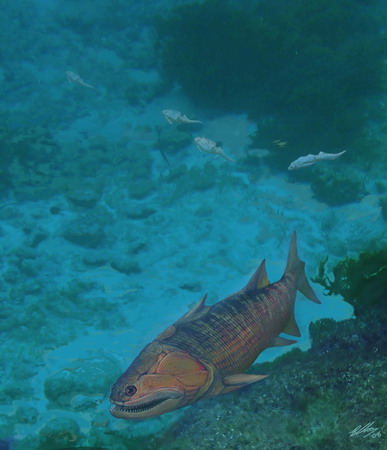
418m-yr-old fish fossil holds key to human evolution
By Lin Shujuan (chinadaily.com.cn)
Updated: 2009-03-26 16:48 The recent discovery in China of an unusually intact and ancient fossil fish, the distant ancestor of about 99.7 percent of today’s living vertebrates including human beings, has provoked a rash of new fieldwork and a fresh look at the early evolution of vertebrates.
The fish, called Guiyu and described in detail in today's (May 26) journal Nature by Zhu Min and his colleagues from the Institute of Vertebrate Paleontology and Paleoanthropology (IVPP) under the China Academy of Sciences, dates back to the Silurian period, more than 418 million years ago. It is the earliest known representative of a very large vertebrate group, the "bony fishes" or Osteichthyes, the class of vertebrates that includes everything from humans to halibut. There are more than 60,000 living species of Osteichthyes today, including almost all the fish that we eat (except sharks) and all land vertebrates, according to Zhu, the first author of the Nature report. "Crucially, this piscine offshoot of our own distant past is both unusually intact and exceptionally old," says Professor Michael I. Coates from the University of Chicago, who wrote a review of the discovery of Guiyu also in today's Nature. "Earlier stretches of Osteichthyan history are littered with fossil detritus, such as isolated teeth and scales," says Coates. Guiyu, with an almost complete fossil specimen, is a valued addition to the "poorly resolved patch of vertebrate evolution", says Coates. Zhu admits the discovery of Guiyu is "a lucky find", which allows people across the world to see for the first time what our distant ancestor looked like, and gives "a better idea of when, where and how the Osteichthyes evolved, and how they are related to other vertebrate groups such as sharks". The discovery of Guiyu in Yunnan province has added to the increasing evidence that some of the key steps in early vertebrate evolution took place in southern China about 400-450 million years ago, at a time when that region was a small separate island continent near the equator, according to Swedish paleontologist Per Ahlberg from Uppsala University. "It also help us to interpret the less complete fossils," says Ahleberg, who has arrived in China for a visit to its discovery site in Southwest China. "It will greatly increase our understanding of the earliest Osteichthyes. "A specific point of interest for me is that rocks of similar age from Sweden and Estonia have yielded fossils of two other early Osteichthyes -- Andreolepis and Lophosteus -- that are known only from isolated bones and scales. My research group at Uppsala University is working on these fossils. Through comparisons with Guiyu and other early fossil fishes from China we hope to be able to make better and more detailed interpretations of our own material than would otherwise be possible." Zhu says it is expected the discovery of Guiyu will revitalize the "long stagnant research tracing the very basal root of vertebrates". "More surprises are to be expected." |
主站蜘蛛池模板: 贺兰县| 德令哈市| 项城市| 巩义市| 沙坪坝区| 盖州市| 乌鲁木齐县| 池州市| 子长县| 刚察县| 涟水县| 海口市| 武安市| 宜兰市| 峨眉山市| 五家渠市| 工布江达县| 亚东县| 武威市| 漾濞| 姜堰市| 信宜市| 清涧县| 连南| 鹿泉市| 漳平市| 安徽省| 莆田市| 建始县| 盐城市| 泸西县| 泾川县| 乐山市| 渝北区| 潮安县| 屏东市| 紫阳县| 台安县| 新和县| 永泰县| 砀山县| 山西省| 全南县| 黄梅县| 宾川县| 宁远县| 福建省| 沂源县| 莫力| 若尔盖县| 浙江省| 西和县| 阿荣旗| 津南区| 金湖县| 定州市| 集安市| 横山县| 元谋县| 中卫市| 阳原县| 南汇区| 昌黎县| 丰都县| 婺源县| 芜湖市| 淳化县| 马山县| 承德县| 庆元县| 怀集县| 天峨县| 广灵县| 内江市| 平陆县| 易门县| 宜丰县| 安国市| 宜春市| 营口市| 水城县| 肥东县|