CHINA> National

|
CHINA> National
|
|
War veteran's unique quest helps troubled 'souls'
By Wang Ru (China Daily)
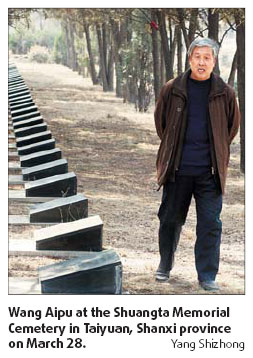
Updated: 2009-04-04 08:29 Wang Aipu has one less soul to worry about on Tomb-Sweeping Day this year. Just before the Spring Festival in February, Wang got in touch with the daughter of Gong Fatang, a Hubei native and one of some 10,000 soldiers buried at the Shuangta Memorial Cemetery in Taiyuan, capital of Shanxi province. The cemetery commemorates those who died in the battle to liberate Taiyuan in 1949. "He (Gong) should be well taken care of now," said the 71-year-old Wang, after a recent visit to the cemetery. For more than a decade, Wang, a war veteran who retired as the manager of a collectors' association, had been searching through these tombstones, identifying 34 soldiers whose heroic deeds had remained unknown.
Wang's odyssey started in April 1996, one week after the Tomb-Sweeping Day, also known as the Qingming Festival. He was wandering around an antique market in Taiyuan when he noticed a pile of old papers on the ground. There were 84 notifications of death, marked "unsent", and a register of 866 soldiers who had died in the battle.
After a military historian confirmed that the letters were authentic, Wang embarked on a painful journey to send the "souls" of these dead soldiers home. Though it came after a six-decade delay, such a form of consolation turned crucial to the family members of the war heroes. "Their families didn't know they were buried in Taiyuan, or even about their deaths," Wang said. "They are not just papers, but the tale of lives once lived. I could hear their souls whisper to me to send them home. I have a duty to bring peace to their souls." The notifications showed that the soldiers had come from all parts of China; one had even joined the war from "Hong Kong county". But many of the addresses did not exist any more. Besides, 26 of those documents did not have any information other than names and divisions. As the war waged on, many young soldiers joined in and were sent to the front. They did not get time to leave behind much personal information. And many Kuomintang soldiers who surrendered had immediately joined the People's Liberation Army in battle. That made the situation even more complicated, Wang explained. Wang sent hundreds of letters and called the civil affairs bureaus in the soldiers' hometowns, but got little or no response. In 2005, with the help of a journalist from Wuhan, capital of Hubei province, Wang found the home of a soldier named Hao Daihu. Ever since Hao had left his native village in Yunmeng some 60 years ago, rumors about him had been growing. Some villagers said he had joined the Kuomintang and become a captive; others claimed that he was still alive and was leading a miserable life. But when Wang handed over the notification and picture of Hao's tombstone to his cousin at the village, Hao's only surviving relative broke into tears. Huo Xiaoshan was another soldier on Wang's search list. Thanks to Wang's efforts, Huo's daughter Yuhua was able to pay her respects at his tomb in 2006. Huo had left his wife and two daughters in 1943 and was never heard of since. Three years later, the mother and daughters started on a 10-year journey to look for Huo that turned out to be unsuccessful. "I used to hate my father for not returning home. Now I finally know that he died for the country 60 years ago," Yuhua, then 71, had said as she stood in front of her father's tomb three years ago. |
主站蜘蛛池模板: 寿宁县| 广饶县| 西平县| 水富县| 鸡东县| 谢通门县| 油尖旺区| 吉首市| 房产| 南昌市| 淮安市| 环江| 赣州市| 永新县| 合江县| 泸州市| 长宁县| 师宗县| 晋中市| 桓仁| 宜城市| 蕉岭县| 焦作市| 陕西省| 吉林市| 五河县| 镇远县| 张家口市| 三原县| 滨州市| 包头市| 柘城县| 江阴市| 巴彦淖尔市| 文昌市| 景德镇市| 庆元县| 汝南县| 合肥市| 苍山县| 屏东市| 昆山市| 横峰县| 盐源县| 上虞市| 林西县| 监利县| 简阳市| 云和县| 绍兴市| 门头沟区| 博乐市| 瑞丽市| 岳普湖县| 商丘市| 新建县| 安康市| 南澳县| 独山县| 鄂托克旗| 吴忠市| 廊坊市| 图片| 和平县| 鄯善县| 漯河市| 霍邱县| 和政县| 永善县| 崇阳县| 新宁县| 沙湾县| 永安市| 大理市| 手机| 南开区| 濮阳市| 布拖县| 高邮市| 莆田市| 镇平县| 葫芦岛市|