CHINA> Focus

|
CHINA> Focus
|
|
Monkey mountain magic
By Erik Nilsson (China Daily)
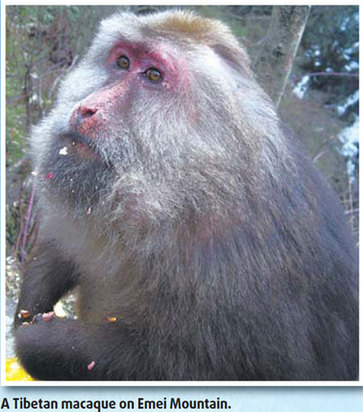
Updated: 2009-04-16 17:13 I thought my wife was rummaging through my backpack, but instead found myself nose-to-nose with a glowering Tibetan macaque. The woolly monkey was up to his armpit in my bag, rooting through clumps of socks and sweaters to pilfer the peanuts stashed inside.
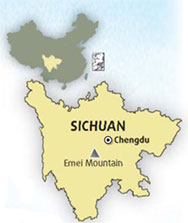
"Hey, that's mine!" I scolded, laughing, and tugged the knapsack away from the creature - or at least tried to. These cheeky Tibetan macaques have surprisingly powerful upper body strength. The primates who dwell on the mountainsides of Sichuan province's Emei Mountain are colloquially known as "little beggars". That's why I'd brought alms of peanuts. But nobody said they were actually "little pickpockets". It was an Oliver Twist meets Planet of the Apes tableau - but one set on a sacred Buddhist mountainside in China.
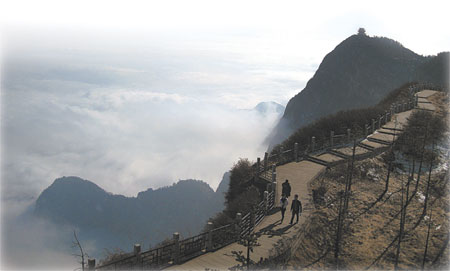
My family and I were trudging toward Emei's second-highest peak, the 3,079-m-high Golden Summit. The range's tallest crown is Qianfoshan (Thousand Buddha Mountain), which zooms 3,099 m into the sky. Lashed around our shoes were bingjiao (ice paws), iron spikes locals wear to puncture the slush to keep from slithering down the mountainside. The way Emei Mountain's precipices jut skyward seems to wave a defiant finger in the face of Newtonian physics, while tapping another finger on climbers' shoulders as if to say: "You really don't want to fall down me." Slogging brought us to the cable car that zips 1.164 km through a spray of aerosol known as the Mist of Leidong Plateau - one of the four "miracles of Emei". The car carries 100 passengers above the clouds within five minutes, and despite the route's distance, there are no supports along the way. Upon disembarking, we gazed out over Emei's second "miracle", the Cloud Sea - white swaths of cirrus, swirling as far as could be seen. Viewing these fleecy cloud billows from above reminded us of archetypical depictions of heaven, and we half expected to see winged harpists flittering from puff to puff. Emei's other two miracles have yet to be explained by modern science. The Holy Lamps are a mysterious scattering of eerie green lights that flicker and dance around the 60-m-tall Buddha Cliff at night.
Only visible a few times a year are the Buddha Halos, techni-colored auras that ring the shadows of those who walk on the Buddha Cliff and appear to move with the people who cast them. The Sichuan government recently invested 300 million yuan ($43.9 million) in refurbishing the 16-sq-km Golden Summit Scenic Area and finished construction last year. The treasure trove of structures here includes the Golden, Silver and Bronze monasteries. Its crown jewel is the 48-m-high multidimensional Samantabhadra Buddha statue. This 66-ton bronze likeness is endowed with 10 heads to catch winds from 10 directions. Emei is not only among China's Four Buddhist Mountains but is also believed to be the alp from which the religion radiated throughout China after arriving from India. Emei's patron is the Samantabhadra - known in Chinese as the "Puxian" - bodhisattva, entrusted with transmitting the belief system. He rides magical elephants with six tusks on its quest to spread Buddhism. The stroll back to the cable car took us past thousands of "lovers' locks" dangling from railings. Couples buy the locks from vendors, and after engraving their names and securing them to the fences, hurl the keys over the edge of the crag. Disembarking from the cable car, we were back in the primeval forests that are home to more than 2,000 species of animals and 280 kinds of butterflies. But the mountain is better known for its flora and is home to about 10 percent of China's plant varieties and a third of Sichuan's.
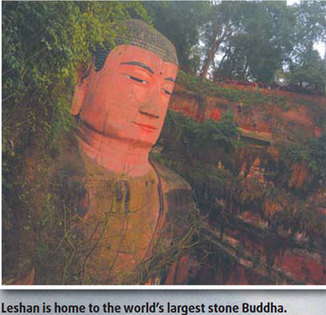
There were about 20 temples left to choose from, but we settled upon the Baoguo Temple near the mountain's base. Appropriately, the Buddhist monastery had an earthier feel than the summit, with most structures fashioned from wood and stone, and seeming to blend into the timberland. The next day we took the 40-km bus ride to Leshan to see the world's largest stone Buddha. Towering 71 m from the base of the cliff into which it was carved, the Maitreya likeness' shoulders span 28 m, and his toenails are big enough for a person to sit on. This gentle giant was chiseled into the bluff starting from AD 713, during a 90-year-campaign led by a monk named Hai Tong. Visitors to Leshan's 1.7-sq-km scenic area, listed as a UNESCO World Heritage Site along with Emei Mountain in 1996, can also visit the nearby cavern in which the lama lived. According to legend, when the Tang government considered slashing funding, the monk scooped out his eyes in a show of pious devotion. Hearing this seemed to paint the whole Van Gogh ear-disembodiment story in a less impressive light. The result of Hai Tong's piety seems to show if faith can't actually move mountains, it can at least reshape them. But the monk died before the project's completion, and his disciples finished the job. Leshan's Giant Buddha was built at the churning confluence of the Min, Qingyi and Dadu rivers, where fiendish aquatic demons were believed to cause frequent shipwrecks. Ironically, the Maitreya's creation did help; so much rock was chipped out of the gorge that the debris slowed the currents, enabling ships to pass safely. Several smaller bodhisattvas are also carved into the escarpment, but most were beheaded during the "cultural revolution" (1966-76). There are also a few temples, including the Wuyou Monastery, and similar sacred spots. The Dragon's Pool and Tiger's Lair are said to have been created when a white tiger and black dragon - inspired by Buddhist scriptures - turned themselves into stone to guard the giant Buddha. The tiger crouches poised to strike in front of a small cave, while the stone dragon slinks above a pool brimming with koi that flash gold, like fistfuls of coins dropped in the water, when they swim. With its natural and supernatural appeal, from monkeys to monks, we found Emei's peaks to be a highpoint of Sichuan travel. |
主站蜘蛛池模板: 奈曼旗| 潮安县| 拉孜县| 察哈| 锦屏县| 襄樊市| 渝北区| 榕江县| 合水县| 五河县| 团风县| 内江市| 威远县| 仁化县| 上杭县| 阜康市| 柳江县| 汉川市| 宁城县| 临海市| 潞城市| 当雄县| 庆元县| 会同县| 博乐市| 玛纳斯县| 龙川县| 双牌县| 房山区| 临城县| 合阳县| 理塘县| 通州市| 长葛市| 丹寨县| 大兴区| 荆州市| 于田县| 美姑县| 昌都县| 英德市| 莎车县| 阿克陶县| 义乌市| 日喀则市| 和田县| 射阳县| 金昌市| 娄底市| 东至县| 科尔| 张北县| 固镇县| 射阳县| 东方市| 民丰县| 光泽县| 天祝| 岳普湖县| 于都县| 光山县| 临朐县| 赣州市| 定兴县| 花垣县| 塔河县| 同心县| 大田县| 龙里县| 丹寨县| 青海省| 察隅县| 芷江| 清河县| 秦安县| 体育| 阳山县| 邵阳县| 谢通门县| 雷山县| 普陀区| 保靖县|