CHINA> Regional

|
CHINA> Regional
|
|
Tourism begins to revive in SW China's quake zones
(Xinhua)
Updated: 2009-05-05 14:00 CHENGDU -- Tourists from other parts of China swarmed to quake zones in southwest China's Sichuan province and during the May 1 holiday weekend.
Also in Anchang, most hotels were fully packed with tourists, and prices of guestrooms rose by 50 percent in the three-day holiday. Li Jiahua, a building material businessman from Tongliang County, Chongqing Municipality, was among the tourists. Li drove to visit the largest prefabs zone at Leigu town, also in Beichuan, May 2. He joined a voluntary drivers' team transporting relief goods to Beichuan last year, and was assisting two quake-ravaged families there. "I just want to know how they are faring with their life, and I should have come earlier if I had time," said Li. The number of tourists to Mount Qingcheng and Dujiangyan, both well-known scenic sites 68 kilometers to the west of Chengdu, the provincial capital of Sichuan, rose by 30 percent from last year's figure to hit 80,000. Most of the tourists were from other parts of the country, said an official from the administration for Mount Qingcheng and Dujiangyan scenery.
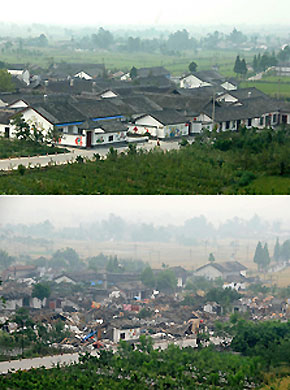
Sichuan, home to giant pandas, scenic nature reserves and ancient cultures, has long been a tourist destination. The devastating earthquake on May 12 last year not only left more than 80,000 people dead or missing, but also destroyed infrastructure as well. The devastating earthquake caused severe damage to the Wolong base, where most of the country's captive pandas were kept. Five base staff were killed, as was one captive panda. Two pandas were injured and six were missing, five of which were eventually found. Reconstruction in quake zones remains massive and has been listed as a key task by the State Council in the forthcoming years. Quake ruins become tourism craze Qingchuan, Wenchuan and Beichuan, three of the worst-hit areas in the powerful quake, are caught in a tight race in turning quake ruins into tourist attractions. Qingchuan opened the first quake theme park, Donghekou, November 12 last year. More than 260,000 tourists have visited this quake theme park. Beichuan county will not be willing to be left behind. It is the only Chinese autonomous county for Qiang, a minority of just 300,000 people. The Qiang people have a unique culture that can be traced to the Shang Dynasty (1600 BC-1046 BC), and was recorded in oracle bone inscriptions. The Qiang, who call themselves "Ermea", literally "native people", are also known as the "people in the white clouds" because they usually live in ornately decorated stone houses in the upper reaches of the mountains, herding sheep and growing crops such as corn and cherries. The old county seat of Beichuan was razed by the quake. The county lost two-thirds of its population in that day, with 15,600 confirmed deaths, and 4,700 other people still missing. A state-level quake ruins museum park is in the pipeline. In accordance with the museum park construction plan, which was published in March, the projected museum park will cover eight square kilometers and will have three parts: a museum building, old Beichuan county town quake ruins, and a center for secondary disaster display and natural conservation. At present, however, police guard the locked gate to the old county seat. Visitors walk near the gate or climb a nearby hill to look down on it. Wenchuan County, the epicenter of May 12 quake, also has a plan for developing tourism by exploring quake ruins, with Yingxiu Township at the forefront. Sandwiched by two mountains, Yingxiu was connected to the outside world by a bridge. It lost 5,462 of its 18,000 population, and 3,694 other people missing. Baihua Bridge, Yingxiu's only overland link to the outside, was also destroyed in the quake. Large chunks of soil also collapsed from the two mountains during the quake, according to Jiang Yongfu, Party boss of Yuzixi Village, Yingxiu. A new bridge is being built parallel to the quake-damaged Baihua Bridge which is left in ruins. According to Jiang, Yuzixi Village, where 268 out of the 269 homes were destroyed in the quake, will build a tourist reception center, a cemetery for those who were killed in the quake, a quake ruins park, a memorial, and a museum of folkways and culture. The village is attracting some 1,000 to 2,000 tourists each day, said Jiang. |
主站蜘蛛池模板: 军事| 湘乡市| 龙海市| 无为县| 安福县| 岢岚县| 龙川县| 绥滨县| 方山县| 辉县市| 太和县| 澄迈县| 贺州市| 南雄市| 蓬莱市| 永德县| 台山市| 西乌| 旺苍县| 徐水县| 浦城县| 台东县| 栖霞市| 丁青县| 富蕴县| 祁阳县| 郸城县| 吉水县| 余江县| 吉林省| 遂昌县| 卓资县| 资源县| 内乡县| 迁西县| 满城县| 沅江市| 铜陵市| 株洲市| 玛曲县| 辰溪县| 石城县| 壶关县| 绥芬河市| 利津县| 浏阳市| 安塞县| 皋兰县| 高陵县| 安阳县| 淮阳县| 分宜县| 龙游县| 息烽县| 临西县| 长丰县| 临潭县| 来凤县| 太仆寺旗| 海兴县| 卢龙县| 泰来县| 南昌县| 义马市| 新化县| 扶绥县| 洛宁县| 东港市| 安平县| 库尔勒市| 台江县| 莆田市| 蓬溪县| 富裕县| 简阳市| 高邑县| 湖南省| 金阳县| 伊通| 高清| 丹巴县| 鸡西市|

 Sichuan, One Year On...


