CHINA> National

|
CHINA> National
|
|
Change tack with sea strategy: China experts
By Zhang Xin (China Daily)
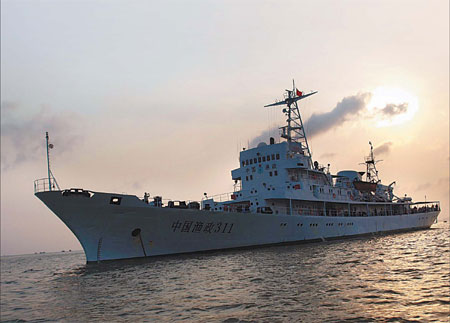
Updated: 2009-05-13 09:48 The recent disputes in the South China Sea, as well as several territorial claims logged with the United Nations, have led to calls from Chinese experts for an overhaul of the country's sea-faring strategy.
The South China Sea, part of the Pacific Ocean, covers an area of around 3.5 million sq m, while China's maritime jurisdiction in total, including the East China Sea and Yellow Sea, is around 3 million sq m, said Wang Hanling, an expert in maritime affairs and international law at the Chinese Academy of Social Sciences (CASS).
China shares common waters with the Philippines, Malaysia, Vietnam, Brunei, Indonesia, Japan, the Republic of Korea and the Democratic People's Republic of Korea. However, three high-profile moves in March this year saw tensions rise in the region. The month began with a Malaysian official landing on two reefs, off China's Nansha Islands, and claiming the islands as his country's territory; just a few days later, United States spy vessel the USNS Impeccable intruded into China's exclusive economic zone without permission, violating international and Chinese laws, and, in the same week, Gloria Macapagal-Arroyo, president of the Philippines, signed a controversial bill into law that claimed Huangyan Island and the Nansha Islands were Filipino territory. Last week, Vietnam also submitted an individual proposal and a joint proposal with Malaysia to the UN Convention on the Law of the Sea (UNCLOS) that questioned the outer limits of the continental shelf. The deadline for submissions is today, while the Chinese foreign ministry immediately branded the claims "illegal and invalid". The South China Sea, or the "South Gate", plays an essential role in China's security, both economically and strategically, explained Wang. It provides a transportation route for 80 percent of the crude oil imported from the Middle East and Africa, it is itself rich in oil and gas reserves, and it is vital to the nation's efforts to diversify trade routes to bolster its export economy. Disputes over the sea have occurred since the early 1970s.
In the Philippines, the stance over Huangyan Island and the Nansha Islands had been affected by an instability exacerbated by the global financial crisis, said Chinese analysts, with Wang accusing the Philippine leadership of resorting to "nationalistic" measures and "political stunts" to win supporters and votes ahead of a general election. However, the waters have been calmed for the time being after serious diplomatic efforts. Following the signing of the Archipelagic Baselines Law, which states the Philippines may claim an extended continental shelf of up to 350 nautical miles, the country made only a "partial submission" to the UN commission on the limits of the continental shelf (CLCS) on April 8. The claim simply involved the undisputed Benham Rise, an extinct volcanic ridge off the east coast of Luzon, while the Philippine government also stated it wanted to "avoid provoking or exacerbating maritime boundary disputes in the South China Sea with its neighboring countries". Meanwhile, the nation's Manila Times reported its government had "stopped the clock on the UN deadline and bought time to sort out border issues with its neighbors". Gao Jianjun, a professor in international maritime law at the China University of Political Science and Law, said the Philippines was "balancing a careful and cautionary approach" as its territorial claims in the South China Sea would not only upset China, but also Vietnam, Malaysia and Brunei. The submission of Manila's claims over Huangyan Island and the Nansha Islands had been indefinitely postponed, as agreed by the UN, said Gao, but "claims over the disputed territory by the Philippines and other neighboring countries may be made later". Vietnam and Malaysia's submission this month, meanwhile, could prove less complex as the rules of procedure for the CLCS state: "In cases where a land or maritime dispute exists, the commission shall not consider and qualify a submission made by any of the states concerned in the dispute". The Chinese Permanent Mission to the UN immediately lodged its opposition to the joint submission on the CLCS on May 6, while Gao Jianjun said "dialogue and cooperation in developing the region based on China's sovereignty is the ultimate solution". In November 2002, China and the 10-member Association of Southeastern Asian Nations (ASEAN) adopted a Declaration on the Conduct of Parties on the South China Sea, which laid a political framework foundation for long-term peace and stability. According to the declaration, countries should "undertake to resolve their territorial and jurisdictional disputes by peaceful means, without resorting to the threat or use of force, through friendly consultations and negotiations by sovereign states directly concerned". It also states that "parties should exercise self-restraint in the conduct of activities that would complicate or escalate disputes and affect peace and stability including, among others, refraining from action of inhabiting on the presently uninhabited islands, reefs, shoals, cays, and other features and to handle their differences in a constructive manner." Wang Hanling said disputes submitted by ASEAN countries were not in line with the declaration, but explained they were more of an attempt to make a public "stand". |
主站蜘蛛池模板: 安达市| 枣庄市| 乐山市| 贡嘎县| 华容县| 石渠县| 唐海县| 南和县| 左权县| 临夏市| 施甸县| 醴陵市| 瑞金市| 广宗县| 西充县| 平邑县| 米泉市| 卢氏县| 舟曲县| 万荣县| 潍坊市| 肥乡县| 乌兰察布市| 贵州省| 镇远县| 新营市| 西和县| 隆昌县| 浠水县| 邓州市| 丽水市| 铁岭市| 邮箱| 尼木县| 福清市| 潼关县| 金乡县| 喀喇| 抚宁县| 松潘县| 高台县| 浮山县| 通山县| 大埔区| 黄陵县| 萍乡市| 望奎县| 广南县| 高要市| 信宜市| 通城县| 禹州市| 封丘县| 太湖县| 大英县| 孟州市| 平罗县| 平舆县| 那曲县| 观塘区| 南京市| 南城县| 宣汉县| 明星| 偏关县| 密山市| 唐海县| 威海市| 鹤岗市| 搜索| 宾川县| 文登市| 栾城县| 乐至县| 吉首市| 石楼县| 韶关市| 广河县| 竹溪县| 临武县| 孟津县| 贵州省|