CHINA> Ethnic and Religious Affairs

|
CHINA> Ethnic and Religious Affairs
|
|
Ethnic food goes down a treat with Xinjiang entrepreneurs
By Zhu Linyong (China Daily)
Updated: 2009-05-15 09:11 Urumqi: How does a one-time primary school dropout get to be the general manager and proprietor of one of the most popular and upmarket restaurant chains in the Xinjiang Uygur Autonomous Region? Kerim Mamuti, a 57-year-old businessman based in Urumqi, the capital city of the region, considers the question briefly, before saying: "I got the two essential lessons of my life from my parents. The first is you must have the courage to face reality. The second is you must be hard-working and sharp at seizing opportunities."
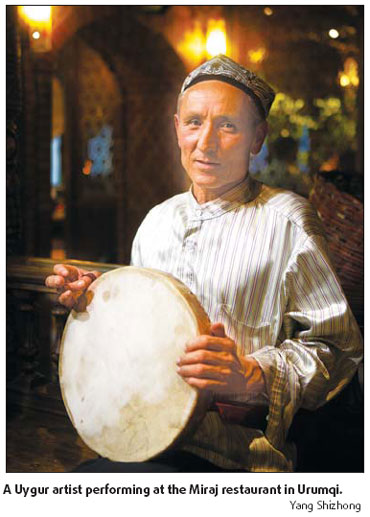 Mamuti has lived by these maxims for the whole of his life and abided by them whenever he had to face tough decisions. They have led him from early educational failure to being the owner of the Miraj chain of restaurants, which are regarded as among the best in the region. Mamuti was born in Atush, a barren land in the northwest Tarim Basin area of Xinjiang. Primarily an agricultural area with harsh natural surroundings, Atush is known for its high-quality cotton, grapes, and sheep but also for the business acumen of many of its residents - a heritage that Mamuti is proud to acknowledge. Prior to becoming a restaurateur, Mamuti was in the retail business. His business saw him trading more 120 different items of Chinese merchandise throughout Central Asia and the Arab world - but it was an experience he always found vaguely unsatisfying. He says: "I am always diligent, but I was dismayed by the fact that I had no control over future developments whilst doing international trade." This realization forced him to consider a drastic change in direction. Following a period of research and reflection, Mamuti believed he had found a niche in the market - high-end restaurants with a strong local and ethnic feel. Never a man for half measures, he invested more than 20 million yuan in his flagship Miraj restaurant and spent five years building it. Sun Shuangzhou, an engineer with Shenhua Xinjiang Thermal Power Plant and a frequent visitor to the Islamic-style Miraj, is just one of many who has been impressed by Mamuti's skills as a restaurateur. He says: "Treating visitors to dinner at Miraj has become a way of life for local people. It is one of the best restaurants in Urumqi. "The food is excellent, the decor is great and the floor shows by Kashgar farmers never fail to entertain. I've never brought anybody here who didn't enjoy it." Mamuti success story is not unique in the region, according to Parat Abdukadir, deputy general of Xinjiang's economic and trade commission: "There are now many sharp-eyed businessmen in Xinjiang, tapping into the goldmine that is ethnic food business. We have successfully adopted a number of preferential polices aimed at encouraging the growth of these large-scale ethnic restaurant chains. "A number of them have come to the fore since the mid-1990s and innovative marketing and positioning strategies have been the key to success for all of them." Abdukadir cites the success of Polat Hoxur, a former civil servant, who opened the first of his Mayflower Islamic Food Palaces in Urumqi in 2001. Hoxur opted for a much more low-key approach for the style of his restaurant's decor, in-house performances and even its cuisine. Whereas Miraj evokes the essence of traditional Uygur culture, the Mayflower is more of fusion of both the old and the new, the East and the West. It features both traditional Uygur paintings and more contemporary oil paintings with bright-colored decorations varying from room to room. All kinds of works from Hoxur's eclectic private art collection are exhibited in niches and recesses. Its cuisine, too, blends the old and the new - with sophisticated cocktails jostling for space on the menu, alongside some of the region's more traditional foods, such as Uygur-style noodles, fried rice, nang cakes, and kebabes. Hoxur remains confident that restaurants, such as his, will prove recession proof: "Establishments offering superb food, service and unusual eating experience, can withstand the fluctuation of the economy." Different again from both the Miraj and Mayflower restaurants is Su's Beef Noodles. Run by Ahmatjan Turgun, a former agriculturist, it offers Islamic fast foods for people in a hurry. In just under seven years, Turgun has managed to open more than 100 directly run fast food outlets across China. Turgun is clear as to his inspiration: "I am copying the business models of McDonalds and KFC, but I add Islamic food and culture into the mix." In Beijing alone, Turgun now has 12 branches, offering noodles and dishes designed to be suitable for the palates of Beijingers. He also now has a dedicated R&D center. |
主站蜘蛛池模板: 富源县| 盐边县| 商南县| 连云港市| 车险| 宣恩县| 介休市| 巢湖市| 大石桥市| 西峡县| 岳池县| 安塞县| 南华县| 静宁县| 诸城市| 庆阳市| 佛坪县| 无极县| 呼玛县| 九江县| 原阳县| 永州市| 通海县| 南岸区| 商洛市| 昭通市| 阳新县| 德庆县| 秭归县| 留坝县| 道孚县| 中宁县| 蓬莱市| 库伦旗| 南靖县| 阿城市| 江门市| 仲巴县| 延川县| 大丰市| 嘉兴市| 南靖县| 东方市| 芦溪县| 满城县| 昌吉市| 大丰市| 平泉县| 沧州市| 临武县| 涟源市| 浦县| 长武县| 吉林省| 江都市| 安庆市| 土默特左旗| 浙江省| 阜阳市| 华安县| 安国市| 三江| 喀喇| 扬中市| 潮安县| 尚义县| 大庆市| 大港区| 榆树市| 西和县| 洛浦县| 南昌市| 陆良县| 徐水县| 安西县| 固原市| 龙陵县| 浙江省| 屏东市| 龙南县| 定兴县| 济宁市|
