CHINA> News

|
CHINA> News
|
|
'Loulan Beauty' unearthed, but still sleeps eternal slumber
By Wang Qian (China Daily)
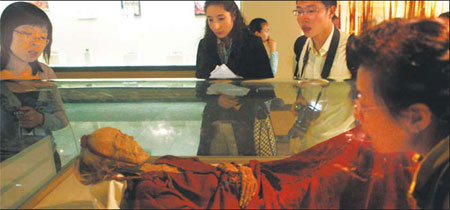
Updated: 2009-05-18 09:55 URUMQI: When the coffin's millennia-old cowhide bindings made an audible snap as they broke free in late 2004, Yidilisi Abuduresule felt tears well up in his eyes and could almost hear a voice from 3,800 years ago.
"It is the most beautiful sound I have ever heard in my life - those of steps made through history," said the head of the Xinjiang Cultural Relics and Archaeology Institute.
Abuduresule knows well about footsteps. He has been in the Taklimakan Desert, "sea of death", and made scores of times over the past 30 years in search of ancient tombs. Today some 2,000 tourists from all over the world come to Xinjiang Uygur Autonomous Region Museum each day to see the Loulan Beauty. This October, Belgium will host part of the collection, said Anniwar Kasim, director of the museum's vault. The Loulan Beauty and other cultural relics have already been to Japan, the US, Germany and other countries. Due to Xinjiang's arid climate, deep sands, long hours of sunshine and wide ranging temperatures, bodies of ancient people have been well preserved for thousands of years, providing valuable insights into the region's history and culture. Foreigners are often interested in the ancient Silk Road, which is represented by artifacts in the museum. They come and imagine the hardships their forefathers endured, the director said. The Xinjiang museum is the only comprehensive provincial museum in the region, with a collection of more than 40,000 cultural relics and specimens. Ten percent of them are classified as first-grade State cultural relics. The museum officially opened in 1959 and was rebuilt in 2005 with a total area of 17,228 sq m. It has staged more than 80 exhibitions in Beijing, Shanghai, Hong Kong, Macao and abroad. "Nearly 1 billion yuan was invested in the construction and since March 28 last year, and the museum has been free of charge," Kasim said. The museum's five sections represent grassland culture of the western regions, dresses and adornments of ancient western regions, Buddhist art of Xinjiang, the ancient mummies of Xinjiang and ethnic customs. "Our museum is an epitome of Xinjiang history," Kasim smiled. The displays help tourists know more about the history and culture of various ethnic groups, he said, adding that the government is funding preservation of the collection with 126.9 million yuan this year. Abuduresule said he is optimistic about protecting the Xiaohe cemetery. After the tomb was unearthed, its support pillars were reinforced with steel bars and two or three watchmen are on station around the clock. |
主站蜘蛛池模板: 南郑县| 姚安县| 九龙城区| 花垣县| 柏乡县| 承德市| 迭部县| 固阳县| 平乡县| 曲阳县| 新乐市| 尼木县| 祁阳县| 宁河县| 宁德市| 璧山县| 平乡县| 七台河市| 青浦区| 杭锦后旗| 措美县| 常熟市| 英超| 筠连县| 夏邑县| 洪湖市| 翼城县| 麻阳| 成武县| 临潭县| 平安县| 扶绥县| 高雄市| 昌平区| 溧水县| 临高县| 余干县| 兖州市| 广宁县| 新安县| 南城县| 贵定县| 浦北县| 安达市| 微博| 五常市| 定陶县| 仁化县| 福贡县| 东乡族自治县| 吉首市| 微山县| 汨罗市| 拜泉县| 平安县| 简阳市| 德令哈市| 民勤县| 綦江县| 绥滨县| 姚安县| 鹰潭市| 牟定县| 大埔区| 巧家县| 宁城县| 手机| 昌都县| 彭山县| 江源县| 咸丰县| 丰城市| 湖北省| 长宁区| 收藏| 太仆寺旗| 昌宁县| 翼城县| 滁州市| 鄂尔多斯市| 承德县| 托克逊县|