CHINA> National

|
CHINA> National
|
|
Fast response helps ease flu threat
By Wang Zhuoqiong and Cui Xiaohuo (China Daily)
Updated: 2009-05-20 10:21 Every time his phone rings and echoes around his vast temporary office at the national Center for Disease Prevention and Control (CDC), Li Qun's heart misses a beat. Every time he prays it is not another reported case of the A(H1N1) influenza.
On Monday night, it was. An Italian tourist in the Tibet autonomous region was suspected of having contracted the virus.
The response team, made up of 67 trained professionals in various fields, is on call 24 hours a day and Li spends a great deal of his time on the phone trying to persuade more people to get involved and help ease their increasing workload. As of Tuesday, the Chinese mainland had four confirmed cases and one suspected case of the virus, all imports from flu-affected regions. Monday was the fifth time Li had dispatched a team in response to a report of a H1N1 case. On arrival, the experts must investigate, diagnose and treat symptoms, as well as make a speedy judgment about the risk of a potential outbreak for the top health authority. However, the remoteness of the Tibet region posed an extra challenge. "Many of our experts were first-timers in Tibet. But our local CDC colleagues were well prepared," said Li.
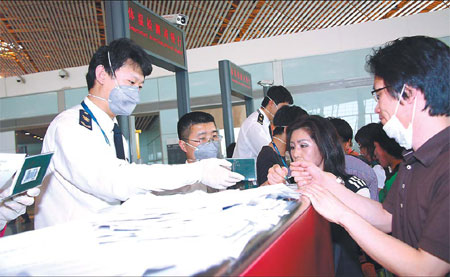
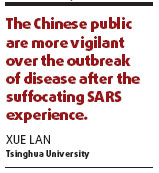
Such a fast reaction to public health incidents is a result of the lessons learned from the SARS outbreak in 2003, he explained, adding: "We are better prepared than during the SARS period. That outbreak happened all of a sudden; the people, resources and information system were not ready." Since SARS, the country has invested heavily in disease control measures, such as a sophisticated Web-linked information sharing system for the CDC, and built an extensive emergency plan and emergency reaction law, as well as created new departments within the health authority. Added to this, prevention has also been boosted by the public awareness, said Li. "Society shows more understanding of the public health sector, which creates a very good environment." During SARS, the battle to contain the deadly virus was dubbed the "people's war". As with that outbreak, the CDC has again divided its fight against the epidemic in China onto two battlefields: The nation's borders and its monitoring system. For the former, quarantine measures at airports, shipping ports and train stations are designed to delay the spread and win more time for research - as Zeng Guang, head of epidemiology for the CDC, explains: "Find one case and isolate close contacts to cut off the origin of the infection" - while, for the latter, the ever-expanding CDC network, along with 170 hospitals and 24 laboratories, provide earlier diagnosis and treatment. In terms of confirmed cases so far, Zeng said the number in China was only the tip of the iceberg, but urged the public not to worry as the strain was considered mild and assured the outbreak had spread over a month or so when "the world was off-guard". After having experienced the SARS epidemic in 2003, the recent outbreak has led to questions about the handling of the latest crisis by China. Should the country act aggressively? Is the nation's reaction effective or exaggerated? "China has reached a very good balance in effective control and social cost," said Xue Lan, dean of the public policy and management school at Tsinghua University in Beijing. "The health and quarantine authorities are very nervous and on high alert, but life and economy have not been disrupted." World leaders acknowledge the H1N1 virus is spreading fast but its severity has been relatively low compared to other flu strains. However, China's strategy of quarantine at borders, quick reaction to suspected cases and information briefing have proved very effective. "Over-reaction is a waste of resources," continued Xue. "There is no set standard across the world. The standards vary nation to nation." In the United States, which is considered to have an educated general public and excellent health facilities, there have been 4,714 confirmed and suspected human H1N1 cases across 47 states. Four people have died. Compared to this, for China, with its 1.3-billion population, high density and less developed health system, a pandemic would come at a tremendous cost. Dr Hans Troedsson, the World Health Organization (WHO)'s representative in China, said the mainland's response to the virus had been well handled, explaining: "Right after we informed the Ministry of Health about the outbreak in North America, China activated its national pandemic preparedness and response plan." He said China had increased surveillance to identify suspected cases, informed health staff nationwide to investigate and report any possible signs of the telltale symptoms and launched campaigns to tell the public how to protect themselves from the virus. |
主站蜘蛛池模板: 出国| 桦甸市| 红安县| 雅安市| 永嘉县| 同仁县| 类乌齐县| 石阡县| 昌都县| 肇源县| 平谷区| 贵港市| 通道| 江山市| 尚义县| 黑水县| 井陉县| 金山区| 色达县| 湖北省| 英德市| 江孜县| 禄丰县| 吉安市| 鸡泽县| 固镇县| 长垣县| 乐清市| 商丘市| 利津县| 稻城县| 乐山市| 襄垣县| 邢台市| 清新县| 稻城县| 奎屯市| 墨脱县| 尚志市| 瓦房店市| 开封市| 蚌埠市| 察哈| 永康市| 杨浦区| 萨迦县| 东至县| 赣州市| 双峰县| 洛浦县| 嘉定区| 吉首市| 武定县| 壶关县| 安多县| 辰溪县| 梨树县| 宜宾市| 陵水| 开原市| 芦山县| 萨迦县| 乌恰县| 佛学| 雷州市| 平远县| 镇原县| 恭城| 茶陵县| 泾源县| 兴义市| 福泉市| 沭阳县| 龙里县| 牟定县| 慈溪市| 武穴市| 包头市| 淮阳县| 依安县| 安丘市| 凤阳县|