CHINA> National

|
CHINA> National
|
|
Identity crisis for China's migrant workers
(Xinhua)
Updated: 2009-05-27 09:31 HEFEI -- Despite high property prices, migrant worker Fan Xiaoshun has decided to buy an apartment in the prosperous eastern Jiangsu Province. "I want to buy a big apartment with three bedrooms so my parents can live with us," Fan, 27, who is from neighboring Anhui Province, home to many members of China's army of migrant workers. Fan has worked in Kunshan City, Jiangsu with his wife for seven years.
On work days, they're in blue or yellow uniforms. But in their free time, they wear jeans with well-known labels as they stride down the street listening to music on their cellphones. Compared with their parents, Fan and his friends are a new generation of migrant workers. Better Conditions Fan, who earned 1,000 yuan (US$147) a month in 2000, has seen his wage double since. His friend, Wu Dong from the eastern Jiangxi Province, is a company guard. He earned just 600 yuan a month in 2000 but can now earn 2,000 yuan. The first generation of migrants workers earned much less. They also went home more often, especially during major festivals or harvest time. Cheng Defu, 60, from Jieshou City, Anhui has retired from the migrant life. Five years ago, he worked as carpenter in Inner Mongolia and the eastern Shandong Province, earning just 700 yuan a month, which he saved and brought back to his family. The younger migrants seem to enjoy life more, and live more for today. Many spend what they make, rather than sending every cent home. Li Dong, 18, from northwestern Gansu Province, works at an industrial park in Suzhou. He earns 1,500 yuan a month and spends most of it. "In the evening, I go to internet cafes after supper, where I chat or play online games," he said. On the weekends, he shops. According to Cao Bingtai, vice director of the migrants work office of Jiangsu Province, some 25 percent of young male migrant workers the office polled this year and 35 percent of the women said they never sent money to their parents at home. Why do they leave home? Li said he wanted to earn money, and get some life experience. He might be typical. Nanjing Normal University surveyed young migrant workers in the manufacturing, mining and service industries. The survey found that 54.2 percent of the 2,500 "new generation" migrant workers polled said improving themselves was the major reason they had left home. Another 9.2 percent said they wanted to enrich their lives and 4.2 percent hoped to gain residence in a city, something their parents' generation seldom aspired to. Their educational levels are rising, too. According to another survey, this one conducted by the School of Politics and Public Administration of the Jiangsu-based Suzhou University, 32.4 percent of the 450 young migrants it polled in Suzhou and Huai'an were graduates of vocational schools, 48.3 percent were middle school graduates and 10.8 percent had graduated from colleges or similar institutions. New Worries Cao noted that 15 percent of the young migrant workers in his survey vowed never to return to their rural homes. "The new generation of workers are internal immigrants," said Wang Kaiyu, research fellow at the Anhui provincial Academy of Social Sciences. Some cities, like Kunshan in Jiangsu, have tried to resolve migrant workers' "identity crisis" by encouraging them to buy an apartment. Migrant workers who owned an apartment larger than 80 square meters for more than three years, paid into the social endowment and health insurance funds for more than three years and had contracts with local companies could gain permanent residence in Kunshan, said Jin Xiongwei, vice head of the Kunshan city public security bureau. This was also a reason for Fan to buy his apartment. But regardless of their residence status, most migrants still find themselves "on the outside, looking in" at the big cities.
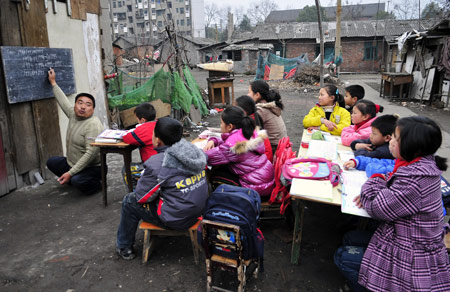
Research by the Party committee of Hangzhou, capital of the prosperous Zhejiang Province, found that 49 percent of the 886 respondents below 35 years old said they were "different" from local citizens. Another 35.8 percent were unsure of their identity. The problem was most obvious when it came to their children's education. Wei Ping from Jieshou City, Anhui went to work in Shanghai with her husband in 2000. Now their son is six, old enough for schooling, but they are worried about where he should get his education. "The quality of schools for migrants' children is poor, but we need an apartment certificate for him to enter a normal school," she said. "Now that we are both in Shanghai, how can we let him study alone in our hometown? Who could go back to accompany him?" |
主站蜘蛛池模板: 双流县| 出国| 蒙山县| 新河县| 准格尔旗| 无棣县| 台安县| 沁源县| 五家渠市| 博罗县| 常州市| 阳东县| 英吉沙县| 西充县| 甘泉县| 固始县| 尉氏县| 宝鸡市| 平江县| 松江区| 嘉兴市| 延长县| 沧源| 湘潭县| 登封市| 九台市| 潮安县| 常熟市| 威远县| 高安市| 大厂| 丹东市| 平阴县| 山东省| 安龙县| 正宁县| 平安县| 株洲市| 盐城市| 黔江区| 临邑县| 安溪县| 镇沅| 新邵县| 四平市| 齐河县| 稷山县| 灵璧县| 北海市| 精河县| 太原市| 黑河市| 恩平市| 正安县| 册亨县| 贞丰县| 富顺县| 南充市| 临澧县| 汉寿县| 连平县| 仁布县| 宜州市| 奉化市| 铜山县| 乐清市| 潜江市| 平顺县| 左云县| 信丰县| 浠水县| 凌云县| 神池县| 茌平县| 贺兰县| 石景山区| 万源市| 肥城市| 上饶市| 札达县| 玉树县| 高要市|