CHINA> Regional

|
CHINA> Regional
|
|
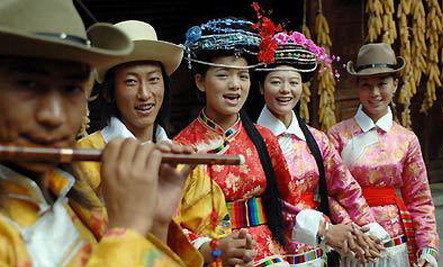
Matriarchal tribe's customs in compromise
(Xinhua)
Updated: 2009-05-27 11:00 KUNMING -- WengJici Erqing and Ruheng Cirenduoji grew up in households where grandmothers had absolute authority. Raised by their mothers and their uncles, neither knew his father well. This unique matrilineal family system followed by the Mosuo people for more than 2,000 years is what the two aspire to protect. But in real life, both chose to compromise their ancient customs to make their modern lives easier.
Erqing not only sees his wife and his two daughters almost every day but also takes them out occasionally. Duoji married his Mosuo girlfriend and acquired an official marriage certificate. Almost 15 years after the previously secluded tribe residing in the outlying areas of southwestern China opened their habitats to tourists, the younger generation like Erqing and Duoji have begun to waver between history and modernity, struggling to hold fast to their identity and their rare matriarchal traditions. With their wood-frame houses scattered around the 60-sq-km Lugu Lake separating Yunnan and Sichuan provinces, the Mosuo ethnic minority has a population of about 40,000. Unlike the majority of China's ethnic groups who follow a strong patrilineal tradition, they have preserved their ancient matriarchal system and the tradition of "walking marriage." After puberty, a Mosuo girl is free to receive men. But they can only visit at night and must go to their own homes in the morning. Any children born from these relationships are raised by the mother's family. The father will raise his sisters' children. If either member of such a couple tires of the relationship, they will move on to a new partner. Fading Custom Although "walking marriage" remains strong in the Mosuo territory, those who follow the ancient tradition have been declining. In Luoshui Village of the Ninglang Yi Autonomous County of Lijiang, Yunnan Province, only 60 percent of the people now participate in walking marriages, compared with 70 percent in 1996. Of the remaining 40 percent, half cohabit and half formally marry. "Poverty is the main driving force. As young people migrated to cities for jobs, cohabitation and marriage cut their living costs. It's strange but true that in villages where people are richer, the tradition is often relatively better preserved," said Erqing. Duoji admitted that it was difficult to maintain village traditions in town. "My wife now works in Lijiang and we plan to have a child. Without a marriage certificate, our relationship would be illegal there. It might also cause lots of hassle in our future child-raising," he said. Living at an elevation of 3,000 meters, the Mosuo have historically lived off the land. But the influx of tourists has given them a chance to see what's going on in the outside world and created a welcome new source of income. A popular business is tourism, especially running guesthouses. The Yunnan Provincial Tourism Bureau has compile statistics showing that the Lugu Lake area, the major habitat of the Mosuo, hosts hundreds of thousands of visitors each year. Erqing and Duoji each own a guesthouse in Luoshui Village. They also co-run an exhibition on Mosuo culture. They each earn more than 100,000 yuan a year from their businesses. "As people here get rich, tradition begins to clash with modern civilization. Lifestyles change. 'Walking marriage' still dominates, but other traditions are ignored," said Erqing. "When we were kids, young people riding horses had to dismount and stand by to wait for senior citizens to walk by first. Now young people whiz past on bikes or in cars. They don't bother to stop," said the 38-year-old. Another waning custom, Duoji said, was the fireplace get-together. "When I was small, people gathered around fireplaces for entertainment. Children had to rise to salute arriving elders, offer them seats and serve them food. These days you won't see that any more," Duoji said. Like anything in the world, Mosuo culture evolves slowly but constantly. As tourists swarm in their habitats to see their exotic lifestyle, the Mosuo wonder how their matrilineal culture will survive. |
主站蜘蛛池模板: 玉环县| 葵青区| 石泉县| 海城市| 吕梁市| 盐边县| 营口市| 平定县| 南充市| 岳普湖县| 元朗区| 九龙县| 永新县| 嘉义市| 章丘市| 普安县| 浙江省| 全南县| 米林县| 嵊泗县| 石台县| 梅州市| 剑川县| 西峡县| 聊城市| 潜山县| 玉屏| 邛崃市| 麻城市| 阿拉尔市| 平顺县| 仁布县| 广德县| 中方县| 石家庄市| 尚义县| 平顶山市| 永川市| 福贡县| 灵川县| 永安市| 邯郸市| 合水县| 丰台区| 河池市| 嵩明县| 承德市| 垫江县| 沿河| 兰西县| 桦甸市| 哈巴河县| 平定县| 呼玛县| 玉龙| 鹤壁市| 定兴县| 元氏县| 扎囊县| 陆河县| 惠州市| 平度市| 凤翔县| 乾安县| 宣汉县| 朝阳区| 磐安县| 耒阳市| 金塔县| 泗阳县| 扬中市| 象山县| 新河县| 平谷区| 贡觉县| 霍山县| 晋中市| 电白县| 阿克| 桃源县| 分宜县| 上杭县|