CHINA> National

|
CHINA> National
|
|
Post-80s: The vexed generation?
By Wang Linyan (China Daily)
Updated: 2009-05-27 14:36 Born following the adoption of the reform and opening up policy in 1978, China's post-80s generation was always going to play an important role in the nation's development. As the country's economy and confidence has grown, so too have they.
Fast food, Hollywood movies and the Internet are a major part of their lives - they are connected and have their fingers on the world's pulse.
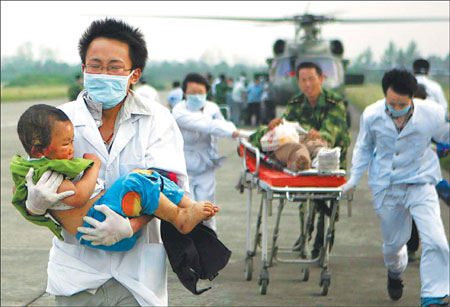
Yuan Yue, the president and CEO of consultancy group Horizon Research, said about 65 percent of the overall post-80s generation - aged 20 to 29 - were from one-child families, while that figure rose to 85 percent in urban areas. During their advancing years, they have been branded spoilt, materialistic and self-centered, and accused of lacking a sense of social responsibility. But those opinions have all but been reversed by an eventful 2008, a year in which they came under the spotlight not only during the worldwide Olympic torch relay, but also during the Beijing Games, and volunteered in their hundreds to boost earthquake relief efforts following the May 12 disaster in Sichuan province. Now many are dubbing them patriotic, persistent, caring and responsible. So which is the real post-80s generation? The question has already grabbed the attention of the Brookings Institution, a United States think tank, which in April held a seminar on "Understanding China's 'angry youth': What does the future hold?" to examine this unique segment of society and discuss what makes them tick. In the seminar's introductory notes, organizers said China's "angry youth", or fenqing, was a phenomenon for China and the rest of the world. They also said that these 20-somethings often use the Internet to publicly express their views on politics and society, while their hyper-nationalistic and slightly anti-US sentiments, which started to emerge in the late 1990s, stand in sharp contrast to the Chinese youth of 20 years ago. "We are a big part of the Chinese society and we have a real responsibility to react when our motherland is misrepresented," said Li Huan, a 27-year-old from Xi'an, Shaanxi province. Li made headlines last year with his patriotic and passionate speech at a Paris rally on April 19. Delivered in fluent French, he spoke before thousands of Chinese students and expatriates to support the Beijing Olympics and denounced the French media for distorted reports of the March 14 riots in Lhasa, capital of the Tibet autonomous region. "The majority of the Chinese students at the rally were post-80s children," he told China Daily. At the time of the speech, which was staged in the city's Place de la Republique, Li was a postgraduate student at the University of Lille II and has since been credited with helping to redefine the Western media's perspective on China's youth. "After the April 19 rally, the French media for the first time reported on Tibet as a feudal serfdom society restricted by the Dalai Lama. It was the first fair reporting on Tibet after the Lhasa riots," he said. Defining the post-80s generation, however, was a harder challenge for Li, who now lives and works in Paris. He described them as active, independent and Internet savvy, with diversified opinions, and "feel China is closer to the rest of the world". "But they are also rebellious and critical of things at home and abroad. They don't accept injustice or unfairness. "Post-80s are a force for justice, fairness and progress. They look at the world objectively. They not only care about China's image, but also the state of the country." An American journalist with a major news agency in Beijing, who asked not to be named, told China Daily the Western media were paying close attention to the young people of China as they would define the future direction of the country. |
主站蜘蛛池模板: 江西省| 平原县| 宁安市| 偃师市| 沁源县| 日照市| 泾阳县| 黎城县| 西充县| 贵溪市| 佳木斯市| 昌图县| 吐鲁番市| 五寨县| 朝阳市| 微山县| 娄烦县| 乌兰察布市| 中西区| 洛扎县| 肥乡县| 隆化县| 武川县| 西吉县| 玉溪市| 宁德市| 鄢陵县| 延吉市| 宁城县| 九龙坡区| 黄浦区| 葫芦岛市| 都江堰市| 桦川县| 抚顺县| 南皮县| 靖安县| 普安县| 尼木县| 元谋县| 桂林市| 西宁市| 开远市| 米泉市| 九龙县| 阜南县| 翁牛特旗| 翁牛特旗| 平塘县| 农安县| 宝丰县| 昌宁县| 宜阳县| 榆中县| 彰化县| 金塔县| 五常市| 唐河县| 南华县| 玉林市| 铜川市| 白水县| 光泽县| 常山县| 和政县| 南江县| 静安区| 自治县| 敦化市| 谢通门县| 扬中市| 禄劝| 全椒县| 阳江市| 凭祥市| 穆棱市| 海伦市| 陈巴尔虎旗| 增城市| 邵阳市| 年辖:市辖区| 兴安县|