CHINA> National

|
CHINA> National
|
|
Related
FDI curbs in real estate may be eased
By Hu Yuanyuan (China Daily)
Updated: 2009-06-23 07:21 The government may relax rules on inward foreign direct investment (FDI) to prevent it from sliding further, sources from the Ministry of Commerce said yesterday.
"We have drawn up a plan to relax some restrictions on foreign investment, particularly in the real-estate sector," an official from the Ministry of Commerce, who did not want to be named, confirmed to China Daily.
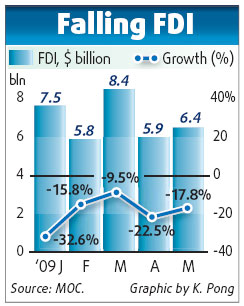
"This is a coordinated job, involving a number of other ministries." The proposal - submitted to the State Council, or the Cabinet - lists 42 rules covering taxation, foreign exchange and regulatory supervision, and calls for an easier approval process for foreign investment, China Times reported on the weekend. One of the biggest changes is loosening regulation on foreign investment in the property sector. Other suggestions include giving foreign investors access to the high-tech industry and relaxing checks on individual foreign investment. FDI dropped 17.8 per cent last month from a year earlier to $6.38 billion, the eighth straight monthly decline amid the global economic downturn. But the drop was less steep than in April, when inflows fell 22.5 per cent on a yearly basis. In the first five months, FDI fell 20.4 per cent to $34.05 billion. "The ministry's proposal is important to maintain growth in investment, one of the three drivers of economic growth, in the second half of the year," said Li Jianfeng, macro-economic and trade analyst with Shanghai Securities. As government-led investment cannot maintain momentum in the next six months, stimulating investment from the private sector, including FDI, is critical to ensure GDP growth, Li added. According to statistics from Shanghai Securities, real estate-related investment accounted for 10-15 percent of FDI in the past three years.
Ji told China Daily that a number of US property developers dropped investment plans at the end of last year because of too many restrictions and the slow approval process. The government introduced a slew of policies to prevent the influx of foreign capital into the sizzling real-estate market in 2006 and 2007. These included raising the ratio of registered capital in developers' overall investment and restrictions on residential purchases by foreign institutions and individuals, as well as tightening the approval and supervision of foreign investment in the sector. But the decline in property prices and transactions amid the economic slowdown last year has prompted policymakers to consider relaxing controls to bolster economic growth. |
|||||
主站蜘蛛池模板: 红河县| 潞城市| 赤水市| 新宁县| 恩平市| 昌都县| 江口县| 内丘县| 德格县| 应城市| 北辰区| 开阳县| 九龙坡区| 黔西县| 乐陵市| 宣汉县| 潍坊市| 柯坪县| 大化| 合江县| 沽源县| 昌都县| 常山县| 扎兰屯市| 云浮市| 双江| 长垣县| 和顺县| 大同市| 望江县| 浏阳市| 含山县| 济源市| 安多县| 明星| 绵阳市| 万载县| 德兴市| 邢台市| 海南省| 石林| 喜德县| 南丰县| 理塘县| 澜沧| 博客| 永济市| 社会| 广河县| 搜索| 淳化县| 昭苏县| 红河县| 兴业县| 华蓥市| 合山市| 上虞市| 河东区| 隆子县| 松溪县| 府谷县| 阜南县| 东兴市| 黄龙县| 衡水市| 横峰县| 仁怀市| 杂多县| 思茅市| 永昌县| 宽城| 新龙县| 潜江市| 锦州市| 玉田县| 淮滨县| 娄烦县| 高安市| 玉林市| 淳化县| 册亨县| 镇原县|