CHINA> Regional

|
CHINA> Regional
|
|
Blue book: West China still struggling
By Tan Yingzi (China Daily)
Updated: 2009-07-14 07:58 Despite massive exploitation of its natural resources and efforts made via the Go West Campaign, the economy of West China still lags behind the rest of the nation, experts said as the latest Blue Book of the Western Region of China was released. The book, a report on economic development in the western region, has been published annually since 2005.
 It reveals that while the area has seen a spike in projects that tap into its hydroelectric and metal ore potential, it has not yet closed the gap on wealthier provinces and remains the poorest region. "The reform of our financial system is the best way to bridge the widening gap between the western and eastern parts of the country," said Yao Yang, deputy director of the China Center for Economic Research at Peking University. Yao said additional regional banks and a local capital market would encourage more investment in the region. Cai Jimin, deputy director of the Institute for Economic Research at Tsinghua University, said the exploitation of West China's rich natural resources has not translated into a financial windfall "because of the unreasonable tax system of natural resources and low compensation standards".
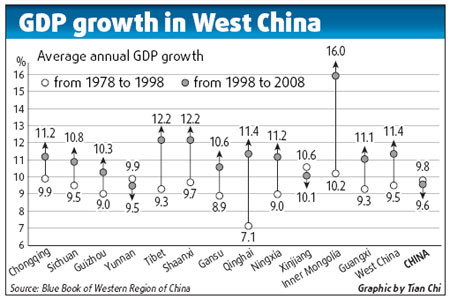
In recent years, West China has experienced its fastest period of economic growth since the founding of the People's Republic in 1949. The region is enjoying an average annual GDP increase of 11.42 percent, which is higher than the country's average of 9.64 percent. In 1999, West China's GDP increase was just 7.2 percent. And West China's average GDP per capita has doubled in recent years from 4,122 yuan ($600) to 13,186 yuan ($1,933).
But the region's GDP was only 17.8 percent of China's total in 2008 and its average GDP per capita was only 41.09 percent of that in the east. People in West China, despite the improvements, are earning less than the country's average. Eight western provinces were among the 10 lowest income areas in 2007. Gansu province had the lowest average income - people there earned 42.34 percent of the average income in Shanghai. The Blue Book was compiled by the Centre for Studies of China Western Economic Development at Northwest University in Xi'an, Shaanxi province. China initiated its western development strategy in 1999 to boost the underdeveloped area, which includes 12 provinces, autonomous regions and Chongqing municipality. West China is home to a quarter of the country's 1.3 billion population. It is also home to most of China's ethnic minorities - including Tibetans, Inner Mongolians and Uygurs. It boasts rich natural resources, including coal and oil - and cheap labor. Policies such as heavy government investment, preferential tax rates and flexibility have been implemented to boost local infrastructure and environment. In the past decade, nearly 1.74 trillion yuan has been poured into 102 major projects. The annual growth rate in investment in fixed assets is more than 20 percent. But it lags behind, in part, because of historic underdevelopment, the report says. Further advances are planned for the next 10 years, said Li Yingming, deputy director of the Department of Western Region Revitalization under the National Development and Reform Commission. |
主站蜘蛛池模板: 攀枝花市| 天门市| 同心县| 绥棱县| 黎川县| 象山县| 察隅县| 罗田县| 定陶县| 绥德县| 桐柏县| 那坡县| 虹口区| 图们市| 长宁区| 绥芬河市| 中方县| 武冈市| 保靖县| 新乡市| 卢湾区| 册亨县| 宝清县| 玉环县| 论坛| 太仓市| 靖西县| 灵山县| 锡林郭勒盟| 大冶市| 娄烦县| 桓仁| 兰州市| 云浮市| 客服| 南充市| 通渭县| 陈巴尔虎旗| 明星| 体育| 田林县| 信丰县| 孝义市| 康马县| 奈曼旗| 惠来县| 临武县| 锡林浩特市| 浦东新区| 山东省| 沭阳县| 新河县| 明星| 湟源县| 平罗县| 黔江区| 阿城市| 呈贡县| 文化| 宁远县| 黄陵县| 隆回县| 安宁市| 鄯善县| 竹溪县| 宁陵县| 漳州市| 龙口市| 滨海县| 定南县| 博客| 商丘市| 玛多县| 封丘县| 固始县| 香港| 无为县| 庄浪县| 江永县| 宜丰县| 雷州市| 博白县|