CHINA> National

|
CHINA> National
|
|
Moon talk before China's moon walk
By Wang Qian (China Daily)
Updated: 2009-07-17 07:39 It may be just a moon crater to most, but Chinese sophistication demands at least five different ways of referring to it. And authorities are now looking for the "right term" to claim the Chinese language's stake on at least 18 lunar features, in the latest sign of the country's growing ambition to explore the heavens, and to land on the moon.
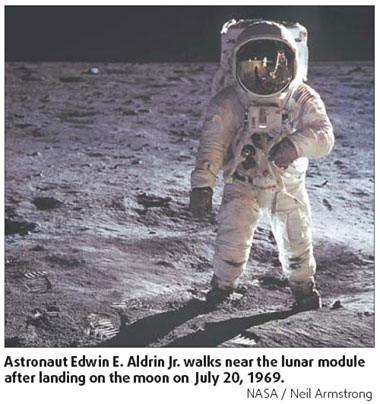 That ambition, plus the interest in naming geological sites on the moon, are coming together as the country sets ambitious goals for space. The Institute of Toponymy, under the Ministry of Civil Affairs, is collecting Chinese translations for the 18 features of the moon to standardize usage and boost the development of moon exploration. "To avoid the inconsistencies of various translated versions of the moon's features, we decided to seek public feedback on naming them," Fan Chenfang, an official of the institute, told China Daily Thursday. Those interested in leaving their mark on the moon can send their ideas to fanchenfang@sina.com, Fan said. The International Astronomical Union first released the names of the 18 lunar features in 1935 and for the past decades, there has been no official standard for their Chinese translations, the ministry said. The 18 terms are the Albedo Feature, catena, crater, dorsum, fossa, lacus, landing site, mare, mons, oceanus, palnus, planitia, promontorium, rima, rupes, satellite feature, sinus and vallis. In the case of the crater, Chinese textbooks have termed it huanxingshan, while zhuangjikeng and yunjikeng have been popular among scholars. Most people simply know it as keng, referring to the Chinese word for "hole".
China marked its foray into space with the launch of its first unmanned spacecraft in November 1999. Four years later, it became the third country, after the United States and Russia, to send a human into orbit, following a two-man mission in 2005. On March 1 this year, Chang'e-I, the country's first lunar probe, hit the moon and ended its 16-month mission. But Chang'e-I, which is named after a legendary Chinese moon goddess, sent the first full map of the moon's surface back to China a month after its launch. The probe's journey was the first phase of the country's three-stage moon mission, whose goal is a landing and launch of a rover vehicle around 2012. "The second phase of the space program aims at a soft landing and the preparation is in progress," said Wu Weiren, chief designer of the country's lunar probe program. In the third phase, another rover is scheduled to land on the moon in 2017 and bring back mineral samples for research. Li Xue, an employee of the China Science and Technology Museum in Beijing, said that, with so many satellites being launched, the latest move for standardized Chinese terms for lunar features should be carried out "as soon as possible". "When our astronauts land on the moon, it will be embarrassing if they do not have any appropriate words to describe what they see to the millions of people watching them on TV," Li said. |
主站蜘蛛池模板: 永丰县| 津市市| 西城区| 巫溪县| 尚志市| 乡城县| 左云县| 永新县| 安义县| 靖江市| 高淳县| 明光市| 沅江市| 托克逊县| 克什克腾旗| 六安市| 贞丰县| 镇平县| 彰化县| 绥阳县| 图木舒克市| 田林县| 乌恰县| 沿河| 建水县| 红河县| 工布江达县| 新沂市| 澜沧| 庆城县| 林周县| 扎囊县| 成都市| 永川市| 武夷山市| 灵丘县| 靖远县| 桂林市| 淮南市| 杭锦旗| 通化县| 和田市| 崇文区| 金门县| 无棣县| 禹城市| 贞丰县| 双流县| 库车县| 开江县| 衡阳县| 黎城县| 江都市| 佛坪县| 巴南区| 新昌县| 涞源县| 天峨县| 开原市| 中方县| 桐城市| 灵璧县| 青海省| 淄博市| 洛宁县| 宁强县| 温宿县| 兴隆县| 天津市| 广宗县| 河北省| 吉木萨尔县| 静乐县| 宁河县| 遵义县| 泰宁县| 阜新| 临清市| 台东市| 安吉县| 尼木县| 广西|



