CHINA> National

|
CHINA> National
|
|
Sucking out the poison in lakes
By Sun Xiaohua (China Daily)
Updated: 2009-07-17 09:36 Dining tables may be missing a few mitten crabs of late but behind the delicacy's shortage lies an epic battle involving man, chemicals and nature. Authorities have closed down many of the farms along a lake in Jiangsu province where the hairy crustaceans are nurtured because of fears it could become polluted by a blue-green algae outbreak affecting a connecting lake.
The crabs are traditionally bred in Yangcheng Lake, which offer ideal conditions for their development. But just along the connecting Yangtze River is Taihu, a lake badly affected by poisonous algae, a scum that floats atop the water. More than 86 percent of 50,000 mu (3,330 hectares) of crab farms were removed from Yangcheng Lake by June in order to reduce the amount of fertilizer dumped into the water, which would otherwise provide an ideal environment for the algae's growth. Suzhou, the city with jurisdiction over Yangcheng Lake, has spent around 220 million yuan ($30 million) to relocate 700 families who, for generations, had been crustacean farmers, according to local government figures.
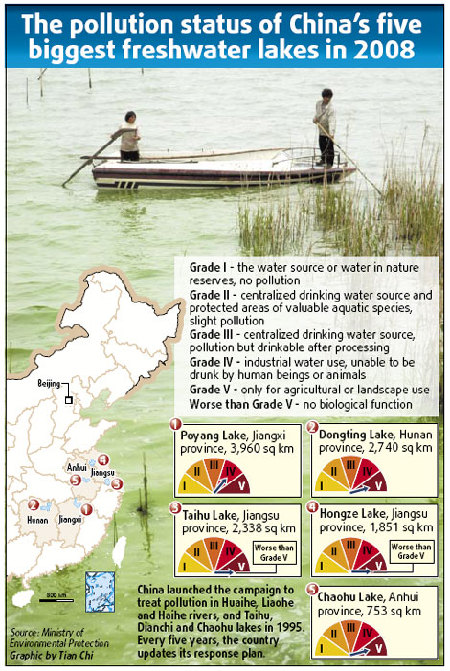
Authorities have devised an estimated 1,600 environmental projects aimed at restoring the ecosystem in Taihu, China's third largest freshwater lake, with an investment of 80 billion yuan before 2012 and a further 28 billion yuan between 2012 and 2020. It is considered a small price to pay for clean drinking water for millions in the Yangtze River Delta. Zhang Jing, a 26-year-old from Wuxi, said she will never forget the day two years ago when she awoke to find her tap water has been badly contaminated. "It stank," she said. "It was summer and the day was so hot and humid. What was worse, I really needed to feed my five-month-old baby." She later discovered the city's water intake from Taihu had been contaminated with blue-green algae and, along with 3 million fellow residents, was forced to rush out and buy bottled water before they all disappeared from the shelves. The desperate mother even had to wash her baby in bottled water - an extra expense and heavy burden for a family with a monthly income of just 3,000 yuan. "It was the first time in my life I realized how precious clean water is," she said. "Now I always store bottled water in time for summer, in case it happens again." Along the shore of the lake today, in both Suzhou or Wuxi, children laugh and play, anglers are fishing and young couples are having their wedding photos taken in front of reed marshes. It is hard to believe only two years ago there was a 30-50 cm layer of blue-green algae and debris floating on the water, giving out a foul stench. The only reminders are the men on boats working to remove algae or silt. Latest research by the National Development and Reform Commission shows the blue-green algae has been reduced by 73 percent from the level in 2007. Now about 20 million algae organisms live in every liter of lake water, compared to more than 100 million two years ago. Pollutants such as hypermanganate, nitrogen and phosphate have been reduced 20 percent since last year.
|
||||||
主站蜘蛛池模板: 清水县| 衡阳市| 湾仔区| 双鸭山市| 岢岚县| 辰溪县| 博兴县| 永城市| 通许县| 准格尔旗| 和林格尔县| 和静县| 大庆市| 石城县| 嘉兴市| 阿尔山市| 珲春市| 芦溪县| 建德市| 普洱| 车致| 安达市| 南江县| 沂水县| 台湾省| 新巴尔虎右旗| 和静县| 长武县| 东至县| 军事| 云林县| 扎鲁特旗| 莱阳市| 任丘市| 兰溪市| 张家界市| 南投市| 福建省| 肃宁县| 揭西县| 阿克| 武宁县| 桃江县| 平南县| 天全县| 麻江县| 达日县| 宁蒗| 临猗县| 遂昌县| 恭城| 且末县| 临澧县| 孟州市| 玛曲县| 抚远县| 当雄县| 赣榆县| 赤水市| 手游| 门源| 台东县| 五大连池市| 建始县| 岑巩县| 宜兰县| 定安县| 昌宁县| 夏津县| 孟连| 进贤县| 东乌珠穆沁旗| 开鲁县| 兴宁市| 鄂州市| 长宁县| 马公市| 定西市| 新宁县| 齐河县| 蚌埠市| 香河县|