CHINA> Regional

|
CHINA> Regional
|
|
Hoteliers from smaller cities gain from stimulus moves
By Ding Qingfen (China Daily)
Updated: 2009-07-18 10:05
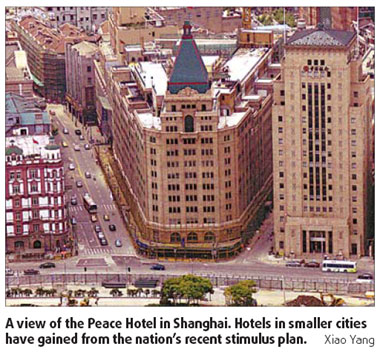
Hoteliers in secondary cities are benefiting more from China's stimulus measures, with larger markets in Beijing and Shanghai weighed down by past construction booms, said Jones Lang LaSalle Hotels on Friday. Tier-two and tier-three cities are benefiting from massive infrastructure spending, while the massive hotel expansion ahead of the 2008 Olympics saturated the Beijing market, said Andreas Flaig, Beijing-based managing director at the consultancy, a unit of Jones Lang LaSalle. From 2006 to 2008, the number of hotel rooms doubled in Beijing and will grow another 23 percent through 2011, said Flaig. That buildout has pushed occupancy rates in Beijing to 47 percent for five-star hotels, and 50 percent in the four-star market. "Once you drop below 50 percent occupancy, then you start to seriously impact the profitability of a hotel," said Flaig. "We are way off the 75 occupancy the city has enjoyed before."
"It is a reflection of the government stimulus and banks pumping in trillions of yuan," said Flaig. "Therefore, buying land to start new projects is easier now than six or nine months ago." Despite high expectations of post-Olympics demand, China's hotel sector was hit badly by the global economic crisis in 2008. Ten out of the 13 cities that the firm interviewed witnessed a decline in revenue per available room (RevPAR). In the five-star sector, occupancy rates for Beijing and Shanghai dropped by 7.2 and 10.4 percent from a year earlier to 60.7 and 56.3 percent. Occupancy rate of four-star hotels in the two cities fell by 13.4 and 8.5 percent to 60.9 and 59 percent. "The anticipated post-Olympic demand was hit badly by the economic crisis," said Lily Ng, senior vice-president, of Jones Lang LaSalle Hotels China. In 2008, international visitor arrivals to the Chinese mainland dropped by 1.4 percent to 130 million, but domestic visitor arrivals surged by 6.3 percent to 1.7 billion. That also explains why the second- and third-tier cities have outperformed Beijing and Shanghai. In 2008, the five-star RevPAR for cities and municipalities including Qingdao, Chengdu, Chongqing, Dalian, Xi'an and Shenyang rose by 37, 10, 14.4, 12.8, 16 and 1 percent, while it dropped by 7 and 3.4 percent for Beijing and Shanghai. Though the new room growth in Shanghai was just 17 percent last year, the city is expected to see a surge of nearly 47 percent over the next three years. "The supply has grown too much, but the demand has not kept pace," Flaig said. Compared with mature markets, China has enough luxury hotels at the moment, but it lacks mid-level hotels especially three- and four-star ones and this is where the opportunities are for hoteliers, he said. Reuters contributed to this story |
主站蜘蛛池模板: 克拉玛依市| 江西省| 江达县| 开鲁县| 白朗县| 宜兰县| 新绛县| 高尔夫| 黑河市| 沽源县| 磴口县| 富顺县| 永定县| 大丰市| 安陆市| 潼关县| 临朐县| 秭归县| 邹平县| 肇东市| 唐海县| 肃北| 美姑县| 丹寨县| 叶城县| 凤翔县| 乐业县| 靖州| 黄浦区| 灌云县| 儋州市| 舞钢市| 沙田区| 阿尔山市| 从化市| 青川县| 始兴县| 陈巴尔虎旗| 鄄城县| 湖州市| 江孜县| 苍溪县| 大荔县| 鹰潭市| 桐梓县| 永康市| 醴陵市| 饶平县| 桂林市| 盈江县| 邮箱| 丰宁| 津市市| 磐安县| 涪陵区| 新闻| 文山县| 濮阳市| 绥棱县| 宜兴市| 新田县| 鸡西市| 宁海县| 云浮市| 海口市| 巴青县| 滦南县| 巴青县| 镇康县| 岑巩县| 鄂州市| 仪征市| 永寿县| 浏阳市| 延庆县| 成都市| 博湖县| 依兰县| 松溪县| 渝中区| 辽中县| 南皮县|