CHINA> National

|
CHINA> National
|
|
Related
Tian'anmen in pictures: then and now
By Mu Qian (China Daily)
Updated: 2009-07-28 10:50
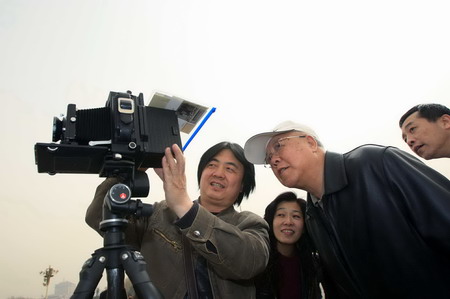
When photographer Hei Ming looks at pictures taken in front of the Tian'anmen Rostrum in the 1960s and now, one thing in particular strikes him. Photos taken during the "cultural revolution" (1966-76) often show people holding small books of quotations from former Chairman Mao Zedong, a daily necessity at that time. But when Hei invited them to take new pictures with the same poses, they substituted Mao's book with senior citizens' cards, mobile phones, bank passbooks or passports. "The unanimous ideology of Chairman Mao's book, which was almost a must in the past, has given way to various items like the mobile phone. It is obvious that Chinese people's thoughts and ways of living have become more diverse," Hei says. Hei, 45, is well known for his documentary photography series such as 100 monks and 100 educated youths. Technically, See You Again, Tian'anmen, is perhaps the simplest of all of his works, yet he regards the project as one of the most important in his career. He says the project gave him a chance to break through the limit of a certain group of people and to capture the changes of the country over the past 60 years. The project began five years ago, when Hei began to collect ordinary people's pictures taken before the Tian'anmen Rostrum, which is located in the heart of Beijing and long recognized as the political symbol of China. Having collected more than 500 such pictures, taken at various time from the 1940s to the 1980s, he tried to find those people in the pictures and asked them to come back to Tian'anmen and take new pictures.
"Tian'anmen is basically the most popular backdrop for Chinese people to take pictures. When you compare the new pictures with the old, you can see the changes in Chinese people and society in the last six decades, in a microscopic yet vivid way," he says. For most people who traveled to Beijing in the 1970s, a photo at Tian'anmen was among the most important things to do. "It was a great honor to have a picture taken with the backdrop of Tian'anmen. For us living in remote Xinjiang, the honor came with hardships," says Duan Li, a woman in her early 50s. When Duan, her sister and parents arrived in Beijing in 1972, they had spent seven days on a bus and train journey from their home in Altay, Xinjiang Uygur autonomous region. The first thing they did after checking into a small guesthouse was to go to Tian'anmen and take a picture together. "There was a long queue. We registered and paid the fee before we had the photo taken, and we wrote down our address on an envelope for them to mail the photo. The photographer was standing on a high wooden platform. The camera was fixed, and everybody was standing in fixed positions, with the same postures and expressions," she recalls. |
||||||
主站蜘蛛池模板: 遂川县| 晴隆县| 丰镇市| 双鸭山市| 习水县| 东兴市| 行唐县| 丘北县| 富顺县| 山东省| 云霄县| 北安市| 延川县| 汶川县| 甘德县| 沙洋县| 云安县| 潞城市| 台中市| 银川市| 宁国市| 襄樊市| 巴林左旗| 木兰县| 资中县| 泉州市| 离岛区| 鸡东县| 建德市| 古丈县| 禄劝| 沁水县| 龙海市| 永州市| 赫章县| 阳山县| 保靖县| 阿瓦提县| 郎溪县| 台北市| 滁州市| 正定县| 江山市| 和田县| 本溪市| 望谟县| 邳州市| 武川县| 余干县| 衡阳市| 五指山市| 年辖:市辖区| 林西县| 古浪县| 眉山市| 游戏| 桑日县| 阿巴嘎旗| 峨边| 阳谷县| 南郑县| 伊宁县| 靖州| 淳化县| 中方县| 同江市| 西峡县| 桃江县| 济源市| 德惠市| 手游| 保山市| 祁阳县| 黔东| 大埔县| 涞水县| 博白县| 都安| 德格县| 太仆寺旗| 潼南县| 银川市|