CHINA> National

|
CHINA> National
|
|
Monetary policy to remain unchanged
By Si Tingting and Li Jing (China Daily)
Updated: 2009-08-08 08:43 The government will not change its stimulus policies because it could derail its hard-won economic recovery, though record bank lending in the first half of the year has raised fears over credit risks and asset bubbles. "The central bank is still committed to a 'moderately loose monetary policy'," said Su Ning, deputy governor of the People's Bank of China (PBOC), at a press conference in Beijing on Friday.
The benchmark Shanghai Composite Index closed down 2.9 percent on Friday, slipping for a third day, after a PBOC announcement on Wednesday said it would "actively fine-tune policies" as the economy improves, raising fears that it could check liquidity. July's major growth figures will be released early next week, and investors are waiting to see more signs of a solid recovery. The country's banks have lent nearly 7.4 trillion yuan ($1.08 trillion) in the first half of the year - far higher than the initial full-year target of 5 trillion yuan. On the back of the unprecedented rise in credit, the Shanghai Composite Index has rallied about 80 percent this year and real estate prices have rebounded to record levels in some major cities. Some economists say much of the country's massive $586-billion stimulus package and record lending in the first half may not have been spent on real economic activities and created asset bubbles.
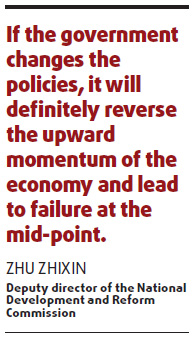
"How far the bubble will go depends on the government's liquidity policy," said Xie Guozhong, board member of Rosetta Stone Advisors. Zhang Jianguo, president of China Construction Bank, said on Thursday that the bank would cut lending by about 70 percent to 200 billion yuan in the second half to avert a surge in bad debt. But the government thinks differently about easing the monetary policy. "The PBOC did not use asset prices as a monetary policy target," Su said. The government's measures to fight recession have been by far the most successful in the world. "The PBOC has a package of tools to keep money supply in check," Su said. "There's no inflation at the moment." "The government's promise to maintain moderately loose monetary policy will boost market sentiment," said Zhao Xijun, deputy director of Financial and Securities Institute of the Renmin University of China. "I think investors have misread the PBOC's recent talk of dynamic fine-tuning which should mean slower credit growth rather than a decrease in credit supply," Zhao said in reaction to the recent fall in stock prices. "If the government changes the policies, it will definitely reverse the upward momentum of the economy and lead to failure at the mid-point," Zhu Zhixin, deputy director of the National Development and Reform Commission, said at the same press conference. To keep the country's recovery on track, Zhu said, the government would give private businesses more access to the market - in "monopoly industries", for instance. Profitable industries, such as electricity, telecommunication, petrochemicals and finance are largely closed to private investment, and the government still has a monopoly over education, healthcare and cultural industries, a recent All-China Federation of Finance and Commerce report said. |
主站蜘蛛池模板: 肇庆市| 凌海市| 信阳市| 呼伦贝尔市| 江津市| 宁国市| 长春市| 泽州县| 全南县| 潞西市| 法库县| 沾化县| 富宁县| 永修县| 石台县| 广灵县| 正安县| 平南县| 佳木斯市| 高碑店市| 怀安县| 宁乡县| 夏河县| 邛崃市| 临江市| 南乐县| 绵竹市| 新竹县| 大理市| 西平县| 五大连池市| 五莲县| 淮阳县| 霍林郭勒市| 获嘉县| 绿春县| 五指山市| 偃师市| 吐鲁番市| 洛浦县| 滨海县| 安达市| 新乡市| 清远市| 内丘县| 兴隆县| 土默特右旗| 崇仁县| 响水县| 开封县| 通榆县| 富川| 台山市| 梨树县| 临高县| 长宁区| 文昌市| 泾源县| 江源县| 金堂县| 大新县| 阿克陶县| 买车| 乾安县| 左云县| 桐乡市| 赣榆县| 焉耆| 肇源县| 汶上县| 襄垣县| 安多县| 常山县| 汾阳市| 淮滨县| 丹棱县| 平罗县| 古浪县| 苍南县| 全椒县| 松溪县| 固镇县|