CHINA> National

|
CHINA> National
|
|
Lessons to avoid human trafficking
By Chen Jia in Beijing and Li Yingqing in Kunming (China Daily)
Updated: 2009-08-20 08:00 * From 30,000 to 60,000 children are reported as missing every year. Migrant workers are getting free classes warning them about the dangers of child abduction and human trafficking, said an official with the Ministry of Public Security.
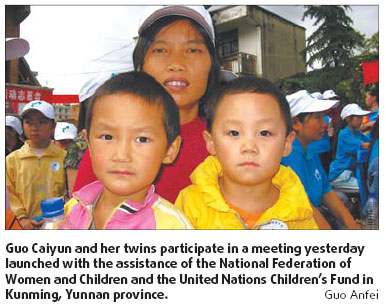 In an exclusive interview with China Daily, Yang Dong, deputy chief of the criminal investigation department, revealed that free classes on protecting children would be offered to migrant workers. "Only a few missing persons cases would turn in to trafficking cases if we could get more cooperation from the community and if migrant families could provide more information to help trace the children before they are too far away," Yang said. From 30,000 to 60,000 children are reported as missing every year, but it is hard to estimate how many trafficking cases that includes, he said. The pilot project, launched yesterday with the assistance of the National Federation of Women and Children (NFWC) and the United Nations Children's Fund(UNICEF), will be conducted in the villages of Kunming, Yunnan province and Dongguan, Guangdong province.
The classes are part of a national crackdown on human trafficking launched in April, and if successful, they will be rolled out across the country. "I might have lost my 4-year-old twins if I decided to work full time," Guo Caiyun, a 35-year-old housewife who moved to Kunming of Yunnan province months ago, told China Daily yesterday. "I want to earn more money to support my husband to finish his postgraduate study in Yunnan University, but I changed my mind after participating in the community lessons," she said. Guo is among the increasing number of migrants in the country whose children face a greater risk of abduction. "Isolated living conditions in big cities cause urban people not to care about the floating population of migrants living in neighboring houses people do nothing even if they have doubts about strangers who talk with neighbors' children," said Guo Ye, the chief of the division of complaints and appeals under the NFWC. "In rural areas the situation gets worse, as people don't always cooperate with police," he said. Lei Meihua, a senior official with the provincial department of NFWC in Guangdong, told China Daily more than 60 percent of the population in Dongguan are migrant workers, and most work for local factories. "That's why we need to encourage local entrepreneurs to join in our program," she said. Bi Yonghong, a 39-year-old landlord in Shageng village of Kunming, told China Daily yesterday she promised to cooperate with the program. "A missing child is a tragedy for any family, so I have the social responsibility to do a favor for my tenants if they are unaware about children's safety," she said. To combat child trafficking, the Ministry of Public Security also set up a DNA database to link all the country's 236 DNA laboratories so they can share information. The database includes DNA of missing children, given by their parents, and samples will be taken from children suspected of having been abducted or vagrant children with an unclear history. "The national DNA database is particularly helpful for the big migrant population," lawyer Zhang Zhiwei, a volunteer with grassroots NGO Baby Come Home, told China Daily. |
主站蜘蛛池模板: 鹤山市| 罗江县| 涿州市| 调兵山市| 太仆寺旗| 北海市| 合水县| 深泽县| 南木林县| 八宿县| 西安市| 哈尔滨市| 社会| 宁乡县| 营口市| 镇原县| 松桃| 宕昌县| 凤翔县| 邵阳市| 宝兴县| 梅州市| 安塞县| 天祝| 渝北区| 清远市| 常熟市| 上饶市| 房山区| 惠安县| 武乡县| 桃源县| 达拉特旗| 民乐县| 建湖县| 英山县| 马公市| 丰宁| 合山市| 公安县| 崇明县| 溧阳市| 玉门市| 乌兰浩特市| 淮北市| 且末县| 河北省| 富民县| 当涂县| 庆阳市| 武宁县| 南溪县| 望江县| 吉安市| 丰县| 沙洋县| 四子王旗| 新闻| 翼城县| 富裕县| 长泰县| 黄骅市| 东莞市| 桦川县| 威信县| 凉城县| 蓬安县| 承德市| 远安县| 三穗县| 额敏县| 明光市| 华宁县| 萨迦县| 茂名市| 扶风县| 闽清县| 漯河市| 北辰区| 湖口县| 阜平县| 新乡市|



