CHINA> Focus

|
CHINA> Focus
|
|
Rewriting the rules of language triggers controversy
By Chen Siwu (China Features)
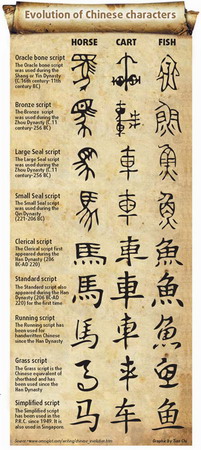
Updated: 2009-08-28 10:29 But the history of the ideographic Chinese language dates back even further, with archaeologists believing it could have been in use more than 3,400 years ago.
Its origins are shrouded in mystery, with legends including how Cang Jie, a minister for the Emperor Huang Di, drew pictures of objects and animals then simplified them by reducing the number of lines. These were the first pictographs, called "xiang xing" by the Han lexicographer Xu Shen (AD 30-124). The earliest recognisable examples of written Chinese date from the Shang Dynasty (c.16th century-11th century BC) and were inscribed on ox bone and turtle shells. The script on these were known as "shell bone writing" or "oracle bone script" (Jiaguwen). Following the introduction of kai shu, or standard script, between AD 200 and 600, there was no further formal development. However, as the system allows the creation pf new characters, the language has continued to evolve. Unlike phonetic symbols in English and Latin, Chinese characters are arranged and combined together by basic character components, or radicals. There are two ways of writing and printing Chinese: traditional characters that are used in regions including Taiwan, Hong Kong and Macao, and simplified characters that are used on the Chinese mainland and in Singapore. Traditional characters usually contain more strokes than simplified ones, which were introduced on the Chinese mainland following the founding of the People's Republic of China in 1949. The central government began simplifying characters to help more people out of illiteracy and encourage education. The Ministry of Education unveiled its wide-ranging reforms with the simplified characters in November 1956. Officials attempted to further simplify them in 1977 but, after nine years of trials, the plan was dropped, mainly due to many of the revised characters caused confusion.
Despite the opposition, Professor Wang assured that the ministry and State Language Commission are not against the public, and added: "We are listening to the public sincerely before coming up with a report for the ministry to decide." However, with a ton of gold currently only worth about 200 million yuan, the old Chinese saying may also need to be revised. Wang Ruoyao and Li Jianmin contributed to the story
|
|||||||
主站蜘蛛池模板: 永康市| 鹤山市| 阳春市| 绥滨县| 赤峰市| 芜湖县| 怀来县| 界首市| 和静县| 开平市| 涿州市| 安义县| 淳化县| 广饶县| 华宁县| 临泽县| 昭觉县| 神木县| 离岛区| 巨鹿县| 沈丘县| 大悟县| 晋州市| 丹江口市| 综艺| 左云县| 马龙县| 江阴市| 阳城县| 尉氏县| 普陀区| 囊谦县| 呼图壁县| 越西县| 青岛市| 高淳县| 巫山县| 东乌珠穆沁旗| 舞阳县| 方山县| 宁乡县| 大石桥市| 临颍县| 察雅县| 军事| 澄迈县| 信阳市| 丘北县| 巍山| 永靖县| 东山县| 兴和县| 聂拉木县| 永春县| 康乐县| 雅江县| 扎兰屯市| 正安县| 随州市| 宣城市| 玛纳斯县| 雅江县| 松江区| 万宁市| 库车县| 常德市| 石阡县| 台东市| 清新县| 凤庆县| 辽宁省| 乌鲁木齐县| 阿城市| 大英县| 新泰市| 东至县| 台山市| 剑河县| 和田市| 无为县| 康平县| 五大连池市|