CHINA> National

|
CHINA> National
|
|
Related
China strives to launch space labs
By Xin Dingding (China Daily)
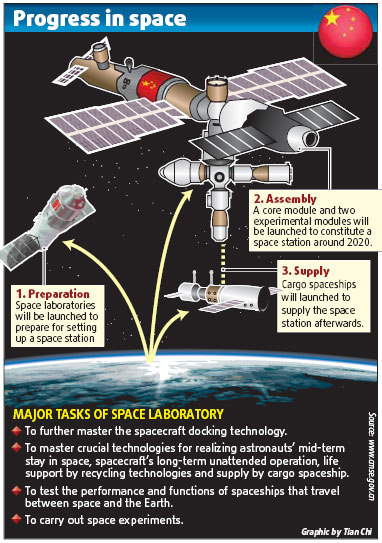
Updated: 2009-09-01 09:09 Two to three space laboratories may be launched by China between 2010 and 2015, roughly less than a decade before the nation embarks upon a space station in 2020, a top scientist said.
Gu Yidong, former chief commander and a designer for China's manned space program, said that space laboratories will be docked on a number of spaceships to test for accurate docking technology. He made the remarks at an annual academic meeting of the Chinese Society of Space Research in Dalian over the weekend. The docking technology is an important feature that China must master before moving forward with the construction of a space station. Any miscalculations during a docking could lead to the collision of spacecraft, according to the official website of China's manned space program, cmse.gov.cn. In addition to the docking technology, China also needs to achieve technological breakthroughs in the length of stay in space for astronauts, the long-term unattended operation of a spacecraft and transferring supplies by cargo spacecraft, according to the website. China is now in the second phase of a three-step plan that the nation drafted to carry out its manned space program.
Two unmanned spaceships and five manned spaceships will also be launched during the phase to dock on the Tiangong crafts to test the docking technology. As for the future space station, Gu Yidong said the core module of the space station will be launched from Hainan in the new launching center, which is currently under construction. And the cargo spaceship will be launched from the existing launching center in Jiuquan, northwest China's Gansu province, to provide supplies to the space station each year, Gu said. Pang Zhihao, researcher and deputy editor-in-chief of the monthly Space International, said yesterday that China now faces several difficulties in launching the space laboratories. "Difficulties include developing a large launching vehicle, and solving the life support and temperature control problems," he said. Providing a larger space and a longer operation time, a space station can enable the exploration of space for a longer amount of time, which spaceships cannot currently achieve, he said. Chinese astronauts have already carried out extravehicular activity during the Shenzhou VII mission last year, signaling a good start of the manned space program's second phase. The next move expected will be the launch of Tiangong I, or Heavenly Palace I, scheduled at the end of 2010 or at the beginning of 2011, Xinhua News Agency reported earlier. Qi Faren, chief designer of the Shenzhou spacecraft, told China Daily in March that Shenzhou VIII, Shenzhou IX and Shenzhou X will dock with Tiangong I to test the docking technology. If Shenzhou VIII, an unmanned spaceship, successfully docks with Tiangong I in 2011 as planned, manned spaceships will be launched to dock with Tiangong I. Then efforts will follow to improve Tiangong I and develop space laboratories, Qi said.
|
主站蜘蛛池模板: 德令哈市| 寻甸| 邯郸县| 冀州市| 建阳市| 珠海市| 宁都县| 岱山县| 互助| 黔东| 怀仁县| 定日县| 西城区| 嘉禾县| 湄潭县| 潜江市| 内江市| 山东省| 眉山市| 江都市| 安庆市| 栾城县| 曲麻莱县| 菏泽市| 长乐市| 白玉县| 广南县| 香河县| 贞丰县| 西乌珠穆沁旗| 望都县| 尚义县| 湖州市| 巫溪县| 越西县| 衡阳市| 星座| 申扎县| 东丰县| 察雅县| 东乡| 新干县| 黑山县| 桂平市| 嘉峪关市| 泗水县| 巩义市| 罗田县| 陆河县| 庆城县| 庆元县| 图们市| SHOW| 甘德县| 招远市| 山阳县| 崇仁县| 彭山县| 友谊县| 汉源县| 英超| 吉林市| 凌云县| 大姚县| 琼海市| 临湘市| 德庆县| 宁城县| 北安市| 桑日县| 彭山县| 新疆| 永寿县| 丰城市| 陇西县| 五河县| 襄城县| 萨嘎县| 大悟县| 邵阳县| 仙游县| 海门市|