CHINA> National

|
CHINA> National
|
|
China limits metal exports to boost price
By Xin Dingding (China Daily)
Updated: 2009-09-03 08:12
Rare earth metals, a collection of 17 different chemical elements, are used in superconductors, hybrid cars and other high-tech devices. China now produces 95 percent of the world's rare earth metals, with 75 percent of that coming from Inner Mongolia, AP reported Wednesday.
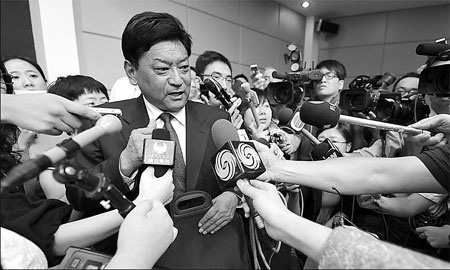
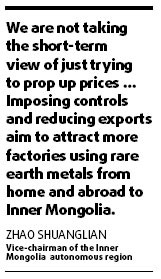
Production at high-quality ore mines will be limited to avoid over-exploitation and protect the resources, Zhao Shuanglian, vice-chairman of the autonomous region, said a joint press conference in Beijing Wednesday involving the five autonomous regions. "We are not taking the short-term view of just trying to prop up prices Imposing controls and reducing exports aim to attract more factories using rare earth metals from home and abroad to Inner Mongolia," he said. In each of the last three years, China has reduced the amount of rare earth metals that can be exported. Manufacturers in other countries that use the metals to make high-density magnets, low-energy light bulbs, computer disk drives, electric motors, lasers and catalytic converters are worried about the curb on exports. Toyota officials reportedly expressed strong concern on Sunday about the availability of the rare metals, since demand is surging for hybrid vehicles and wind turbines, the New York Times reported on Tuesday. The electric motor in a Prius, for example, requires two to four pounds of neodymium, said Dudley Kingsnorth, a consultant in Perth, Australia, it reported. But according to a Xinhua News Agency report citing Xu Guangxian, academician of Chinese Academy of Sciences, Japan has enough reserves of rare earth metals to last for two decades. The huge reserves also give Japan a say in the price, since it stops importing and uses reserves when the price rises, Xu said.
Xu previously suggested that the central government should spend $1 billion each year to store rare metals when the price is low. The autonomous region government is also trying to revamp the industry in western China by merging smaller companies into the Baogang Rare Earth Corporation, he said. The mushrooming of small-scale producers in the past few years has led to a production capacity in China of 120,000 to 150,000 tons per year, higher than the global demand of 100,000 tons, according to Xu. "Many of these producers would rather sacrifice the export price than stop production," Zhang Peicheng, director of Rare Earth Research Institute under Baogang Group, told China Daily Wednesday. As a result, the prices of some rare earth metals have become unreasonably low. According Xu's estimate, the current price of rare earths oxide equals the levels before 1985. Xinjiang tourism A senior official of the Xinjiang Uygur autonomous regional government said Wednesday at the press conference that tourism is gradually recovering from the deadly July 5 riots and it will reach a "new peak" during the National Day holiday next month. Kuresh Mahsut, vice chairman of the regional government, said the riot in the regional capital of Urumqi, in which 197 people were killed and 1,600 injured, seriously affected Xinjiang's tourism industry. "The situation is stabilizing and tourism is recovering as was demonstrated by the successful hosting of the 18th Urumqi Trade Fair, which opened in Urumqi on Monday," he said at a press conference. "There was no decrease in the number of participants at the fair. In addition to those previously registered, business people came from other countries and regions," he said. More than 500 businessmen from 29 countries and regions including Russia, Kazakhstan and Uzbekistan, and business delegations from 21 provinces, municipalities and autonomous regions across China attended the trade fair. The five-day trade fair, China's only business event targeting central, west and south Asia, has more than 2,000 exhibition booths. Last year, the exhibition area was 18,800 sq m. The tourism industry contributes 6 to 7 percent of Xinjiang's gross domestic product and is an important source of income for residents. To revive the industry, the regional tourism authority has sought a 5-million-yuan ($731,900) subsidy from the regional government to help travel agencies survive. The annual Urumqi Trade Fair first started in 1992. The total value of contracts signed with overseas businessmen at the fair in the past 17 years has reached $31.7 billion. Xinhua and AP contributed to the story |
主站蜘蛛池模板: 钟山县| 彭阳县| 郯城县| 左云县| 元氏县| 华安县| 洛浦县| 沙洋县| 华池县| 尚义县| 海宁市| 钦州市| 汉中市| 镇江市| 永修县| 平湖市| 新疆| 鹤岗市| 岱山县| 广平县| 渭南市| 湖南省| 定南县| 普洱| 桐柏县| 含山县| 福泉市| 沿河| 宿迁市| 广饶县| 曲沃县| 闻喜县| 新干县| 建湖县| 莫力| 措勤县| 马尔康县| 泸定县| 龙江县| 秦安县| 新津县| 漠河县| 田林县| 佛坪县| 铜山县| 广安市| 西安市| 吴川市| 井研县| 洛南县| 潮安县| 东兴市| 慈利县| 萨迦县| 图木舒克市| 赣州市| 柳江县| 宝清县| 乌恰县| 厦门市| 浦县| 美姑县| 延庆县| 北宁市| 赣州市| 朝阳区| 藁城市| 金寨县| 嘉兴市| 调兵山市| 衡水市| 怀柔区| 昌宁县| 漳州市| 南阳市| 剑河县| 海阳市| 阿克| 景宁| 安国市| 辽阳市| 阳原县|