CHINA> National

|
CHINA> National
|
|
Party meets to build democracy, fight corruption
By Xie Yu (China Daily)
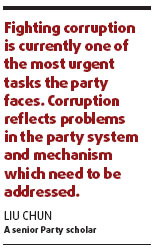
Updated: 2009-09-16 07:23 Intra-party democracy and the fight against corruption are expected to headline discussions at a key annual meeting of the Communist Party of China (CPC) this week. "Fighting corruption is currently one of the most urgent tasks the party faces," Liu Chun, deputy dean of the Graduate Institute of the Party School of the CPC Central Committee, told China Daily Tuesday.
"Corruption reflects problems in the party system and mechanism which need to be addressed." Some 200 members of the 17th CPC Central Committee began its annual meeting Tuesday, which is aimed at strengthening ways to build the party to address social and economic challenges amid the fast-growing economy. The closed-door session will last until Friday. It is widely seen as a significant event two weeks before the 60th anniversary of the founding of the People's Republic of China. According to Xinhua News Agency, the public is expecting policies to benefit people's livelihood, measures to curb corruption, more strict measures to govern the party and more capable leaders with noble morality. The CPC Central Committee meets in these full sessions usually once a year to endorse policy directions.
Latest statistics show that by the end of 2008 there were nearly 76 million CPC members in China, 17 times of the number in 1949. In each of the past six years, some 50,000 officials have been convicted of corruption, the Beijing-based Legal Evening News reported, citing an anti-corruption research. The average size of bribes for each official rose from 2.5 million yuan ($365,000) in 2007 to 8.8 million yuan last year, the newspaper said. The CPC Central Committee and the central government issued regulations in 1995 and in 2001 requiring officials to declare their income, but these were limited to officials' salaries and allowances, and the information was not made available to the public or the media. There have been recent calls requiring party cadres to make their family assets public, especially for high ranking officials. Earlier this year, Premier Wen Jiabao triggered public anticipation for a "sunshine law" targeting government officials during his debut Web chat, saying his government was making "active preparation" for officials to declare their assets as part of efforts to promote transparency. The Outlook Weekly magazine run by the Xinhua News Agency referred to this in an article on July 27, saying: "There is reason to believe that the Fourth Plenum will meet society's expectations to come up with these new measures." Signs of democratic reform became evident in the grassroots of the CPC, as it made "Party building" its top priority at the plenum. Wang Qi, head of the organization department of the Nanjing city committee of the CPC, said direct elections had been carried out this year in CPC committees in 363 neighborhoods in Nanjing, capital of east China's Jiangsu province. "The time is ripe to extend democratic reform to the city level, which will be the first time in the CPC's rule," he said. He did not give a specific schedule for such elections. A direct election was carried out in one neighborhood in 2004 in Nanjing, the city chosen to pioneer intra-Party democracy, with direct elections as one of its forms of implementation. The move is considered a significant sign to boost the CPC's desire to advance its internal democracy, which is anticipated will drive ahead the building of democracy in Chinese society, said Cai Xia, a professor with the Party School of the CPC Central Committee. "To a great extent, the progress of China's political reform rests with the development of the CPC's intra-Party democratic reform, which is essential to optimize Party organization," Cai said. "It is imperative the Party reform its highly centralized organization into a democratic, institutionalized system to catch up with profound social change," she said. At the 16th National Congress of the CPC in 2002, intra-Party democracy was stressed as the lifeblood of the Party, said Yu Keping, a well-known political commentator and deputy director of the Central Compilation and Translation Bureau. The democratic reform aimed to empower individual Party members and increase transparency and intra-Party supervision, he said. He noted the word "democracy" had appeared more than 60 times in Hu Jintao's report to the 17th CPC National Congress on Oct 15, 2007. "We will expand intra-Party democracy to develop people's democracy and increase intra-Party harmony to promote social harmony," Hu, the Party's top leader, said at the congress. Professor Cai said democracy has the inherent nature of growth. "Once it is unleashed, we can only go forward and never back," she said. She advised the Party to set up a high-level institution to monitor progress, as intra-Party democratic reform has been carried out at preliminary levels step by step. "The institution can plan strategy and make timely corrections if problems appear," she said. Xinhua contributed to the story |
|||||||
主站蜘蛛池模板: 东兴市| 阳泉市| 甘肃省| 历史| 苏州市| 稻城县| 昌都县| 广宁县| 阿荣旗| 开阳县| 比如县| 许昌县| 昌乐县| 三江| 凉城县| 东莞市| 田阳县| 武鸣县| 洛阳市| 黔西县| 东海县| 富源县| 黔江区| 济宁市| 曲沃县| 揭阳市| 山西省| 营口市| 富宁县| 廉江市| 项城市| 大新县| 江永县| 永昌县| 延安市| 临夏市| 北流市| 汨罗市| 丰宁| 兴山县| 吉木乃县| 黎城县| 郓城县| 彝良县| 加查县| 西城区| 巴彦淖尔市| 永仁县| 曲沃县| 屏山县| 高密市| 任丘市| 逊克县| 凭祥市| 长宁区| 饶平县| 安达市| 宁波市| 东方市| 横山县| 虹口区| 武强县| 泸西县| 大足县| 筠连县| 财经| 桑日县| 岗巴县| 青浦区| 思茅市| 监利县| 巴青县| 平定县| 丹东市| 阳东县| 西贡区| 如东县| 平潭县| 宕昌县| 全椒县| 胶南市| 南安市|