CHINA> Focus

|
CHINA> Focus
|
|
Race is on to halt trade war
By Mark Hughes, Si Tingting and Yu Tianyu (China Daily)
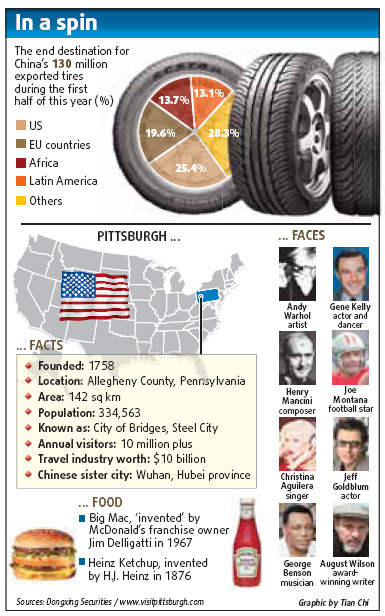
Updated: 2009-09-24 07:38 United States President Barack Obama selected Pittsburgh as the venue for this week's Group of 20 (G20) summit because it is a shining beacon of regeneration.
When the steel industry from which it grew imploded in the 1970s and 80s, it survived and thrived by shifting its economic base to healthcare, technology and financial services. The second largest city in the state of Pennsylvania and just over 300 km from Washington, it has also weathered the recent global financial meltdown, adding jobs when most have been shedding them. World leaders are desperate to know the secret to Pittsburgh's success but, when they gather today and tomorrow for the first time since the London G20 talks in April, there will be an elephant in the room. If ignored, it could mean resolutions from the summit may prove flawed and, at a time when the global economy is showing signs of recovery, there is much at stake. The "elephant" is protectionism and it made its appearance following Obama's decision on Sept 11 to approve raising the tariff on all passenger vehicle and light truck tires imported from China for three years. The move answered calls by US unions, who blamed the growth in imports of Chinese-made tires for the loss of thousands of jobs. China reacted angrily, claiming the move violated rules set down by the World Trade Organization (WTO). Yao Jian, spokesman of the Ministry of Commerce, accused the Obama administration of acting without sufficient proof and bowing before domestic protectionist forces.
Beijing also filed a complaint on the new tariffs with the WTO on Sept 14, starting a 60-day period of negotiations between the two sides. If that fails, China can request a WTO probe and ruling. What happens after that is anyone's guess, but some fear the worst. "This step ... sends the wrong trade protectionist signal to the world," said Yao. "Although the world economy has shown positive developments, the outlook for revival remains tortuous, and rampant trade protectionism can only delay the course of recovery." The greatest fear about the tariffs is the danger they could spread to other industries, with the WTO already investigating a ban by the White House on Chinese poultry imports. China is the largest chicken export market for the US, generating $722 million last year and $393 million in the first seven months of this year. The nation exports about 20 percent of its annual chicken production, worth an estimated $5 billion. Before the tire tariff was announced, the US denied allegations by Beijing its poultry firms were receiving government subsidies and selling products, mainly chicken feet, below market prices in China. The situation is grave, according to Hubert Tse, an Australian lawyer based in Shanghai who specializes in foreign direct investment and mergers and acquisitions. "China nor the US want to get into a trade war. It's not in their interests, but many people around the world fear the tariff could lead to strong retaliatory actions from China," said Tse. "There are a lot of companies in China and the US watching the development of this dispute, as well as the probe into pricing of US chicken and auto products, very closely because the situation might prompt US producers of steel, apparel or other goods to file similar safeguard complaints against Chinese imports. "Companies don't want to be caught up in this as it will hurt sales in what is already a very challenging global environment but there are a lot of people out there who want to see China retaliate against the tariff hike to warn the US about playing fair in global trade." Eswar Prasad, a professor in trade policy at Cornell University, New York, and a former head of the International Monetary Fund's China desk, agreed. "A trade war between these two major economies could disrupt the world trading system and stall the fragile global economic recovery. Heightened trade tensions could also hinder progress on important multilateral initiatives, including tackling climate change and promoting reform of the international financial institutions," he said. The effects of the tariff are already being felt in China, not least by workers at the nation's tire molding plants. Hangzhou Zhongce Rubber Co Ltd employs around 20,000 staff at its factory in the capital of Zhejiang province but bosses say they plan to make 5 percent redundant because of the duty hike. Zhou Xiaojun, 37, who has worked at the plant for nine years, lives with his wife and 11-year-old son in the suburbs in a 9-sq-m room that costs 400 yuan ($60) a month to rent. "My son is studying at primary school now but I will need more money to support his education in the future," he said. "I know there will be job cuts because of this distant dispute. At my age, it would be difficult to find another job that is as stable as my current one. "No one will benefit from this dispute. It hurts Chinese people and also US consumers." Minsitry of Commerce spokesman Yao said: "The US trade relationship is one of China's most important and the ministry's priority is to promote and further develop it." He promised China would take measures, including making use of the China-US Joint Commission on Commerce and Trade meeting next month, to resolve the friction. China and the US are each other's second largest trade partners. China-based tire manufacturers want tax cuts to help soften the blow of the new tariffs, while firms have "reached a consensus to raise prices on tire exports to the US by large margins", said Zhou Zhiyong, general manager of Guangzhou Huanan Rubber Tire Co Ltd, China's largest tire exporter. |
|||||||
主站蜘蛛池模板: 灵台县| 江津市| 新郑市| 安岳县| 新兴县| 新营市| 都江堰市| 沾化县| 陇西县| 双江| 景泰县| 修武县| 黑山县| 赫章县| 重庆市| 望城县| 手机| 临江市| 儋州市| 潮州市| 望江县| 中西区| 昆明市| 永靖县| 沿河| 积石山| 南江县| 通山县| 安仁县| 交口县| 民乐县| 永安市| 黄骅市| 长宁县| 新宾| 辽阳市| 宣城市| 梅河口市| 林西县| 万载县| 渝北区| 宁波市| 沈阳市| 柞水县| 汕头市| 怀集县| 长白| 芦溪县| 湟源县| 庆安县| 安福县| 泌阳县| 平安县| 米易县| 丹寨县| 康马县| 卢氏县| 芜湖市| 济阳县| 金沙县| 新乡县| 鄂托克前旗| 绍兴市| 得荣县| 合肥市| 福清市| 治县。| 麻栗坡县| 建始县| 牡丹江市| 大连市| 铜陵市| 怀安县| 阿坝| 大城县| 台南市| 玛沁县| 罗定市| 法库县| 晋宁县| 聂拉木县| 芮城县|