CHINA> National

|
CHINA> National
|
|
Mao revered as China hails diamond jubilee
(Xinhua)
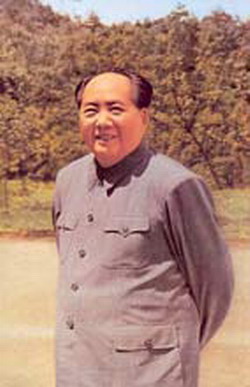
Updated: 2009-10-01 09:07 Mao remembered as New China hails 60th founding anniversary BEIJING: Tian'anmen Square turns into a sea of colors and joy Thursday morning as a grand parade is set to proceed. In the Memorial Hall of Chairman Mao Zedong, peace and tranquility prevail as usual. Sixty years has passed since much-revered Chairman Mao announced on Tian'anmen Rostrum the official establishment of the People's Republic of China. His declaration to the world "The Chinese people have stood up" is now, more than ever before, truly echoed and felt in the country with a population of more than 1.3 billion as it becomes increasingly influential amid rapid economic and social progress.
Mao's gigantic portrait on the front of Tian'anmen Rostrum still overlooks Chang'an Avenue, where 13 military reviews have been taken place over the past six decades, and Tian'anmen Square, the world's largest urban square where throngs of visitors never escape a eye contact with the portrait upon entry. The eclipse of time affects little to change people's admiration for the founding father. Mao badges, posters and statues are found across the country. The memorial hall, which is located at the heart of the Chinese capital, draws millions of visitors each year. People born after the founding of New China account for large percentage of the army of visitors. Wang Yuhua, who was born in 1978 in eastern Jiangxi Province, the birthplace of the Chinese Red Army, said his 65-year-old father had deep gratitude for the great leader. "The first thing my father did after he came to Beijing was asking me to bring him immediately to the Memorial Hall of Chairman Mao Zedong," she says. She can still recall their visit before the National Day. Upon entry to the hall, people flow in quietly and in respect, mothers hush their children, youngsters turn off their cell phones.
In the room where Mao's remains are kept, two soldiers stand solemnly to guard Mao's coffin. Mao's remains are laid under a sickle-and-hammer red flag of the Communist Party of China. Mao was born in 1893 in a farmer's family. He died in 1976. Despite his mistakes in his late years, especially in the chaotic Cultural Revolution (1966-76) that brought China to the verge of collapse, his thoughts has spread to many parts of the world. Wang says her father used to pass down his gratitude for Mao and Mao's stories to her when she was a primary school student. She says she will tell Mao's stories to her son when he grows up. Chen Jiashun, a 70-year-old retiree in southwest China's Chongqing Municipality, says he feels lucky as he had a chance to travel thousands of miles in late 1990s to go to the memorial hall and pay his tribute to Chairman Mao. And he wants to bring his wife to the memorial hall one day to fulfill her wish of visiting the great leader. Mao's influence is still felt today, not only as a seasoned military strategist, philosopher and statesman, but also as a poet and calligrapher. Zhao Shouye, a villager in Wenling City of eastern Zhejiang Province, spent more than one month to write on a 75-meter-long drawing paper a calligraphy masterpiece featuring Mao's poetry ahead of the National Day. For Mao's descendant, the National Day is an occasion for reminiscence. "More than ten people in the Mao family sacrificed their lives to the revolutionary cause for the founding of New China. When it comes to National Day, I miss them more," the Guangzhou Daily quoted Mao Xinyu, grandson of Mao Zedong, as saying on September 26. |
主站蜘蛛池模板: 嘉善县| 措美县| 黑龙江省| 盱眙县| 潢川县| 锡林郭勒盟| 永善县| 梅河口市| 凤山县| 江陵县| 雷州市| 乌兰浩特市| 新蔡县| 竹山县| 绥中县| 屏东县| 南丰县| 积石山| 东平县| 正宁县| 门源| 黄骅市| 武强县| 汝州市| 遂溪县| 公主岭市| 扎赉特旗| 康乐县| 阳东县| 缙云县| 中宁县| 常山县| 大荔县| 安龙县| 喀喇沁旗| 长阳| 台南市| 白城市| 登封市| 班戈县| 惠来县| 平利县| 庆阳市| 西和县| 九龙坡区| 延长县| 通许县| 桐柏县| 长春市| 揭西县| 房产| 乌海市| 喜德县| 镇安县| 清水县| 沁水县| 红桥区| 四子王旗| 太仆寺旗| 滨海县| 天水市| 泸州市| 宜兴市| 琼结县| 辉县市| 抚远县| 万盛区| 报价| 周口市| 祁连县| 淄博市| 贵溪市| 开江县| 松滋市| 梅州市| 襄城县| 横峰县| 辰溪县| 准格尔旗| 镇雄县| 和龙市| 大姚县|