CHINA> Focus


|
CHINA> Focus
|
|
Terracotta Warriors Discovery transform finder's lives
(Xinhua)
Updated: 2009-10-13 10:58 Terracotta army divisions The army has been a source of resentment among local people, too. Three farmers, who were among those digging the well 35 years ago, submitted a request to the Museum of Terracotta Warriors and Horses in 2003, asking the establishment to issue them a certificate to confirm them as the discoverers of terracotta army. One of the three, Yang Xinman, 71, says, "The museum only says in the introduction that the terracotta warriors and horses were discovered by local farmers digging a well. They should add our names to the introduction."
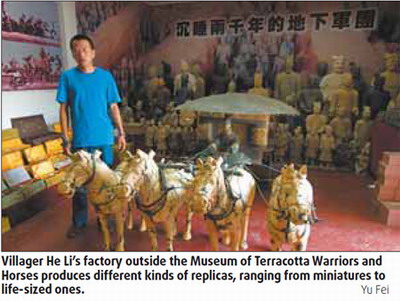
But they ended up with nothing, because China has no law requiring official recognition of cultural relics' discoverers. Nobody can say for sure how many people were working on the well, but Yang Zhifa's fame and earnings have made the other farmers envious. Another key figure in the discovery was very angry at the farmers' request. Zhao Kangmin, whose name is rarely heard, was the first to realize the true value of the terracotta fragments. He was also the first to reconstruct the warriors and horses. "What they want is money," said Zhao, who has retired from his post of curator of the Lintong Museum in Lintong town. "Seeing doesn't mean discovering. The farmers saw the terracotta fragments, but they didn't know they were cultural relics, and they even broke them," the 74-year-old says. "It was me who stopped the damage, collected the fragments and reconstructed the first terracotta warrior." The elderly man goes to the Lintong Museum every day. He sits in a dark display room, autographing postcards beside four terracotta warriors and a horse that he reconstructed 35 years ago. But the tourists visiting this small museum are not as generous as those in the Museum of Terracotta Warriors and Horses. Few want to pay 15 yuan for a set of postcards. Unlike Yang Zhifa, who only signs his name on books, Zhao writes. "Zhao Kangmin, the first discoverer, restorer, appreciator, name-giver and excavator of the terracotta warriors." Zhao was a Lintong county official responsible for cultural relics when he learned that a large number of terracotta fragments had been found. He rushed to the site and was surprised to see fragments of heads, torsos, arms and legs. Zhao asked the farmers to collect them and pile them into three trucks, which took them to Lintong Museum. He began to reconstruct the statues from the thousands of fragments, some of which were as small as a fingernail. While he was undertaking this task, Xinhua News Agency journalist Lin Anwen heard the news and came to see the find. His report roused the interest of China's leaders, who sent an archaeological team to do the excavation. During the dig, archaeologists found 30 tombs dating to different periods spanning the past 2,000 years, indicating that the terracotta warriors and horses could have been "seen" at least 30 times in history. But the army kept its secret secure for two millennia. Tea and clones The first emperor of China's feudal dynasties, Qin Shihuang (founder of the Qin Dynasty, 221-206 BC), hoped the underground army would protect his mausoleum forever. Ironically, the real beneficiaries are the local people 2,000 years later. Since its discovery, the terracotta army has attracted almost 60 million visitors. A saying in the new village outside of the museum goes: "Don't forget the Communist Party who liberated us. Don't forget Qin Shihuang who made us prosperous." The settlement's two-story houses with white walls and gray tiles were designed by the local government and built by villagers from 2003 to 2005. About 500 people from 200 families have moved into the new village to protect the environment around Qin Shihuang's mausoleum. Every family has telephone access, and more than 10 percent have broadband Internet access. Seven families in the village own factories and stores producing and selling terracotta warrior and horse replicas, and 38 families have opened farmhouse restaurants and hotels. About half of the villagers make and sell souvenirs. He Li, owner of a restaurant and a souvenir production factory, treats guests with tea ceremonies in his home. The 48-year-old's living room is decorated with tea sets and art. The darkness of his skin is the only sign he once worked in the fields. He was 14 when the terracotta warriors and horses were found. Every family in the village was poor at that time. The teenager went to the site and found "nothing interesting". He worked in the museum's cinema in the 1980s. When he saw many tourists buying replicas, he thought that producing and selling such items might be good business. He set up a factory, becoming one of the first farmers to produce the replicas. His statues, ranging in scale from miniatures to life-sized, can cost more than 10,000 yuan. He opened a shop outside of the factory where wholesalers come to buy in bulk. The replicas are sold to the United States, Germany, Spain, Japan and other countries. He, who recently purchased his third car, won't say how much he earns a year. "Recently, the statues of generals and kneeling archers have been most popular," He says. "We can also replicate the faces of our customers and show them as warriors in golfing poses. "The terracotta warriors and horses are great, and Qin Shihuang really was a great emperor."
|