Highlights
Walking among dinosaurs
By Dan Chinoy (China Daily)
Updated: 2009-11-24 10:00
Sihetun is a nondescript village tucked into the dusty brown hills of western Liaoning province, in almost every respect indistinguishable from countless other farming communities of Northeast China. But it was here 13 years ago that Li Yinfang changed the course of science.
Li, a stocky, good-humored farmer with two children, was planting a tree when he noticed something unusual in the ground. With the help of three friends, he carefully unearthed what turned out to be a stunningly well-preserved fossil.
|
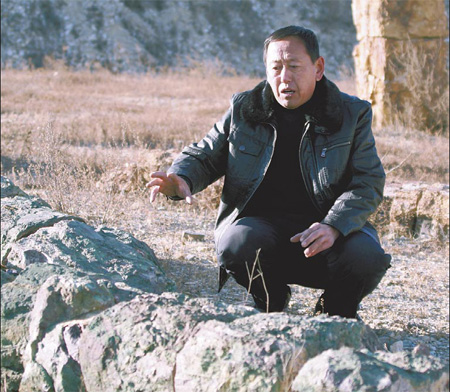 Farmer-turned-dinosaur museum guide Li Yinfang shows the spot where he found the first sinosauropteryx fossil in Sihetun, Liaoning province. [China Daily/Feng Yongbin] |
About half a meter in length, the skeleton appeared to have a long tail, strong legs, small arms and a head like a miniature tyrannosaurus rex. Along the outside of the body were mysterious black markings, like lines drawn with a charcoal pencil.
"I was very surprised because it was very different from the small fish and insect fossils we normally find here. But as ordinary people, we didn't understand it," said Li, 48, who now works as a guide at Sihetun's dinosaur museum.
A month after his discovery, Li delivered the fossil to the Chinese Academy of Geological Sciences in Beijing, where paleontologists were also stumped.


This led them to startling conclusion: Li had discovered the world's first feathered dinosaur.
The fossil, which the two scientists named sinosauropteryx, or Chinese reptile-wing, was the first hard proof of an evolutionary link between dinosaurs and birds for more than a century.
"Sinosauropteryx upsets and supersedes the 100-year standing of archaeopteryx as the ancestor to birds," Ji Qiang wrote in Chinese Geology, a scientific journal.
The discovery proved that, as well as archaeopteryx, small theropods - a sub-order of small, usually carnivorous dinosaurs - also had feathers.
"We realized there is no line, no border" between dinosaurs and birds, said Martin Kundrat, a biologist at the Slovak Academy of Sciences in Bratislava, capital of Slovakia, who is working in Beijing to research the relationship between dinosaurs and birds.
"We like to categorize, but evolution didn't work in this way," he said.
After the unearthing of sinosauropteryx in 1996, scientists began investigating China's northeastern region for more evidence of feathered dinosaurs. What they found was remarkable.
As the world today marks the 150th anniversary of the publication of Charles Darwin's pioneering work on the theory of evolution, On the Origin of Species, experts agree that fossils found in western Liaoning offer some of the most interesting insights into how species evolve.
Modern Liaoning is not the most obvious place to look for fossils. At the heart of China's rust belt, the region is best known for its bitterly cold winters, smoke-belching factories and aging industrial cities still reeling from the layoffs that followed the reforms of state-run enterprises in the late 1990s.
But about 125 million years ago, most of what would become Northeast China - including Liaoning - and southeast Siberia was a muddy swamp, dotted with lakes and lined to the west with volcanoes in what is today the Inner Mongolia autonomous region.
An American scientist dubbed the ecosystem Jehol Biota in the 1920s because it was centered in Jehol, a former Chinese province absorbed by Liaoning, Inner Mongolia and Hebei province in the 1950s.
"We had some of the first flowers here and an enormous amount of vegetation," explained Damien Leloup, general manager of Yizhou Fossil and Geology Park near Jinzhou, western Liaoning. "The swamp area made everything grow. There were large numbers of species of birds and hardly any predators. It was fantastic."
The presence of the museum, a joint German-Chinese venture often visited by domestic and foreign specialists, is further evidence of the paleontological importance of the region. Packed with relics, the geology park also boasts one of the best dinosaur fossil casting centers in the world.