Economy
China's economy grew 9.6% last year
By Si Tingting (China Daily)
Updated: 2009-12-26 08:35
 |
Large Medium Small |
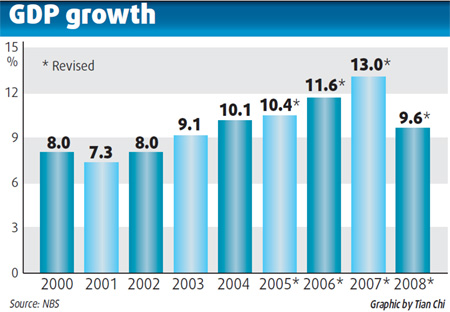
China's economy grew by 9.6 percent, 0.6 percentage points more than earlier estimates, in 2008, the National Bureau of Statistics (NBS) said on Friday after discovering that the service sector had played a greater role than thought earlier.
|
 |
The NBS economic census results also show that the country achieved greater success in reducing its energy intensity, or the amount of energy used to generate each unit of GDP, last year. It used 5.2 percent less energy per unit of GDP, much less than the 4.6 percent as reported earlier.


"With the revision, the goal is more attainable," said Yang Fuqiang, director of WWF's global climate change solutions. Preliminary calculations show energy intensity could be 17 percent lower than the 2005 level by the end of this year, falling by another 4 percent next year, he said, and dismissed concerns over the country's ability to achieve that goal.
Yang said the decline in energy intensity in 2008 and this year was largely because of the global financial crisis. The country used 3.35 percent less energy to generate each dollar worth of GDP in the first half of this year, the National Development and Reform Commission said in August. Yang said it might drop by another 3 percent in the second half.
With its growing power, China could allot more funds and achieve more technology breakthroughs to help achieve another 20 percent reduction in energy intensity during the 12th Five-Year Plan (2011-15), Yang said.
Despite some concerns over the credibility of the NBS figures, Yang said the revised data were more reliable than previous estimates.
Macro-economic data revisions are not unusual even in other countries. The US, for example, said recently that its third-quarter GDP rose 2.8 percent year-on-year compared with the previous estimate of 3.5 percent.
In the revised data for last year, the service sector accounted for 41.8 percent of China's GDP, compared with the earlier estimate of 40.1 percent. It is still far less than the levels in Western countries, where it could be more than 70 percent.
"Even in Asia, the sector contributes an average of 45 percent to a country's economy," said Zhuang Jian, a senior economist with Asian Development Bank.
Second largest economy?
A likely impact of the revision is that it entered 2009 on a higher statistical base. As a result, a fast-growing China could possibly overtake Japan as the world's second largest economy more quickly.
The revised GDP of 2008 for China is 31.405 trillion yuan, or $4.6 trillion, according to the market exchange rate, 1.34 trillion yuan more than the earlier estimate, the NBS said. And the World Bank estimates Japan's economy to be worth $4.9 trillion in 2008, and it has contracted further this year.
If China's GDP is calculated on the basis of "purchasing power parity", which attempts to factor in price differences across countries while estimating the size of a foreign economy in US dollars, China may already have become the world's second largest economy, Zhuang said.
The economic revision will mainly affect the value of this year's GDP with "minimal" impact on the growth rate, said Peng Zhilong, head of the NBS' department of national accounts.
China's economy grew 7.7 percent year-on-year in the first three quarters of this year, which Peng said the government was likely to revise.
And Zhuang said he still had no doubt that this year's economic growth would be more than 8 percent.