Society
Tomb of legendary ruler unearthed
By Lin Shujuan (China Daily)
Updated: 2009-12-28 07:29
 |
Large Medium Small |
Legend has it that Cao Cao, King Wu of Wei kingdom in the Three Kingdoms period (AD 208 to 280), had built 72 tombs to thwart tomb raiders.
Experts, however, have always doubted this, believing it was more a fabrication that reflected Cao's political cunning as portrayed in the classic Romance of the Three Kingdoms. Now, they have come up with solid evidence to prove it wrong.
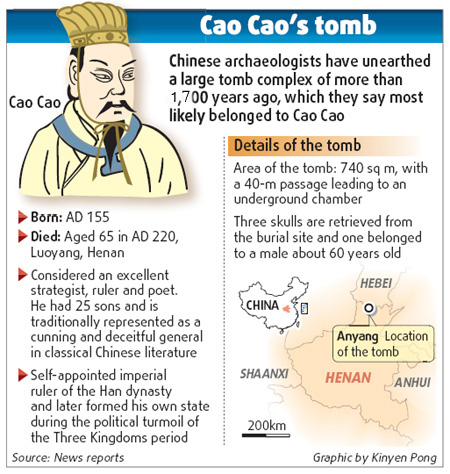
Archaeological officials confirmed yesterday the discovery of Cao's mausoleum in Xigaoxue, a village in Anyang county of Henan province, which, much to the surprise of many, was indeed built as austerely as recorded in historical archives.
"Excavation has been going on for nearly one year, and we'll come up with further evidence. But even based on what we've got, we can tell for sure that the mausoleum belongs to Cao Cao," Guan Qiang, deputy director of the department of cultural heritage conservation at the State Administration of Cultural Heritage (SACH), told a briefing in Beijing.
Experts also unearthed bones of three people, through which they identified their ages: One male of around 60, and two women, one in her 50s and the other between 20 and 25.
Experts believe the male was Cao, the elder woman his empress who died in AD 230 and was buried at Cao's tomb with her close companion, the younger woman.
The tomb was discovered in December last year when workers at a nearby kiln were digging for mud to make bricks. The discovery was not reported and local authorities knew of it only when they seized stone tablets carrying inscriptions of "King Wu of Wei" - Cao's posthumous reference - from some tomb raiders.
The culprits claimed to have stolen the tablets from the tomb, according to Sun Yingmin, vice-director of the Henan Provincial Cultural Relics Administration (HPCRA).
Over the past year, archaeologists have recovered more than 250 relics from the west-to-east two-chamber tomb that covers an area of 740 sq m. Among them are stone paintings featuring social life of Cao's time, stone tablets bearing inscriptions of sacrificial objects, and Cao's personal belongings bearing the inscription "personal belongings frequently used by King Wu of Wei" such as the one found on a stone pillow.
Hao Benxing, an HPCRA researcher, said it was hard to tell if the mausoleum was robbed before the damage done by recent tomb raiders.
"But it is clear that the tomb was built with imperial solemnity and scale, the 40-m tunnel leading to the tomb's gate being one example," Hao said.
It is also clear that the tomb was built and furnished austerely, which is in accordance with historical records saying Cao ordered his tomb to be built "on non-arable highland, with no (pyramid-shape) mound or any plantation upon it", and "no treasures of gold and jade in it", Hao added.
The fact that the tomb's location is only a few kilometers from Yecheng (to the southwest of today's Linzhang county, Hebei province), historically the political center of Wei kingdom, is also strong proof that it is Cao's tomb, according to archaeologist Liu Qingzhu of the Chinese Academy of Social Sciences.
In Yecheng, Cao built the famous Bronze Sparrow Terrace, where musicians and dancers would perform to entertain guests at his banquets.
Before his death, Cao left word he wanted his tomb to be built in a place where his children could see from the terrace anytime they remember him, or from where he, as a spirit in the underworld, could enjoy the performances on the terrace.
"The stone tablets bearing inscriptions of Cao's posthumous reference are the strongest evidence," said Liu. "No one would or could have so many relics inscribed with Cao' posthumous reference in the tomb unless it was Cao's."
Experts agree that excavation of the mausoleum has just started and further research and study would prove the historical importance of the discovery, considering the important role Cao played in history.
"The tomb is a capsule of the historical time in which Cao lived," said Liu. "For example, it will serve as a clear chronological reference for many other relics, whose age would otherwise be too difficult to tell."
As a king's mausoleum is often built in the center of a tomb compound, it is likely that there are many burial sites in the surrounding area, Liu added.