Opinion
Low-carbon innovation versus trade war
By Dennis Pamlin (China Daily)
Updated: 2009-12-09 09:37
 |
Large Medium Small |
The UN General Assembly and the G20 in Pittsburgh marked a new era. At both meetings, President Hu Jintao presented China's climate policy and put it in a global context with a clear and much-needed message that global collaboration is necessary.

Over the last weeks trade has emerged as a major challenge in global climate negotiations. Countries like the US and France have started discussing ways to impose tax on imported products that have been made using a lot of CO2. Even though not explicit, it shows that China is one of their main targets.
This trend is dangerous and can easily result in protectionism and trade wars. It is therefore important to explore possible ways forward that link trade and reduced CO2 emissions in a way that they support each other. China has a great opportunity to turn this potential conflict into increased cooperation. Building on the collaboration message, China has an opportunity to present concrete suggestions for low-carbon development.
The biggest problem with the current discussion is probably not the possibility of a trade war in itself, even if that would be a serious problem, it is the fact that the current discussions have focused on conflicts and problems. What is needed instead is collaboration and focus on solutions.
The current approach of countries such as the US and France is based on two assumptions. First, that the focus should be on reducing emissions from the big polluting companies that are creating the problem. Second, that countries should try to reduce their own emissions as little as possible and get others to reduce as much as possible without collaboration. Both should be challenged, and the government and companies in China can play an important role here.
The problem approach with focus on the big emitters has dominated global climate negotiations since the Kyoto Protocol. It is time to move away from a situation where all counties are trying to protect their dirty industries.
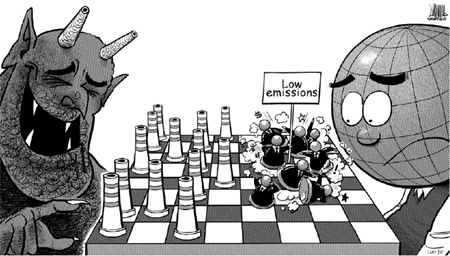
China could help to shift the focus from big emitters to also include the new solutions providers. With companies such as Suntech, Himin Group, China Mobile and Broad, China is well positioned to make the case for policies that support solutions, not just try to reduce the problems. Instead of a focus on how to deal with carbon intensive trade we could have a discussion on how export of low-carbon solutions should be encouraged.
A solution initiative could include incentives to support global trade that would enable the world's cities to build buildings that are net producers of renewable energy, and support an accelerated uptake of electric cars that in turn are supported by renewable energy and other solutions, which help reduce the need for fossil fuels. A special focus should be given to transformative solutions that can help reduce emissions by 90 percent or more, such as teleworking, smart grids, smart buildings and e-paper.
China could propose initiatives to encourage trade and investment in low-carbon solutions. China could also suggest that a system is created where solutions-providing companies can report their contribution to reduced emission through their products and services. Today, the focus is on how much polluting companies are emitting, but in the future the focus should shift to how much the solutions-providing companies are helping reduce emissions.
The second assumption is that negotiations should continue to only focus on individual countries and how they can reduce their emissions. This approach is problematic from two perspectives. First, because it undermines smart collaboration and second because it ignores the fact that the most important question is how we can provide low-carbon lifestyles. The solutions that are needed must be developed through international collaboration, and countries, companies, universities and cities must come together to solve the climate crisis.
It is important to remember that the main problem is the high-carbon lifestyles in Western counties. What the world needs is solutions that can provide a high quality of life with low emissions. Instead of focusing on where the emissions happen today, China can help shift the focus to the need for low-carbon lifestyles.
China could initiate key collaborations in areas such as the creation of a global virtual meeting infrastructure, an initiative for buildings that are net producers of renewable energy, and software for smart city planning. China could collect a number of such ideas and present a global low-carbon city development initiative. This would focus on collaboration between countries and cities around the world and allow solutions-based companies to implement their best ideas.
The world really needs China to step forward and turn the current problem into an opportunity and the emerging conflict into increased collaboration. By putting forward solutions- and collaboration-based proposals the Chinese government would not only avoid a difficult situation, but also get solutions-providing companies, both in China and abroad, the kind of recognition that they deserve.
The author is adviser to various companies, governments and NGOs.
(China Daily 12/09/2009 page9)