CHINA> China and World

|
CHINA> China and World
|
|
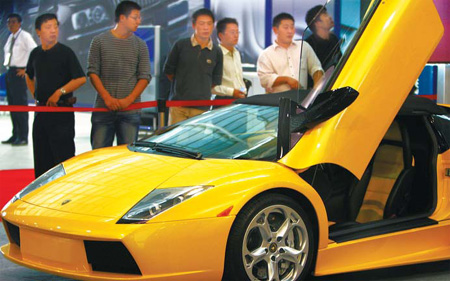
Luxury autos racing toward bright future
By Timothy Dunne (China Daily)
Updated: 2009-09-10 08:50
In yet another tangible sign of China's emergence as a top global economic power, it surpassed Japan a few years ago as the largest luxury vehicle market in Asia. In 2008, sales of luxury vehicles in China reached nearly a quarter million units, about equal to the combined sales of the next three largest Asia-Pacific markets - Japan, Australia and South Korea. JD Power and Associates expects luxury vehicle sales in China to continue to accelerate during the next six to seven years, while its neighbors in Asia will likely experience much more modest growth. By 2015, JD Power anticipates luxury vehicle sales in China will reach nearly 600,000 units, or 90,000 units more than the combined sales of the next 10 largest luxury vehicle markets in Asia. With all this momentum, the natural question is "Who is selling these luxury cars, and who in China is buying them?" First, we need to define what a luxury car is. JD Power and Associates defines a luxury vehicle by its brand and its price. The world's leading automotive luxury brands are already fairly well known and defined. JD Power defines a luxury car in China as priced at 400,000 yuan ($57,000) and above. In the first five months of 2009, four brands - Audi, BMW, Mercedes-Benz and Lexus - accounted for about 85 percent of all luxury sales in China. Audi boasts the two top-selling luxury cars in China: The A6L is the best selling car in the segment (39,198 units through May 2009), followed by the entry-level luxury A4 (11,312 units). If we add in other models from Audi - including the full-size A8 sedan, Q7 SUV, and TT Sports Car - Audi accounts for roughly 45 percent of all luxury vehicle sales in China. BMW's 5-series sedan is the third-best selling vehicle in the luxury vehicle segment (9,944 units), the entry-level BMW 3-series sedan is the fifth-best selling model (7,637 units) and the BMW 7-series is the eighth-best selling vehicle. Other models appearing on the top-10 list include the Lexus ES (fourth), the Mercedes Benz S-class (sixth), C-class (seventh) and E-class (ninth) and the Volvo S40/V50 (tenth). One unusual aspect of the China luxury car market is that larger luxury cars tend to outsell smaller luxury cars. This is unusual because in most developed markets, the opposite is true. For example, the entry-level BMW 3-series sedan tends to outsell its larger siblings, the 5-series and 7-series vehicles and the entry-level Mercedes-Benz C-class sedan typically outsells the larger E-Class and S-Class sedans. But in China, it is more common for the larger and more expensive full-size and midsize luxury vehicles to outsell a company's entry-level models. In addition to the leading brands, Porsche, the sports luxury automaker from Germany, recently said that China is already its third-largest market in the world (with 8,000 sales in 2008), and it expects China to become its second-largest market in the not too distant future. And that is probably why Porsche decided to introduce its all-new full-size sports luxury sedan - the Porsche Panamera - at the Shanghai Motor Show in April 2009. Now let's look at luxury car consumers in China. When the price tag for a luxury car starts at 400,000 yuan ($58,600), and frequently exceeds 1 million yuan, this is a consumer segment worth getting to know better. For China's top three selling brands - Audi, BMW and Mercedes - research from the JD Power Asia Pacific 2008 China Sales Satisfaction Index (SSI) Study shows that approximately 50 percent of customers are between 30-40 years old and 85-95 percent are married. For all three brands, nearly 45 percent of their customers own their own business or are self-employed, while 20-30 percent are those in senior management. The study also finds that most of these customers purchase their vehicles with cash. Sales of luxury vehicles in China are up by 5 percent in the first five months of 2009, trailing the total industry growth pace of 15 percent. Imported brands are expected to have a tough year due to the increase in consumption tax for high-emission cars imposed last September and a dip in consumer confidence brought on by the economic uncertainties of recent months. Key importers, such as Lexus, are expected to suffer a slowdown in the months ahead. But if the trend continues through the rest of 2009, luxury vehicle sales are expected to approach 280,000 units for the year. This is a particularly good performance considering most other markets throughout the world are experiencing declines in 2009. With many experts predicting that the world economy will stabilize in 2010 and rebound thereafter, it appears the future for China's luxury car market is bright. The world's luxury car builders are most likely looking to the future with anticipation, ready to fill the demands of consumers in China. The author is the director of Asia Pacific Market Intelligence at JD Power and Associates. |
主站蜘蛛池模板: 荥经县| 辰溪县| 托里县| 佛冈县| 多伦县| 准格尔旗| 保康县| 青神县| 金山区| 独山县| 陈巴尔虎旗| 和政县| 齐齐哈尔市| 攀枝花市| 台北县| 观塘区| 织金县| 蓬莱市| 平远县| 龙口市| 谢通门县| 广安市| 磴口县| 光山县| 汶上县| 新疆| 西和县| 册亨县| 招远市| 沅陵县| 九龙坡区| 思南县| 济源市| 泰顺县| 科技| 甘谷县| 江达县| 青岛市| 泰州市| 陇南市| 富裕县| 吉木乃县| 洪雅县| 策勒县| 寿光市| 工布江达县| 石台县| 桂林市| 红河县| 色达县| 阿坝县| 贡觉县| 柞水县| 忻城县| 汕头市| 政和县| 房山区| 株洲县| 云南省| 方山县| 东山县| 丰宁| 虞城县| 邵东县| 乌审旗| 砚山县| 潮州市| 上蔡县| 青海省| 开阳县| 易门县| 鹤壁市| 汝阳县| 榆林市| 南部县| 都安| 双峰县| 澄城县| 襄汾县| 天长市| 类乌齐县| 渭南市|