CHINA> Post-quake Life

|
CHINA> Post-quake Life
|
|
Elixir of life pours into earthquake village
By Alexis Hooi and Wang Xu (China Daily)
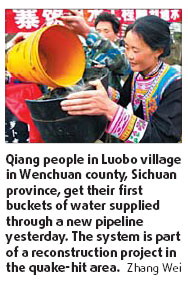
Updated: 2009-04-27 07:52 WENCHUAN, Sichuan: For thousands of years, the Qiang people in Luobo village more than 2,000 m above the sea level have had to collect or haul water for daily use. "Getting enough water for drinking and other basic needs was always a top concern for us," Ma Luquan, 56, a farmer who grows corn in northern Wenchuan county, said yesterday. Last year, Ma and about 1,000 of his fellow villagers from the Qiang minority ethnic group had to leave the area after the deadly earthquake struck Sichuan province on May 12 and devastated Luobo.
But when the Qiangs moved into their newly built homes in an area adjacent to their former village, they had a pleasant surprise waiting for them: a network of pipes carrying water from mountain streams. "It's great the water pours into wells in our village and we don't have to walk very far now. It's such a simple thing and yet so important," Ma said. The Qiangs are one of the 56 ethnic groups of the country, and have a population of more than 300,000. Most of them live in northwestern Sichuan. Forty-four Qiang villagers died in Luobo, while almost all of the 200-odd buildings in their village were destroyed, village head Ma Qianguo said. Luobo is one of the oldest Qiang settlements and used to be famous for its architecture and culture. The red radish - after which the village is named - grown there was famous for its taste and freshness.
The village now gets water from springs 13.5 km away, and the network cost 3.66 million yuan ($536,000) to build, which came from the Jiangmen government. The water pipeline is part of the 100-million-yuan rebuilding project for Luobo, and the amount has come from Jiangmen authorities and private donors, Zhen Lifu, assistant mayor of Jiangmen's municipal people's government, said at a ceremony yesterday to mark the start of the water supply network. The money will also help restore the mountain roads leading up to the village as well as the farmlands, Zhen said. More than 200 new buildings have been built since the people of Jiangmen joined the reconstruction efforts, village head Ma said. "The water network will help villagers eke out a better living and live a healthier life. We hope the move will boost the local tourism industry, too," Zhen said. He is hopeful of such a development because lodging and other facilities for tourists will be built on the site of the original village. "Our lives were changed forever by the quake but now we can use the facilities to rebuild our future," Ma Luquan said.
|
主站蜘蛛池模板: 赞皇县| 中西区| 岑溪市| 阳高县| 金门县| 栾川县| 渑池县| 右玉县| 江西省| 宜兰县| 武川县| 静乐县| 徐州市| 泉州市| 静宁县| 虹口区| 得荣县| 抚顺市| 东兰县| 中西区| 萨迦县| 鹤庆县| 太康县| 宣城市| 平罗县| 沙田区| 钟祥市| 四子王旗| 旅游| 连江县| 迭部县| 临泉县| 华坪县| 旬邑县| 杨浦区| 榆中县| 博湖县| 新源县| 辛集市| 搜索| 德安县| 宝清县| 滨海县| 石阡县| 大方县| 九寨沟县| 夏邑县| 仪陇县| 浦城县| 泗阳县| 珠海市| 勃利县| 天镇县| 浏阳市| 常德市| 乌什县| 刚察县| 拜泉县| 汕头市| 麻江县| 崇阳县| 阜阳市| 三原县| 平度市| 泰顺县| 扶沟县| 南投市| 阜南县| 陆丰市| 东乡| 柏乡县| 阿拉善右旗| 浮山县| 阜城县| 永和县| 凌云县| 会同县| 兴安县| 大余县| 东乌珠穆沁旗| 桃江县| 响水县|