CHINA> News

|
CHINA> News
|
|
'Only respect will restore trust rioters destroyed'
By Hu Yinan (China Daily)
Updated: 2009-07-15 07:47
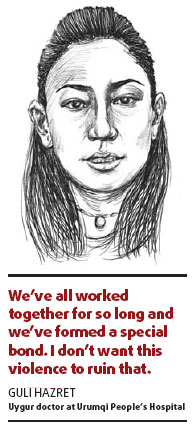
July 4 was like any other Saturday for Guli Hazret. She was in a bar drinking and chatting with friends, both Uygur and Han. She knew her shift at the hospital the next day did not start until 7 pm. "Plenty of time for a hangover," she thought.
At that moment, she did not have a care in the world. Fast forward 24 hours and the mellow bar music was replaced by the angry screams of Uygur men as they attempted to smash down the gates of the People's Hospital in Urumqi, the capital of the Xinjiang Uygur autonomous region.
"That afternoon I had been shopping. It was strangely quiet on the streets and I wore a mini-skirt and wandered around Shanxi alley (a Uygur part of the city). I've been thinking that if I had got to work late that day, I would've been beaten too, or even killed. Work saved me." On the street she had strolled along only hours earlier, women similar to her had been savagely beaten by the rampaging mobs of "20-something Uygur boys, who clearly had no decent jobs", Guli said. "I used to think, 'What could they possibly do to Uygur girls?' Many girls today wear fashionable clothes like me, like mini-skirts," she explained, adding the worst she had experienced was crude comments about her dress sense from "fundamentalist boys". "They are in the minority usually, but the rioters beat every Uygur woman who wore fashionable or fancy clothing." It was the darkest day in the history of the Xinjiang region, when Uygur rioters, funded and sparked by forces overseas, brutally slaughtered mostly Han civilians in Urumqi. At least 184 people, 137 of them Han, were killed.
The government's most recent update showed that the final death toll could eventually reach as many as 300. Foreign media reported that the tragedy was ethnically fueled and has left a deep scar, as the city struggles to recover amid government calls for ethnic unity. For Guli, the youngest of five children born in the remote prefecture of Hotan, and the only one who lives in Urumqi, the event offered a double blow: she has not only been forced to witness the transformation of verbal abuse into real and shocking Uygur-on-Uygur violence, but she now has fears for her working environment, as almost half of her colleagues are Han. "The riot was beyond my worst nightmare. I may not have time for namaz (Muslim prayer) and I may be acting against fundamentalist (Muslim) customs by wearing this," she said, pointing at her one-piece dress, "but I do have beliefs in my heart." City officials have never openly acknowledged or addressed Uygur-on-Uygur violence as an issue, but Uygur sources said it has existed in Urumqi for a long time. "No one talks about it," a female Uygur graduate student, who refused to reveal her name for fear of retaliation, told China Daily. "People always put other things higher up on the agenda." |
||||||
主站蜘蛛池模板: 法库县| 洛扎县| 且末县| 江口县| 永嘉县| 红原县| 乡城县| 安义县| 普陀区| 潞西市| 平阳县| 正阳县| 巴南区| 孟村| 伽师县| 泽州县| 安国市| 西贡区| 沧州市| 壶关县| 厦门市| 西乌| 韶关市| 通州区| 敖汉旗| 汉川市| 虞城县| 北安市| 沙坪坝区| 泰顺县| 阿勒泰市| 余江县| 舒城县| 元江| 南江县| 沾化县| 彰武县| 天气| 寿光市| 嵊州市| 乡城县| 嘉义县| 洛南县| 西华县| 称多县| 翁牛特旗| 五台县| 巴彦淖尔市| 应城市| 阿拉善左旗| 夹江县| 页游| 拉孜县| 盐津县| 黑山县| 腾冲县| 墨江| 富阳市| 东乌珠穆沁旗| 绥化市| 山阴县| 遂昌县| 景德镇市| 双城市| 保德县| 惠来县| 海南省| 安庆市| 贵溪市| 乐至县| 肇州县| 洪江市| 峨山| 白城市| 武鸣县| 武山县| 如东县| 凤庆县| 池州市| 兰溪市| 曲沃县| 五指山市|