Economy
Science to revolutionize food supply
By Wang Zhuoqiong (China Daily)
Updated: 2010-02-04 07:04
 |
Large Medium Small |
| ?
 |
|
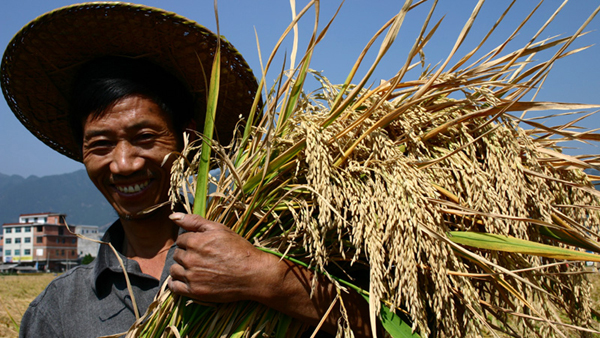
A farmer smiles after a good harvest of the high-yielding “super rice” in Tiantai, Zhejiang province. CHINA DAILY |
Genetically modified rice may have long-term risks, experts say
The foreseeable large-scale production of genetically modified (GM) rice in the country will alter hybrid rice plantation, a traditional way of breeding the main staple food for millions of Chinese, a senior hybrid rice expert said.
"The approval of the safety of the pesticide-resistant rice is a breakthrough," said Cao Mengliang, a researcher on molecular rice at China's National Hybrid Rice Research and Development Center.
The center, led by Yuan Longping, who has been dubbed the Father of Hybrid Rice, has promoted hybrid technology successfully to improve yield and taste in China, as well as in many countries in southeastern Asia and Africa.
Last November the Ministry of Agriculture issued safety certificates to two breeds of genetically modified rice to Zhang Qifa, professor and director of the National Center of Plant Gene Research at Huazhong Agricultural University.
The certificate is the last step before the breed goes to the market. The process of the breed going into production might take three years, Cao said.
Similarly to transgenic cotton, the traditional rice planting would gradually change from hybrid rice to genetically modified rice, Cao said.
The genetically modified rice is expected to be pesticide-resistant and the herbicide-resistant, and the quality and yield of the rice are expected to improve, he said.
The trend will have a significant impact on the country - the world's largest consumer and exporter of rice.
China's rice output is No 1 in the world, accounting for 33 percent. China currently produces approximately 500 million tons of rice annually. With its population expected to grow to 1.6 billion by 2020, 630 million tons of rice will be needed.
The country is leading the genetically modified technology with an investment of more than 20 billion yuan.
Officials said that by 2020, the country could be a leader in genetically modified foods, cloning, large-scale transgenic technology and new breed promotion. Rice and corn are the foods nearest commercialization.
Rice is a crucial staple in Asia and increased production would make a massive difference.
Science is seen as the best way to meet that demand.
|
 |
|
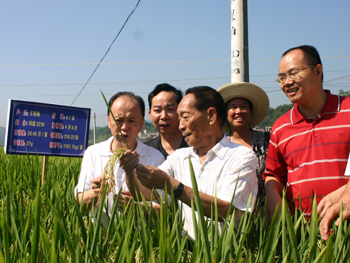
Yuan Longping, dubbed “Father of Hybrid Rice” in China, looks at his super hybrid rice in an experimental fi eld in Changsha, Hunan province. XINHUA |
The use of genetically modified rice is an important solution to securing the needed food supply, Cao said.
However, Fang Lifeng, Greenpeace's food and agriculture campaigner, told China Daily that the long-term risk of genetically modified rice should be taken into consideration.
"Once the engineered rice gets into the food chain on large scale, it will have a very big impact on food safety, environmental safety and biological diversity," Fang warned.
He cited some examples on the long-term risk of genetically modified food since it first appeared on the market in 1994.
In 2008, the immune systems of laboratory mice that consumed genetically modified corn were found to be abnormal.
The official nod to pesticide-resistant rice has triggered questions on whether the resistance technology will also work on humans.
"If the substance is killing pests, will it be hurting us if we eat it every day?" Jiang Gaoming, a professor at the Chinese Academy of Sciences' Institute of Botany told the International Herald Leader.
Professor Zhang Qifa was not available to comment yesterday.
Cao refuted the doubts, saying no scientific proof exists that the pesticide-resistant rice is harmful to humans because "the structure of human and pests are different".
The government has prioritized the development of functional genetic and biological new breeds with application value and self-owned intellectual property rights, according to the "No 1 Central Document", issued by the Central Committee of the Communist Party of China and the State Council at the end of last month. The document urges improvement on the industrialization of new genetically modified breeds.
"This again makes the industrialization of new genetically modified products a national strategy," Deng Xiuxin, president of Huazhong Agricultural University, told Science and Technology Daily.
"The research on genetically modified products has entered a new phase."
Despite the rapid progress in agriculture in China, a supply shortage has emerged among some products, as indicated by the peak of imports in soy beans and vegetable oil, said Chen Xiwen, deputy director of the Central Rural Work Leading Group on the importance and urgency of modernization of agriculture's productivity.
Tang Renjian, deputy director of the Central Rural Work Leading Group, said technology innovation will assist the supply shortage. He said cautious management and assessment will be carried out on what breeds to promote and industrialize.
(China Daily 02/04/2010 page5)