Government and Policy
Water project alters flow of life along its route
By Qian Yanfeng (China Daily)
Updated: 2010-03-04 06:51
 |
Large Medium Small |
|
 |
|
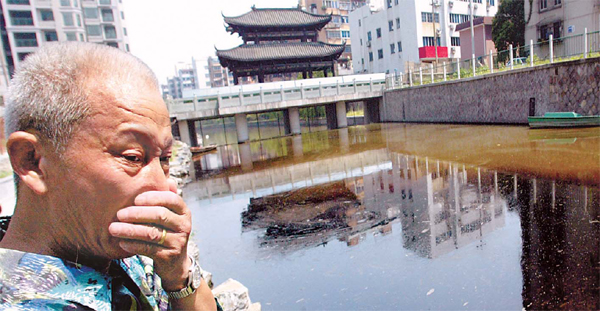
A man reacts to the smell from Guxin River, which flows into the Grand Canal in Zhejiang province. Pollution is a major challenge to the water diversion project, say experts. BO LEI/FOR CHINA DAILY
|
When Wu Huasheng was told that after 2013 he would be unable to continue fishing the Beijing-Hangzhou Grand Canal, something he has done for four decades, he was philosophical.
"It is for the greater good. I'm willing to make the sacrifice," he said.
The 52-year-old is one of thousands of fishermen along the waterway who must find a new way of life once the historic South-to-North Water Diversion Project becomes operational in three years.
Part of the project's eastern section, the canal is one of three routes that will channel water from the Yangtze River to the parched cities of the north. Studies show that the rapid currents this will create will make it technically impossible to catch fish.
"If it means better quality drinking water in North China, as well as improvements in the environment for residents along the canal, then it's worth it," said Wu, who lives by the canal in Jiangdu.
Although he will receive compensation - the sum is yet to be decided - from the local maritime authorities, the fisherman still has no idea how he will make a living after 2013. One thing he is sure of is that he is unlikely to find another stretch of water as good as the canal.
"The water quality in this section of the canal is good but the other rivers and lakes are seriously polluted, just like in other parts of China," he said.
Unlike the central route of the SNWD project, which runs from the Danjiangkou Reservoir in Hubei province to Beijing and requires the resettlement of millions of people, the eastern route involves few relocation issues. It does, however, raise some daunting environmental concerns.
The eastern route runs through major industrial regions, including Jiangsu and Shandong, where rivers and lakes are far more polluted than in Central and Western China after two decades of rapid GDP growth, and officials believe pollution control is fundamental to the success of the project.
When work on the route began in 2002, residents along the ancient canal were promised grand initiatives aimed at cleaning up nearby lakes and waterways. So far, progress has been slow going.
To ensure clean, safe drinking water for people in the north, the central government pledged to spend 44 percent of its 32-billion-yuan ($4.6 billion) investment in the first phase of the eastern route on curbing pollution. Yet after seven years of efforts, during which thousands of factories have been shut down and tons of wastewater has been treated instead of discharged into the canal, pollution remains a massive challenge.
Water at only half of the canal's cross-sections met the approved quality standards when tested last October, according to figures released by the SNWD Project Office.
In the original plans, the 118-million-yuan eastern route was scheduled to open in 2007. Several media reports have blamed the delays on water quality problems and soaring costs. However, residents told China Daily that the situation is getting worse, not better.
Teng Weimin lives in Dinggou town beside Sanyang River, an auxiliary channel for the eastern route that flows into the Grand Canal. He said his town, which comes under the administration of Jiangdu, does not have a single sewage disposal facility, meaning residents simply throw their wastewater into a huge drainage ditch. Although separated from the river by a floodgate, the ditch, he said, often spills over in heavy rainfall and contaminates the waterway.
"The ditch water has grown very dark over the years and you can see solid waste floating on the surface. Even during the cold winter months, the rotten stench still hangs in the air," said the 30-something resident. To make matters worse, in recent years a cluster of chemical plants has opened in the town. Residents complain the factories have seriously polluted the waterways and are threatening lives.
"Sanyang River has become undrinkable over the years and now we even cannot have clean underground drinking water. That's been polluted, too. It has a very strange smell," said Teng.
For years, he and his neighbors had hoped the SNWD project would bring an improvement to their local environment, he said. "We used to think of the project as a catalyst for environmental improvement but it seems that it is much talk without action. The authorities must have known the rivers and lakes connected to the Grand Canal would pose pollution threats."
Construction of wastewater treatment facilities serving 60 percent of Jiangdu's 13 townships should have been completed by 2007 in the original plans, according to Wang Minzhi, publicity officer for the municipal environmental protection bureau. So far, only three have been finished and another five are still being built. He blamed the delays on a lack of funding.
"It is very difficult for projects like that to get funding from higher authorities. They are busy constructing pumping stations to meet schedules rather than building wastewater treatment facilities," he said.