Government and Policy
Demolition guidelines tightened
By WANG JINGQIONG (China Daily)
Updated: 2010-03-09 06:39
 |
Large Medium Small |
Forced relocation is last resort to benefit majority
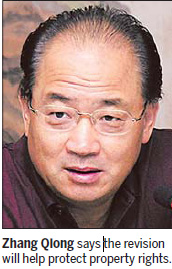
BEIJING: Forced urban housing demolition, which caused several deaths and injuries last year and snowballed into a major controversy, will be strictly supervised thanks to a proposal to better protect the rights of property owners, a senior official has said.
But forced relocation will be used if necessary so that the self-interests of a handful of people will not hurt the interests of the majority, said Zhang Qiong, deputy director of the State Council Legislative Affairs Office.
Zhang, a member of the Chinese People's Political Consultative Conference National Committee, made the remarks in an interview with China Daily about the proposed amendment to the regulation on urban housing demolition.
In January, Zhang's office published a draft revision to the Regulations on Property Requisition, which has long been criticized for neglecting the rights of property owners, to solicit public opinion.
The draft amendment stipulates that no violence, threat or other illegal means be used in forced relocation, such as cutting off electricity, water, heating or gas.
| ||||


Responding to a common public suggestion that demolition should not proceed unless all residents agree to move, Zhang said "it is not realistic".
"Take the rebuilding of dangerous and old houses, for example. Most people living in such poor conditions would like to move out, yet there are always one or two who would take this opportunity to ask for very high prices and refuse to be relocated", Zhang said.
"In such cases, we tend to consider the interest of most people and use forced relocation."
According to the draft, dangerous and old houses will be rebuilt only after 90 percent of residents give their consent. The current rule gives the government the final say.
"China is undergoing rapid urbanization, and needs a lot of land," Zhang said. "As we have to ensure preservation of arable land, the use of urban land is inevitable."
Zhang acknowledged that another major public concern was a clause in the amendment, which says: "To demolish housing for constructions of non-public interest, the constructors - such as real-estate developers - need to seek permission of related government departments."
Ma Guangyuan, a researcher at the Chinese Academy of Social Sciences, said this stipulation should be deleted as both the Constitution and the draft revision itself stipulate that the government can only intervene in relocation cases "for public interest".
The draft revision, which emphasizes public interest, will be watered down by this single item that authorizes the government to permit demolitions for non-public interests, such as real-estate developers, Ma said.
In response, Zhang said the government will not back down as "a lot of disputes and conflicts have already arisen from demolishing housing for non-public interest. More problems will arise if the government leaves it to the developers and residents themselves".
"Besides, it is very difficult to differentiate public interest from non-public interest," Zhang said, admitting that balancing different interests is "complicated and difficult".
"The basic idea of the amendment is that efficiency should give way to people's rights, and we set strict limits and conditions for forced relocation ," he said.