Foreign and Military Affairs
Sino-US tensions show no sign of easing
By Li Xiaokun and Ding Qingfen (China Daily)
Updated: 2010-03-26 06:58
 |
Large Medium Small |
BEIJING - There are no clear signals of an easing in trade and political tensions in Sino-US relations despite the hope generated by the visits of two Chinese vice-ministers to Washington.
Vice-Commerce Minister Zhong Shan said in the US capital on Wednesday that Beijing will reform its currency regime gradually and keep the exchange rate stable.
|
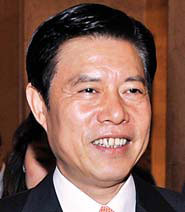 Zhong Shan, vice-minister of commerce, visited Washington.[ZHANG JUN / XINHUA] |
Rejecting mounting US calls to allow the yuan to rise more quickly, Zhong said changing the exchange rate was not the way to fix a huge bilateral trade gap, and that it could upset the global economy.
"Revaluing the renminbi is not a good recipe for resolving problems," he told the US Chamber of Commerce.
"It is in nobody's interest - China's, the US' or other countries' - to see big ups in the renminbi or big downs in the dollar," Zhong said.


Zhu Min, deputy governor of the People's Bank of China, the central bank, also said on Thursday that Beijing will refine its exchange rate regime but declined to set a timetable.
US Treasury Secretary Timothy Geithner said it was critical for China to allow its currency to rise.
"We can't force them to make that change," he said in an interview with CNN. "But it is very important that they let it start to appreciate again. And I think many of them understand that," he said.
US Senators are crafting a law that would slap import duties on Chinese goods to offset what they believe is the low value of its currency.
The sponsors of the bill, Democratic Senator Charles Schumer and Republican Senator Lindsey Graham, also want the Barack Obama administration to formally label China a currency manipulator in a semi-annual Treasury Department report due on April 15.
Referring to Vice-Foreign Minister Cui Tiankai, who was on a transit visit in Washington earlier this week, the Foreign Ministry said on its website that he received promises from high-level US officials that Washington "attaches great importance to China's stance and concerns on issues related to Taiwan and Tibet" and would "cautiously handle the sensitive issues".
Ministry spokesman Qin Gang said on Thursday at a regular press briefing that the visits aimed to "clarify China's positions and policies and listen to opinions from all quarters in the US" to seek a solution to the current problems.
Shi Yinhong, an expert on American studies at the Renmin University of China, said the latest developments are not a clear signal of mending ties.
"Washington should take positive steps (to show its sincerity). For instance, whether it will go ahead with the move to label China a currency manipulator in April is crucial in defining bilateral relations."
Huo Jianguo, dean of the Trade Research Institute affiliated to the Ministry of Commerce, urged Washington to tread cautiously. "The US government should be sober-minded on the issue of labeling China a currency manipulator. It should not be carried away by domestic political pressure," he said.
This year, the two countries have had spats over issues related to Taiwan, trade and human rights. Adding to the tensions was Google's decision on Tuesday to exit the Chinese mainland market.
Two other US companies appeared to have joined Google on Wednesday.
The two Internet services providers said they would halt registration of Chinese domain names because the Chinese government has begun demanding pictures and other identification documents from their customers.
Shi said the exits are individual decisions.
"Maybe some are for political reasons while some are just for business purposes," he said. He added that as long as China's economic and investment conditions remain good, foreign firms would stay.
Derek Scissors, research fellow at the Heritage Foundation, told China Daily that one or two Internet companies following Google's departure could not change the whole business environment.
"In determining whether this is an issue of Internet restrictions or a broader issue, it is much more important whether different kinds of American companies - in agriculture, banking, entertainment, and so on - are also reconsidering their China business.
"Thus far, that does not seem to be the case," he said.
Ai Yang and Cheng Guangjin in Beijing,Tan Yingzi in Washington contributed to the story